"Multi-Host Concurrency" for Serial to Ethernet Converters: Solving the Pain Points of High-Frequency Data Acquisition in Steel Continuous Casting Machines
In the steel manufacturing process, the stable operation of continuous casting machines directly determines product yield and production safety, and vibration monitoring is the core means of ensuring their reliable operation—by collecting high-frequency vibration data from key parts such as molds and oscillator tables in real time, enterprises can predict equipment wear in advance and avoid sudden downtime incidents from the source.
However, many steel enterprises have encountered common difficulties during actual deployment: after traditional serial-to-Ethernet devices are connected to multiple monitoring systems, problems such as data packet loss, acquisition delays, and screen freezes frequently occur, directly leading to delayed vibration anomaly warnings and creating safety hazards for continuous production.
The core cause of this issue lies in the design limitations of early serial to Ethernet converters: most traditional devices only support a single TCP connection mode, meaning they can transmit serial data to only one host at a time.
In modern continuous casting machine monitoring scenarios, however, multiple systems often need to be connected simultaneously: the on-site PLC needs to acquire real-time vibration data to adjust casting speed, the local operation and maintenance platform needs to display waveforms and threshold alarms, the remote analysis platform needs synchronized data for long-term trend modeling, and third-party safety systems also need to access the data for coordinated decision-making.
When multiple hosts initiate requests at the same time, a single-connection device can only poll and switch between different hosts. This not only significantly lengthens data transmission intervals but also easily causes serial buffer overflows, directly resulting in the loss of high-frequency vibration data. The vibration signals of continuous casting machines themselves contain a large number of millisecond-level anomaly features. Once acquisition stutters, early fault signals may be missed, potentially leading to serious production accidents such as mold breakouts.
To address such industrial multi-system acquisition pain points, the "multi-host concurrency" technology of serial to Ethernet converters provides a precise solution. It completely abandons the polling logic of traditional single-connection devices, enabling multiple independent TCP connections to be established simultaneously on the same serial link, and synchronously forwards the vibration data received on the serial side to all connected hosts in real time without any switching delays throughout the process.
The core value of this technology is concentrated in three dimensions:
① A significant improvement in data synchronization—multiple hosts can obtain completely identical raw vibration data within the same millisecond-level time window, completely eliminating data deviations between different systems;
② A notable optimization in acquisition efficiency—the additional latency caused by the polling mechanism is entirely avoided, serial bandwidth utilization is increased by more than 60%, easily meeting the high-frequency vibration data transmission requirements of thousands of data points per second;
③ An effective reduction in deployment costs—no additional data distribution gateways are required, as a single device can complete multi-system interfacing, greatly reducing on-site cabling and hardware investment.
At present, this technology has been extensively validated in steel industry scenarios: at a steel enterprise in Jinan, Shandong Province, when the previously used ordinary single-connection serial to Ethernet converter was simultaneously connected to three systems—HMI, local analysis server, and remote operation and maintenance platform—the data refresh interval extended from the required 100 milliseconds to over 2 seconds, vibration waveforms frequently suffered frame loss, and alarm delays occurred multiple times. After replacing it with a serial to Ethernet converter that supports multi-host concurrency, the data refresh delays of all three systems were stably controlled within 50 milliseconds. Over six consecutive months of operation, no packet loss or stuttering occurred, and the number of unplanned shutdowns of the continuous casting machine decreased by 32% year-on-year, directly yielding substantial production benefits.
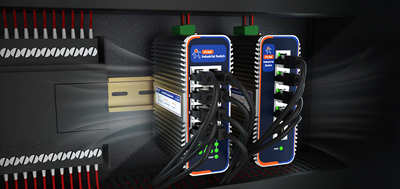
For industrial users, choosing a serial to Ethernet converter with proven multi-host concurrency capabilities not only solves the current acquisition stuttering issues but also reserves room for future production line system expansion, eliminating the need to repeatedly replace hardware when new monitoring requirements arise. A typical product suited for such high-reliability scenarios is the PUSR USR-TCP232-410s serial to Ethernet converter, which supports multi-host concurrency with up to 8 TCP connections online simultaneously, easily covering the multi-system acquisition needs in continuous casting machine monitoring scenarios; paired with a 10/100Mbps adaptive Ethernet port and a maximum serial baud rate of 921600bps, it fully matches the bandwidth requirements of high-frequency data transmission; it also holds multiple international certifications such as CE and FCC, operates stably across a wide temperature range of -40°C to 85°C, and is well-suited to the complex operating conditions with strong electromagnetic interference found in steel workshops.
For industrial users with relevant needs, further details on product specifications can be explored. By relying on mature multi-host concurrency technology, the persistent challenge of vibration acquisition stuttering in continuous casting machines can be thoroughly resolved, building a solid data foundation for the stable operation of steel production lines.