PUSR Cellular Router: The Cornerstone of Industrial Communication Reliability Built by SMT Process
In the era of the Industrial Internet, cellular routers, as the core devices connecting the physical and digital worlds, directly determine the continuity of production systems and the stability of data transmission. According to statistics, over 35% of communication interruptions in industrial scenarios stem from soldering defects in electronic components, and Surface Mount Technology (SMT), with its advantages of high density and high reliability, has become the mainstream process for manufacturing high-end cellular router. This article will provide an in-depth analysis of how PUSR cellular router address the core pain points in industrial communication through SMT process from three dimensions: SMT technology principles, PUSR process control system, and industry application cases.
Traditional Through-Hole Technology (THT) achieves electrical connections by inserting pins through PCB boards, which has drawbacks such as large component size, low soldering reliability, and poor production efficiency. SMT, on the other hand, directly mounts leadless or short-lead components onto the PCB surface and uses reflow soldering to achieve soldering, offering three core advantages:
High-density integration: Component size is reduced to 1/10 of traditional components, and PCB area utilization increases by 40%-60%, meeting the miniaturization and multifunctional requirements of cellular routers.
Reliability leap: The contact area between surface-mount components and PCBs increases by three times, and the mechanical strength of solder joints improves by 50%, maintaining stable electrical performance in a wide temperature range of -40°C to 85°C.
Automated production: With fully automatic placement machines achieving tens of thousands of component placements per hour, production efficiency increases by more than ten times compared to THT, significantly reducing human operation errors.
The SMT production process includes four core steps: solder paste printing, component placement, reflow soldering, and AOI inspection, each requiring strict control:
Solder paste printing: Laser-cut stencils are used to control solder paste thickness within the range of 0.12-0.15mm, ensuring precise alignment between component pins and pads. For example, PUSR uses SPI (Solder Paste Inspection) equipment to monitor parameters such as solder paste volume, area, and height in real time, keeping the printing defect rate below 0.01%.
Component placement: High-speed placement machines (e.g., Siemens HS60) are used to achieve placement accuracy at the 0.1mm level through a visual positioning system, supporting the placement of small components such as 0402 and 0201. PUSR introduces anti-static measures and temperature and humidity control (25°C ± 3°C, RH 45% ± 10%) during the placement process to avoid component performance drift.
Reflow soldering: A ten-zone reflow oven is used to precisely control the temperature profile (preheat zone: 120-150°C, soak zone: 150-180°C, reflow zone: 235-245°C, cooling zone: ≤5°C/s) to ensure the formation of good intermetallic compounds (IMC) at solder joints, avoiding defects such as dry joints and cold solder joints.
AOI inspection: Optical inspection technology is used to conduct a full inspection of solder joint morphology, component polarity, and placement position, combined with X-ray inspection for透视 (perspective) analysis of hidden solder joints such as BGAs and QFNs, achieving 100% quality traceability.
PUSR has established strategic partnerships with international first-tier component suppliers such as Murata, TDK, and Samsung, implementing a "triple verification" process for key raw materials:
Electrical performance verification: Passive components such as capacitors, inductors, and resistors are tested for voltage resistance, capacitance value, and ESR value to ensure parameter fluctuations are ≤5%.
Environmental adaptability verification: HALT (Highly Accelerated Life Testing) is used to simulate temperature shocks from -40°C to 85°C and vibration shocks from 5-500Hz to screen components with an MTBF (Mean Time Between Failures) of ≥100,000 hours.
Reliability traceability verification: Suppliers are required to provide information such as component batch numbers, production dates, and test reports to achieve full quality traceability from raw materials to finished products.
PUSR has introduced the ISO 9001 quality management system and IATF 16949 automotive industry quality standards to build a process control system covering the entire production flow:
Equipment precision control: Key equipment such as placement machines and reflow ovens undergo monthly CPK (Process Capability Index) calibration to ensure placement accuracy with a CPK ≥ 1.33 (industry benchmark ≥ 1.0).
Environmental cleanliness control: The production workshop meets Class 10,000 cleanliness standards (dust particle count ≤ 3,500 particles/m³) to avoid short circuits caused by dust at solder joints.
Personnel skill control: Operators must pass IPC-A-610 electronic assembly standard certification and undergo regular skill retraining and assessment.
PUSR has established a DFMEA (Design Failure Mode and Effects Analysis) and HALT laboratory to quickly expose potential defects by simulating extreme environmental conditions:
Temperature cycling test: Rapid switching between -40°C and 85°C (one cycle every 15 minutes) for 100 cycles to detect the thermal expansion coefficient matching of components.
Vibration test: Applying a 5G vibration acceleration within the frequency range of 5-500Hz for 2 hours to detect structural loosening or component damage.
Data-driven improvement: By recording detailed information on every field failure (e.g., failure phenomenon, environmental conditions, usage duration), a failure database is constructed, and big data analysis is used to identify common issues. For example, by analyzing the repair data of a batch of power modules, it was found that their electrolytic capacitors experienced rapid capacitance decay at high temperatures. Subsequently, the capacitor lifespan standard was increased from 8,000 hours to 10,000 hours, reducing the repair rate of this batch of products by 60%.
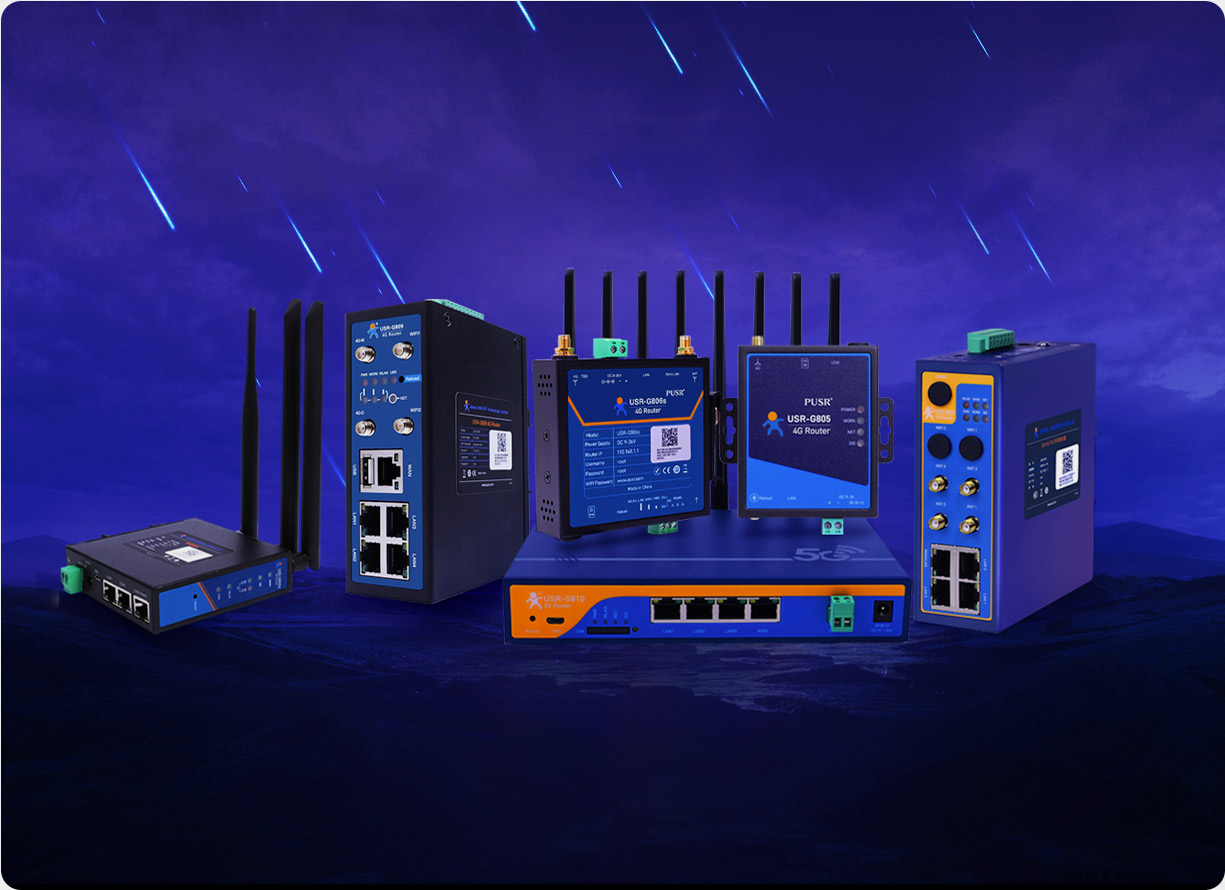
Under PUSR's strict SMT process control system, the USR-G809s 4G cellular router has become an ideal choice for high-reliability requirements:
Industrial-grade design: Featuring a metal sheet metal housing (IP30 protection rating), it supports a wide operating temperature range of -20°C to 70°C and humidity resistance of 5% to 95% RH (non-condensing), adapting to complex industrial scenarios such as warehousing, manufacturing, and energy.
Multimodal communication: Integrating 4G LTE, Wi-Fi, serial ports, and Ethernet ports, it supports intelligent wired/4G multi-network switching and backup functions to ensure continuous data transmission. For example, in an AGV scheduling project at an automotive final assembly line, the USR-G809s achieved a 99.97% data transmission success rate with a network switching delay of less than 30ms.
Edge computing capability: Equipped with a quad-core ARM Cortex-A7 processor, it supports the deployment of lightweight AI models, capable of real-time processing of 8-channel 1080P video streams. Using the YOLOv5 algorithm, it can identify shelf numbers and obstacle types, reducing AGV path replanning time to 80ms.
Security protection system: Built-in firewall, NAT, DMZ, port forwarding, and other functions, it supports multiple VPN protocols such as IPSec, PPTP, and L2TP to ensure data transmission security. For example, in a smart grid project, the USR-G809s enabled real-time communication between substations and control centers through VPN encryption, avoiding data leakage risks.
For customers with high-reliability requirements, it is recommended to evaluate cellular router suppliers from the following dimensions:
Process transparency: Require suppliers to provide equipment lists, test reports, and quality certification documents (e.g., ISO 9001, IATF 16949) for their SMT production lines.
Supply chain control: Prioritize suppliers that partner with international first-tier component suppliers such as Murata and TDK to ensure traceable raw material quality.
Failure analysis capability: Examine whether suppliers have HALT laboratories and DFMEA analysis capabilities and can continuously improve product reliability through data-driven approaches.
Field verification: Require suppliers to provide prototype machines for high-temperature aging tests (85°C/1000 hours) or vibration tests (5G/2 hours) to verify their claimed reliability data.
In the "reliability race" of the Industrial Internet, SMT process has become a key variable determining the outcome. PUSR has elevated the reliability of cellular routers to industry-leading levels by establishing a full-process quality assurance system covering "raw material screening - production process control - failure analysis and improvement." For customers pursuing "zero-interruption" communication, choosing PUSR cellular routers is not just choosing a product but also choosing a complete quality control philosophy.
Act now and usher in a new era of high-reliability communication!
Contact us to obtain detailed technical solutions and on-site demonstration invitations for the USR-G809s 4G cellular router, and witness firsthand how SMT process forges the "iron body" of industrial communication.