January 15, 2026
PUSR Industrial Router Power Module
PUSR Industrial Router Power Module: In-Depth Analysis of Raw Material Quality Assurance System and Selection Guide
In the era of the Industrial Internet, industrial router serve as the core devices connecting the physical and digital worlds, and the reliability of their power modules directly determines the continuity of data transmission and the stability of equipment operation. According to statistics, over 40% of communication interruptions in industrial scenarios stem from power module failures, with raw material quality defects being the primary cause of power failures. This article will conduct an in-depth analysis of the quality assurance system of PUSR industrial router power modules from three dimensions: raw material selection criteria, supply chain control, and failure analysis mechanisms, providing professional selection references for customers with high reliability requirements.
1. Raw Material Quality: The "Genetic Code" of Industrial Power Modules
Industrial router power modules need to operate stably in harsh environments such as extreme temperature differentials ranging from -40°C to 85°C, strong electromagnetic interference, and continuous vibration. This places stringent requirements on the temperature resistance, anti-interference capabilities, and mechanical strength of raw materials. PUSR ensures the reliability of power modules from the source by establishing a "three-tier raw material screening system":
1.1 Core Component Selection Criteria
Power Devices: Utilize MOSFETs and IGBTs from international first-tier brands such as TI and Infineon. Their on-resistance (Rds(on)) is 30% lower than that of ordinary devices, with better temperature rise control, and they can withstand 100A-level transient current surges. For example, in a blast furnace monitoring project at a steel group, PUSR power modules operated continuously for 3 years at 85°C without any power device failures.
Electrolytic Capacitors: Select industrial-grade capacitors from manufacturers such as Rubycon and Nichicon in Japan, with a lifespan of over 10,000 hours (under 105°C conditions), which is 5 times longer than that of commercial-grade capacitors. X-Ray inspection technology is used to ensure that there are no air gaps inside the capacitors and that the pin soldering is firm, preventing power short circuits caused by capacitor explosion.
Magnetic Components: Collaborate with TDK and Murata to customize high-frequency transformers and inductors. Their core losses (Pcv) are 40% lower than those of general-purpose models, enabling stable operation at switching frequencies above 200kHz and meeting the design requirements of high efficiency and small size.
1.2 Environmentally Adaptive Enhanced Design
Wide-Temperature Materials: The PCB substrate adopts FR-4 TG170 high heat-resistant board material, with a glass transition temperature (Tg) of 170°C, which is more resistant to high-temperature aging than ordinary FR-4 (Tg 130°C).
Anti-Vibration Structure: The power module housing is manufactured using aluminum alloy die-casting technology, and the internal components are fixed by silicone potting, enabling it to withstand vibration impacts within the frequency range of 5-500Hz and meeting the IEC 60068-2-6 standard.
Corrosion Prevention Treatment: In coastal or chemical scenarios, the power module housing is coated with a three-proof paint (moisture-proof, salt spray-proof, and mold-proof), and the terminals are gold-plated, with a contact resistance of ≤5mΩ, ensuring no oxidation during long-term use.
1.3 Closed-Loop Supply Chain Control
PUSR has established a supply chain management system of "supplier admission - batch sampling inspection - full lifecycle traceability":
Admission Audit: Suppliers must pass quality system certifications such as ISO 9001 and IATF 16949 and provide environmental compliance reports such as RoHS and REACH for raw materials.
Batch Sampling Inspection: After each batch of raw materials arrives, 100% visual inspection and 20% performance sampling inspection (such as capacitor capacity and ESR value testing) are conducted. Unqualified batches are returned in whole.
Traceability System: Information such as the batch number, production date, and inspection data of raw materials is recorded through the MES system, enabling full traceability from raw materials to finished products. For example, if a batch of power modules fails at a customer site, the specific raw material supplier and production batch can be quickly located, and targeted improvement measures can be taken.
2. Failure Analysis: From "Post-Maintenance" to "Pre-Prevention"
PUSR introduces DFMEA (Design Failure Mode and Effects Analysis) and HALT (Highly Accelerated Life Testing) technologies to build a closed-loop quality control system of "prevention - detection - improvement":
2.1 DFMEA: The "Risk Firewall" in the Design Stage
At the initial stage of power module design, the PUSR team identifies potential failure modes (such as capacitor explosion, inductor saturation, and PCB board warping) through DFMEA analysis and formulates targeted improvement measures:
Capacitor Selection: For high-temperature scenarios, select 105°C electrolytic capacitors with a lifespan of 10,000 hours instead of 85°C commercial-grade capacitors.
PCB Layout: Separate the layout of power devices and sensitive signal lines to reduce electromagnetic interference; optimize the heat dissipation channels through thermal simulation to ensure that the module surface temperature is ≤65°C.
Protection Circuits: Integrate overvoltage protection (OVP), overcurrent protection (OCP), and overtemperature protection (OTP) functions. When the voltage exceeds 15% of the nominal value, the current exceeds 120% of the rated value, or the temperature exceeds 85°C, the output is automatically cut off to prevent module damage.
2.2 HALT: The "Extreme Challenge" of Accelerated Aging Testing
PUSR has invested in the construction of a HALT laboratory to quickly expose potential defects in power modules by simulating extreme environmental conditions:
High-Temperature Aging: Continuously operate for 1000 hours in a humid environment of 85°C and 85% RH to detect issues such as capacitor capacity attenuation and PCB insulation performance degradation.
Temperature Cycling: Rapidly switch between -40°C and 85°C (one cycle every 15 minutes) for 100 cycles to detect the matching of the thermal expansion coefficients of materials and prevent PCB board warping or solder joint cracking.
Vibration Testing: Apply a vibration acceleration of 5G within the frequency range of 5-500Hz for 2 hours to detect structural looseness or component damage. Through HALT testing, PUSR has increased the mean time between failures (MTBF) of power modules to over 50,000 hours, which is 150% higher than the industry average (20,000 hours).
2.3 Data-Driven Continuous Improvement
PUSR has established a "fault database" to record detailed information on every field fault (such as fault phenomena, environmental conditions, and usage duration) and identify common issues through big data analysis. For example, by analyzing the repair data of a batch of power modules, it was found that the capacity of their electrolytic capacitors attenuated too quickly in high-temperature environments. Subsequently, the capacitor lifespan standard was increased from 8,000 hours to 10,000 hours, and the PCB heat dissipation design was optimized, reducing the repair rate of products in this batch by 60%.
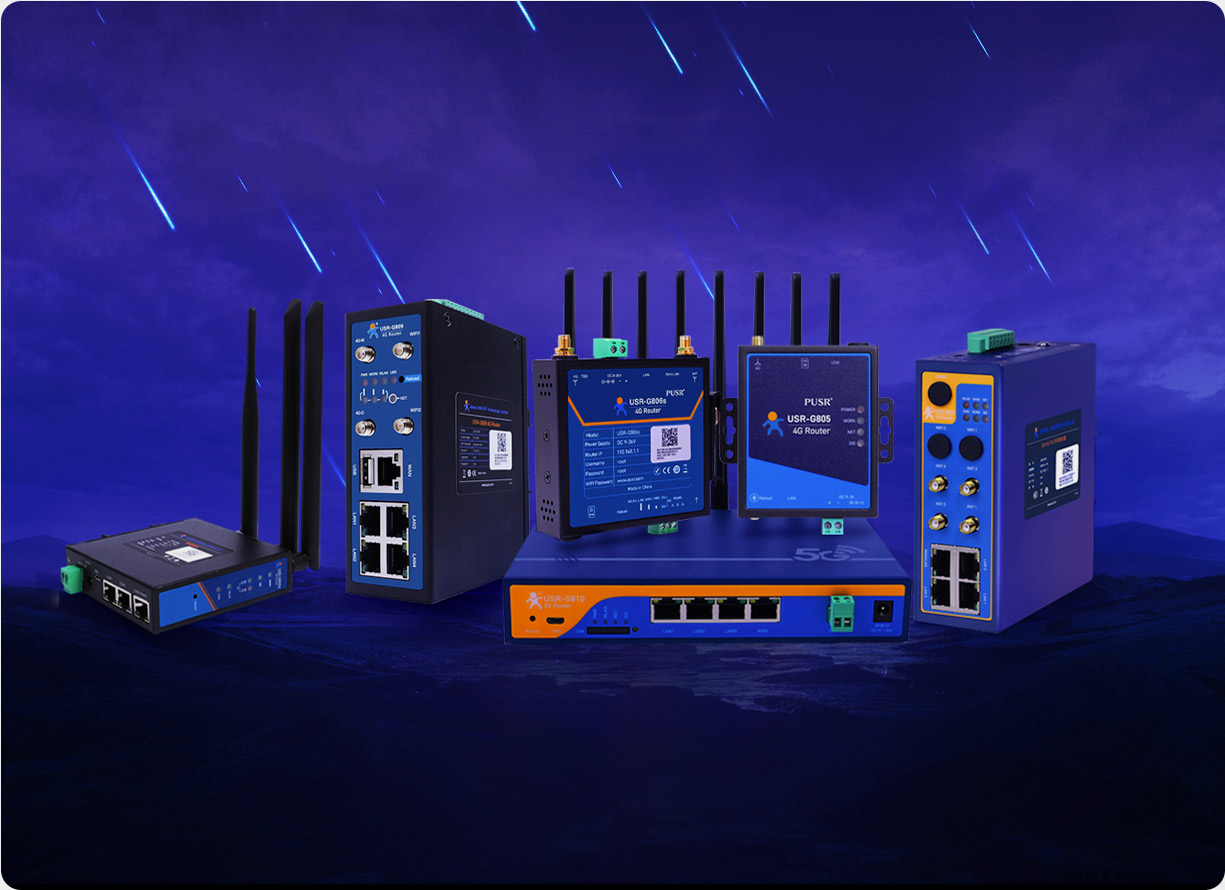
3. USR-G809s: The "Reliability Benchmark" of Industrial Routers
Under PUSR's power module quality assurance system, the USR-G809s industrial router has become an ideal choice for high reliability requirements:
Multimodal Communication: Supports 5G + Wi-Fi 6 + LoRa triple-mode redundant transmission. When the primary network fails, it automatically switches to the backup link to ensure the continuity of data transmission. For example, in an AGV scheduling project on an automobile assembly line, the USR-G809s achieved a 99.97% data transmission success rate, with a network switching delay of less than 30ms.
Edge Computing Capabilities: Equipped with a quad-core ARM Cortex-A7 processor, it supports the deployment of lightweight AI models and can process 8 channels of 1080P video streams in real time. Through the YOLOv5 algorithm, it can identify shelf numbers and obstacle types, reducing the AGV path replanning time to 80ms.
Industrial-Grade Design: With a metal housing (IP30 protection level), a wide operating temperature range of -20°C to 70°C, and humidity resistance of 5% to 95% RH (without condensation), it is suitable for complex industrial scenarios such as warehousing, manufacturing, and energy.
4. Selection Recommendations: How to Choose a High-Reliability Industrial Router?
For customers with high reliability requirements, it is recommended to evaluate industrial router suppliers from the following dimensions:
Raw Material Transparency: Require suppliers to provide a list of core components of the power module (such as capacitor and MOSFET brands and models), inspection reports, and supply chain traceability information.
Quality Certifications: Give priority to products that have passed certifications such as ISO 9001, IEC 61508 (functional safety), and IEC 62443 (network security).
Field Validation: Require suppliers to provide prototype machines for HALT testing or long-term high-temperature aging testing to verify their reliability claims.
Service Response: Choose suppliers with technical service outlets nationwide to ensure that they can arrive at the site within 48 hours after a fault occurs.
In the "reliability race" of the Industrial Internet, the raw material quality of power modules has become a key variable determining the outcome. By establishing a "three-tier raw material screening system," introducing DFMEA and HALT technologies, and building a fault database, PUSR has elevated the reliability of power modules to an industry-leading level. For customers pursuing "zero-interruption" communication, choosing PUSR industrial routers is not just choosing a product but also selecting a complete quality assurance system.
Industrial loT Gateways Ranked First in China by Online Sales for Seven Consecutive Years **Data from China's Industrial IoT Gateways Market Research in 2023 by Frost & Sullivan
We use cookies to ensure that we give you the best
experience on our website. If you continue to use this site we will assume that you are happy with it.