SNMP Monitoring Protocol for Industrial 4G LTE Router: How to Integrate into Existing O&M Management Systems?
In today's rapid development of the Industrial Internet of Things (IIoT), enterprises' demand for device connectivity has evolved from simply being able to connect to being efficient, secure, and manageable. However, when hundreds of industrial 4G LTE router are connected to the network, enterprises often face a core pain point: how to uniformly integrate scattered router monitoring data into existing operational and maintenance (O&M) management systems to achieve visual, automated, and intelligent management of all network devices? Traditional O&M methods rely on manual inspections or independent monitoring tools, which struggle to cope with multi-device, multi-protocol, and multi-network environments in complex industrial scenarios. This article will analyze the technical characteristics of the Simple Network Management Protocol (SNMP) and explain how to deeply integrate it into existing O&M systems. It will also recommend an efficient solution—the USR-G809s industrial 4G LTE router.
Industrial site devices are widely distributed, possibly across multiple workshops, warehouses, and even remote sites. Traditional O&M methods require the use of different tools or logging into devices individually to check their status, such as:
Logging into the router's web interface to view traffic statistics;
Using serial port tools to debug sensor data;
Connecting to remote devices via VPN for configuration.
This "decentralized" management approach leads to frequent tool switching by O&M personnel, resulting in low efficiency and a high risk of errors.
Industrial networks feature a variety of device protocols, including Modbus, MQTT, HTTP, etc., while traditional O&M systems may only support specific protocols. For example:
A factory's PLC uploads data to the SCADA system via Modbus TCP;
Industrial cameras transmit video streams to a local server via the HTTP protocol;
Routers report traffic to an independent monitoring platform via the SNMP protocol.
Different protocols prevent data interoperability, creating "data silos" and making it difficult to achieve unified analysis across the entire network.
When devices fail, traditional O&M methods rely on manual troubleshooting, such as:
Analyzing logs to locate problems;
Testing the connection status of each device;
Manually restarting or reconfiguring devices.
This "post-incident" approach results in an average repair time (MTTR) of several hours, seriously affecting production efficiency.
Device security is crucial in industrial networks, but traditional O&M methods struggle to implement unified security policies, such as:
Different devices using different password management;
Lack of detection for unauthorized access devices;
Inability to monitor device security events in real-time (e.g., DDoS attacks).
Security vulnerabilities can lead to data breaches or production interruptions, causing significant losses.
SNMP (Simple Network Management Protocol) is a standard protocol designed specifically for network device management. Its core advantages include:
Standardized Interface: Defines device parameters through the Management Information Base (MIB), ensuring uniform data formats across devices from different manufacturers;
Lightweight Communication: Based on the UDP protocol, it transmits data without establishing a connection, making it suitable for low-bandwidth or unstable networks;
Proactive Alert Mechanism: Supports Trap alerts, allowing devices to actively report abnormal events (e.g., interface disconnection, traffic overload);
Batch Management Capability: A single SNMP client can monitor hundreds of devices, supporting topology discovery and performance statistics.
Taking the USR-G809s industrial 4G LTE router as an example, its SNMP functionality enables the following scenarios:
Device Status Monitoring: Real-time viewing of the router's CPU usage, memory occupancy, temperature, and other operational statuses;
Network Traffic Statistics: Statistics on upload/download traffic by interface (e.g., 4G, LAN, WAN), generating daily/weekly/monthly reports;
Proactive Fault Alerts: Automatic email/SMS notifications when signal strength is weak, traffic is abnormal, or the device goes offline;
Remote Configuration Management: Modifying device parameters (e.g., restart, network switching, firmware updates) via SNMP SET commands.
SNMP can complement protocols like Modbus and MQTT to form a "standardized + industry-specific" monitoring system:
SNMP for Basic Monitoring: Unified collection of general data such as device status, traffic, and alerts;
Modbus/MQTT for Industry Data: Collection of professional data from sensors, PLCs, etc. (e.g., temperature, humidity, pressure, rotational speed);
Unified Platform Integration: Summarizing all data to existing O&M systems (e.g., Zabbix, Prometheus, USR Cloud) via SNMP for "single-pane-of-glass" management.
Taking the USR-G809s as an example, the configuration steps are as follows:
Log in to the router's management interface: Enter the device's IP address (e.g., 192.168.1.1) in a web browser and input the username/password (both default to root);
Enable SNMP service: In "Network Settings → SNMP," enable SNMP functionality and select the version (v1/v2c/v3);
Configure community names or encryption information:For v1/v2c: Set "read-write community names" (e.g., public/private);
For v3: Set the username, authentication protocol (MD5/SHA), encryption protocol (DES/AES), and privacy password;
Save the configuration and restart the device: Ensure the SNMP service takes effect.
Taking the "USR Cloud" platform as an example, the integration steps are as follows:
Log in to the USR Cloud platform: Visit https://account.usr.cn, register, and log in to your account;
Add a device: In "Device Management → Add Device," select "Custom Device," fill in the device name, group, and SNMP version;
Configure SNMP credentials: Input the USR-G809s's IP address, port (default 161), community name, or v3 encryption information;
Import MIB files (optional): If parsing private OIDs is required, upload the USR-G809s's MIB file (available for download from the official website);
Set alert rules: In "Alert Management," configure thresholds (e.g., traffic overload, weak signal) and select notification methods (email/SMS/DO relay);
Verify data collection: View real-time data on the "Device Snapshot" page to confirm successful SNMP integration.
Batch Management: Use SNMP to discover devices in batches, reducing manual addition workload;
Group Management: Group devices by workshop, area, or device type for quick problem location;
Historical Data Analysis: Utilize the platform to generate traffic trend charts and fault statistics reports to optimize network planning;
Automated O&M: Combine SNMP SET commands for remote batch configuration (e.g., firmware upgrades, network switching).
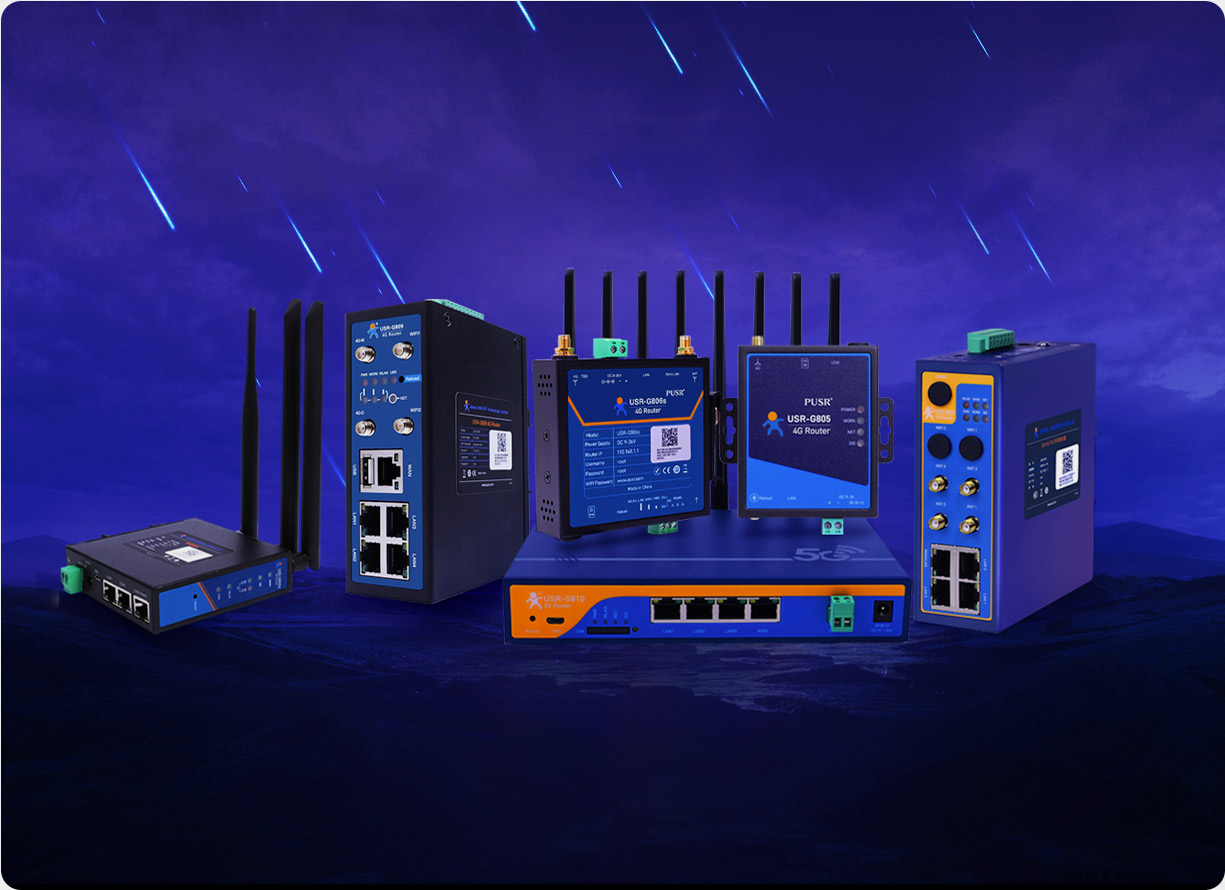
The USR-G809s is a 4G industrial router gateway with the following features:
Multi-interface Support: 1 x 100Mbps WAN port, 4 x 100Mbps LAN ports, supporting RS232/RS485 serial port transparency;
High Reliability Design: Industrial-grade metal casing, resistant to high temperatures (-20℃~70℃), anti-static, and anti-electromagnetic interference;
Multi-network Backup: Supports intelligent switching between wired and 4G networks to ensure continuous connectivity;
Security Protection: Supports VPN (PPTP/L2TP/IPSec/OpenVPN), firewalls, and access control lists (ACLs).
The USR-G809s is built-in with the USR Cloud management platform, providing the following SNMP-related functions:
Real-time Monitoring: View device status, traffic, signal strength, etc., via the web interface or app;
Historical Query: Support exporting traffic reports by day/week/month to analyze bandwidth usage;
Alert Management: Customize thresholds to trigger email/SMS/DO relay alerts when exceeded;
Remote O&M: Batch upgrade firmware and modify configurations via the cloud, reducing on-site operations.
Smart Factories: Monitor the traffic of AGVs, robotic arms, and industrial cameras to optimize 4G plan selection;
Smart Energy: Real-time monitoring of the network status of photovoltaic inverters and wind turbine controllers to prevent unauthorized access;
Smart Agriculture: Collect data from soil sensors and weather stations and uniformly upload it to the cloud platform via SNMP;
Smart Logistics: Track the traffic of automatic sorters and unmanned forklifts to avoid network congestion.
Click to submit an inquiry, and our technical team will provide the following based on your scenario (e.g., device quantity, network type, security requirements):
USR-G809s selection recommendations and configuration lists;
SNMP integration plans and steps for interfacing with existing systems;
Cost-sharing models and optimization suggestions.
Apply for a trial opportunity for the USR-G809s and enjoy:
30-day full-feature access to the USR Cloud platform;
7x12-hour technical support;
Trial reports and optimization suggestion feedback.
Join the USR IoT Ecosystem Alliance to share:
The latest industrial control security technology resources;
A success case library and learning community;
Joint solution development and collaboration opportunities.
Conclusion: In the era of the Industrial Internet of Things, the SNMP protocol has become the "standardized bridge" connecting devices and O&M systems. By integrating SNMP into existing systems, enterprises can achieve a leap from "decentralized management" to "unified control," significantly improving O&M efficiency, reducing costs, and enhancing security. The USR-G809s industrial 4G LTE router, with its powerful SNMP functionality and ease of use, is an ideal choice for enterprises upgrading their O&M systems. Take action now to make your industrial network more efficient and intelligent!