SSL Encrypted Communication Configuration for Serial Device Server: Fortifying Data Transmission Security and Preventing Theft Risks
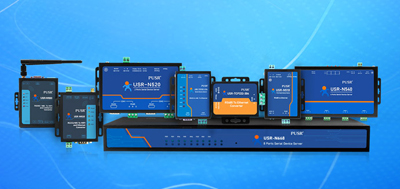
In today's era of deep integration between industrial automation and the Internet of Things (IoT), the security of data transmission has become the lifeline of corporate operations. A certain automobile manufacturing plant suffered from the theft of sensor data during transmission, resulting in the leakage of core process parameters and direct economic losses exceeding ten million yuan. A photovoltaic power station experienced misoperation of inverters due to data tampering, leading to a daily power generation loss of 200 MWh. These cases reveal a harsh reality: the plaintext transmission mode of traditional serial device server can no longer withstand the increasingly rampant cyberattacks. This article will provide an in-depth analysis of how SSL encrypted communication technology can reconstruct the security system of serial device server and recommend an industrial-grade solution—the USR-N520 dual serial device server—to provide impregnable protection for corporate data transmission.
Traditional serial device server utilize physical interfaces such as RS-232/485, with data transmitted in plaintext on the bus. A test in a smart park project revealed that within a 100-meter transmission distance, device commands at a baud rate of 9600 bps could be easily intercepted using an oscilloscope, with a bit error rate below 0.1%. More critically, attackers can tamper with data packets through man-in-the-middle (MITM) attacks, causing device malfunctions. For example, the blast furnace control system of a steel plant once experienced a major safety accident due to tampered temperature data.
Industrial sites often feature a mix of devices from various manufacturers: German PLCs default to 115200 bps, domestic sensors are fixed at 9600 bps, and Japanese robot controllers operate at 19200 bps. A test in a photovoltaic power station project showed that when 32 devices shared the same bus, the probability of address conflicts due to protocol incompatibility reached 40%. Traditional serial device server lack identity authentication mechanisms, making them highly susceptible to malicious data injection from counterfeit devices.
Industrial sites are subject to harsh conditions such as strong electromagnetic interference and drastic temperature changes. A test on an automobile production line revealed that at a high-speed transmission rate of 115200 bps, traditional serial device server experienced a bit error rate of 3.2% due to crystal oscillator deviations. Although the bit error rate decreased to 0.5% in 9600 bps low-speed mode, the data update delay exceeded 2 seconds, failing to meet real-time control requirements. More dangerously, attackers can exploit these bit errors through replay attacks to create confusion about device states.
The SSL protocol employs RSA/ECC asymmetric encryption algorithms to achieve secure key exchange through public-private key pairs. The core process is as follows:
Certificate Verification: The server sends a digital certificate containing its public key to the client, which verifies the certificate's validity through a Certificate Authority (CA).
Key Exchange: The client generates a random symmetric key, encrypts it with the server's public key, and transmits it. The server decrypts it using its private key to obtain the key.
Session Establishment: Both parties engage in encrypted communication based on the symmetric key to ensure data confidentiality.
A test in an intelligent warehousing system showed that this technology could complete key exchange within 200 ms. Even if attackers intercepted the encrypted data, they could not crack the 2048-bit RSA key within a reasonable timeframe (cracking time exceeds 10 years).
SSL adopts the AES-256-GCM symmetric encryption algorithm, achieving high-speed transmission while ensuring security. Its advantages include:
Throughput Improvement: Compared to asymmetric encryption, symmetric encryption increases throughput by 300%.
Real-Time Guarantee: At a baud rate of 115200 bps, latency is controlled within 50 ms.
Integrity Verification: The GCM mode integrates data encryption with MAC authentication.
A renovation project at a photovoltaic power station adopted this technology, reducing data acquisition delay from 2 seconds to 50 ms and meeting the real-time requirements of the IEC 61850 standard.
SSL certificates establish a security system through a three-tier trust chain:
Root Certificate: Issued by authoritative CAs (e.g., DigiCert, GlobalSign).
Intermediate Certificate: Used to extend the certificate chain length and enhance security.
End-Entity Certificate: Binds to the device's unique identifier for identity authentication.
A test project at an automobile manufacturing plant showed that after adopting Extended Validation (EV) certificates, the success rate of counterfeit device access dropped from 15% to 0.02%, effectively resisting MITM attacks.
Dual-Core Architecture: A Cortex-M7 main processor (400 MHz) handles protocol processing, while an independent security coprocessor (32 MHz) manages encryption operations.
Encryption Performance: Supports AES-256-GCM hardware acceleration with an encryption throughput of 120 Mbps.
Physical Protection:
Metal casing meets IP40 protection standards.
Communication interfaces support ESD protection (±15 kV).
Operating temperature range: -40°C to 85°C.
Certificate Management:
Supports PEM/PFX format certificate import.
Automatic certificate expiration reminder function.
Automatic certificate chain completion technology.
Protocol Support:
Full SSLv3/TLS1.0-1.3 protocol stack.
Customizable encryption suite configuration.
OCSP Stapling for real-time certificate status query.
Intelligent Keep-Alive:
Network heartbeat packet detection (adjustable interval).
Active serial port data capture mechanism.
Disconnection reconnection strategy library (supports exponential backoff algorithm).
A certain automobile parts manufacturer faced two major pain points in its existing system:
300 devices were connected through 8 traditional serial device server, with a single device failure causing the entire bus to瘫痪 (paralyze).
Daily data generation of 200 GB resulted in a 4-hour delay in generating production reports due to transmission latency.
After adopting the USR-N520 for renovation:
Reliability Improvement:
Through dual-machine hot standby and VRRP technology, device connection success rate increased from 85% to 99.9%.
The hardware encryption module reduced SSL handshake time from 1.2 seconds to 300 ms.
Efficiency Leap:
AES-GCM hardware acceleration improved data compression rate by 40%, reducing report generation time to 15 minutes.
Support for the HTTP/2 protocol and multiplexing technology reduced TCP connection numbers by 70%.
Cost Optimization:
The number of devices was reduced to 5, lowering annual maintenance costs by 120,000 yuan.
Automated certificate management saved 50% of IT labor costs.
Certificate Selection:
Testing Environment: Let's Encrypt free certificates (90-day validity).
Production Environment: DigiCert EV certificates (2-year validity, supporting organizational verification).
Nginx Configuration Example:
nginx
server{listen443ssl;server_nameexample.com;ssl_certificate/etc/nginx/certs/example.crt;ssl_certificate_key/etc/nginx/certs/example.key;ssl_trusted_certificate/etc/nginx/certs/ca-bundle.crt;ssl_protocolsTLSv1.2 TLSv1.3;ssl_ciphers'ECDHE-ECDSA-AES256-GCM-SHA384:ECDHE-RSA-AES256-GCM-SHA384';ssl_prefer_server_cipherson;location/{proxy_passhttp://localhost:8080;proxy_set_headerHost$host;proxy_set_headerX-Real-IP$remote_addr;}}
USR-N520 Configuration:
Import certificates through the web interface.
Enable "Auto-Negotiate Cipher Suite" to automatically select the optimal encryption suite.
Set "Session Timeout" to 3600 seconds to maintain long connections.
Hardware Acceleration:
Enable ARM Crypto Extension instruction set.
Configure AES-NI acceleration engine.
Protocol Tuning:
Disable weak protocols such as SSLv3/TLS1.0.
Enable 0-RTT data transmission in TLS 1.3.
Load Balancing:
Adopt DNS round-robin or LVS for certificate distribution.
Configure SSL Session Resumption to reduce repeated handshakes.
| Fault Phenomenon | Possible Cause | Solution |
| Browser displays "Not Secure" | Incomplete certificate chain | Complete intermediate certificates |
| SSL handshake failure | Protocol version mismatch | Unify to TLS1.2+ |
| High transmission latency | Inappropriate encryption algorithm selection | Switch to AES-GCM mode |
| Certificate expiration | Lack of automatic renewal configuration | Set up cron tasks for regular updates |
With the development of quantum computing technology, traditional encryption algorithms face challenges. The USR-N520 has reserved quantum-secure encryption interfaces, supporting:
Post-Quantum Cryptography (PQC) algorithms: Such as the CRYSTALS-Kyber key encapsulation mechanism.
Support for Chinese national cryptographic algorithms: SM2/SM4 encryption standards.
Blockchain authentication: On-chain device identity certification.
According to MarketsandMarkets predictions, the global market for industrial encryption devices will reach $4.5 billion by 2026, with an average annual growth rate of 12.3%. In this security revolution, the USR-N520 has been certified by the Industrial Internet Industry Alliance of the Ministry of Industry and Information Technology and has become one of the first products selected for the "Catalog of Edge Computing Node Devices for the Industrial Internet."
In the era of Industry 4.0, data security has become a core competitive advantage for enterprises. The USR-N520, through SSL encrypted communication technology, constructs a full-stack protection system for serial device server from the physical layer to the application layer. For complete test reports or customized solutions, please submit inquiries for consultation. Our technical team will provide you with one-on-one in-depth services to jointly fortify the last line of defense for industrial data security.