In a factory workshop, a PLC runs Modbus RTU over an RS-485 bus. The control room needs remote monitoring, but the SCADA software only recognizes COM ports. Replace the equipment? The software is incompatible. Add a converter? Configuration becomes a mess.
This is exactly what a serial to ethernet converter solves: connecting legacy serial devices to modern industrial networks through Ethernet, without changing software or replacing devices.
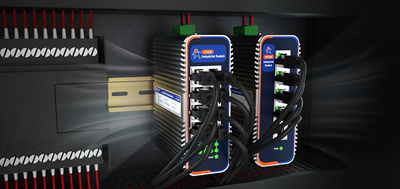
Aserial to ethernet converteris a physical device plugged between a serial device and an Ethernet cable, converting RS-232 or RS-485 signals into TCP/IP data packets. The PUSR USR-TCP232-410s, for example, carries dual serial ports (RS232 + RS485), supports Modbus gateway functionality, SSL encryption, edge computing, and operates from -40 to 85 degrees Celsius. Mounting on a DIN rail or wall is both possible.
Avirtual COM portis a software-level solution. After installing a driver on the PC, TCP Socket communication gets "wrapped" into a traditional COM port, allowing serial software to communicate with remote devices through a virtual port without any code modification.
A PLC engineer once described a setup where the HMI connects to an OPC Server through virtual COM ports, reading sensor data from dozens of devices across the workshop. The serial devices themselves undergo zero modifications. Data passes through a serial to ethernet converter, transforms into network packets, then gets "unwrapped" back into serial form at the control end via virtual COM ports. SCADA software reads the data exactly as if devices were physically connected to local COM ports on the same machine.
The advantage is straightforward: no PLC program updates required, no SCADA software replacement needed, just data flowing through a network instead of a copper cable.
Choose a serial to ethernet converter when: multiple serial devices need centralized management, the environment is harsh (high temperature, humidity, vibration), or hardware-grade reliability is required. The PUSR USR-TCP232-410s, for instance, supports water supply system monitoring: one RS232 meter and one RS-485 bus can connect simultaneously, with edge computing processing up to 300 data points locally before uploading to a server, reducing bandwidth pressure.
Choose virtual COM ports when: a converter already exists but the software does not recognize TCP Sockets, only COM ports. A virtual COM driver makes software believe the serial port is locally connected while data actually travels over the network. This suits temporary debugging, legacy system retrofits, or any scenario where software configuration changes are unwelcome.
Use both together: the converter handles hardware transformation, virtual COM handles software compatibility. This combination appears most often in practice.
The PUSR USR-TCP232-410s is a classic RS232+RS485 serial-to-Ethernet converter supporting:
For space-constrained scenarios like electrical cabinets or equipment enclosures, the PUSR USR-DR132/DR134 series fits. The unit is roughly the size of a gum packet, carries a single RS485 port, and suits individual device retrofits where full-size converters would not fit.
Neither approach is inherently "more advanced." The choice depends on what the existing system requires. If software only accepts COM ports, start by adding a virtual COM driver. If hardware reliability and edge computing matter, deploy a serial to ethernet converter directly. Frequently, both working together proves easier than relying on either alone.
A serial to ethernet converter is a physical device converting RS-232 or RS-485 serial signals into TCP/IP network packets. A virtual COM port is a software driver creating a virtual serial port on a PC, letting traditional serial software communicate over a network without modification. The two typically work together: the converter handles hardware transformation, and the virtual COM driver handles software compatibility.
Not necessarily. With a serial to ethernet converter, existing serial devices stay in place. Only one converter needs to be inserted between the device and the network. Paired with a virtual COM driver on the software side, SCADA software remains unchanged: only the data path switches from a direct cable to a network connection. This approach minimizes retrofit costs.
Yes. The PUSR USR-TCP232-410s supports Modbus gateway functionality with built-in RTU-to-TCP protocol conversion. PLCs and sensors continue transmitting data using Modbus RTU, while the converter automatically translates to Modbus TCP. SCADA software reads the translated data through a standard TCP Socket connection.
With encryption, it is. The PUSR USR-TCP232-410s supports SSL/TLS encrypted transmission, keeping data in encrypted form across the network and preventing man-in-the-middle attacks or data interception. Industrial sites are advised to combine encryption with VLAN isolation and firewall policies for layered protection.
It depends on the model. The PUSR USR-TCP232-410s carries dual serial ports: one RS232 and one RS485. A single RS-485 bus can daisy-chain up to 32 devices (depending on slave address allocation). For more ports, the PUSR USR-N540 (4 ports) or USR-N520 (2 secure ports) serve as alternatives.
Edge computing lets the converter process data locally, uploading only critical information to a server. This reduces network bandwidth pressure and server load. The PUSR USR-TCP232-410s supports edge buffering and processing for up to 300 data points, making it suitable for industrial sites with large data volumes or unstable network connections.
Not as much as it sounds. After installing the virtual COM driver, the system creates a virtual COM port (e.g., COM3 or COM4). The target IP address and port number are entered into the serial software, and communication begins. No software code modification is required, making this approach ideal for legacy systems that only recognize COM ports.
Three specifications matter most: operating temperature range (recommend -40 to 85 degrees Celsius for wide temperature), power supply method (5-36V DC wide voltage range to accommodate industrial power fluctuations), and isolation rating (1.5kV electromagnetic isolation for interference resistance). The PUSR USR-TCP232-410s meets all three criteria and carries CE, FCC, ROHS, WEEE, and RCM certifications, usable in both domestic and international markets.