Smart City Traffic Signal Control: How Industrial Mini PCs Resolve "Management Dilemma" at 200 Intersections
At 7 a.m., a traffic control center in a core district of Beijing shows real-time feeds from over 200 intersections. Traffic builds up on one main road while vehicles wait idly at adjacent intersections due to poor signal timing. This scene repeats daily in cities nationwide.
Traditional traffic management relies on isolated systems for each intersection, lacking global coordination. For example, in a second-tier city, 200 intersections use signal controllers from eight different vendors, with incompatible protocols and data formats, preventing real-time road condition updates. This leads to:
Main road coordination failure: Long gaps between green lights cause frequent stops, reducing efficiency by 30%.
Regional congestion spread: When one intersection jams, nearby intersections fail to adjust, expanding congestion by 2-3 times.
Delayed emergency response: Special vehicles like ambulances and fire trucks require manual signal adjustments, averaging over 5 minutes of delay.
Traffic signal control is a lifeline for urban safety, but traditional systems' fragility often causes disasters. A provincial capital once saw a fatal crash when a signal controller malfunctioned, causing red and green lights to show simultaneously, killing three. Worse, manual inspections mean an average 47-minute delay in fault detection, with unforeseeable risks.
As cities expand, maintaining 200 intersections' signal systems becomes exponentially costly:
Hardware redundancy: Servers are over-configured by 300% to handle peak traffic, with annual maintenance costs exceeding 100,000 yuan per intersection.
Data silos: Traffic Operating Systems (TOS), electronic police systems, and checkpoint systems use incompatible data formats, requiring manual re-entry and adding millions in annual labor costs.
Upgrade challenges: Traditional X86 industrial computers have less than 30% localization, relying on imported chips and facing supply chain risks.
Path dependency: "Our 20-year-old signal system is inefficient but stable. Replacing it means retraining 200 maintenance staff," admits a city traffic bureau leader.
High trial costs: A smart traffic signal system costs over 10 million yuan. Failure affects annual KPIs and even job security.
Safety liability: "If AI scheduling causes an accident, who is responsible—the algorithm provider, system integrator, or us?" This unspoken fear haunts most managers.
Policy pressure: The Ministry of Transport's Smart Traffic Guidelines require over 80% signal intelligence in key cities by 2025, with non-compliance risking loss of subsidies.
Competitive threat: Shenzhen and Hangzhou have improved traffic efficiency by 40% with smart systems, attracting more logistics firms and creating a "Matthew effect."
Public expectations: Sensitive to travel experiences, citizens protest on social media when signal optimization lags, even causing a 0.2 rise in congestion index in one city.
Traditional systems use centralized cloud computing, with data processed in data centers and returned to terminals, causing over 500ms latency—too slow for real-time obstacle avoidance. Edge computing with industrial mini PCs brings computing power to intersections:
Real-time response: The USR-EG828 industrial mini PC, with a Rockchip RK3568 quad-core processor (2.0GHz) and 1.0 TOPS NPU, adjusts signal timing in 10ms, 50 times faster.
Local data processing: With 8 RS485 and 2 CAN ports, it connects over 200 devices (electronic police, checkpoints, radar) for on-site data processing, reducing cloud traffic by over 90%.
Protocol compatibility: Built-in "M300" edge service supports 12 industrial protocols like Modbus and MQTT, seamlessly integrating devices from Siemens, Hikvision, and others, solving "seven nations, eight systems" issues.
Case Study: After deploying USR-EG828 in Nanjing's Jiangning District, signal optimization cycles for 200 intersections shortened from "daily" to "second-level," reducing peak congestion by 15% and increasing vehicle speed by 18%.
Traditional industrial computers rely on imported chips, posing supply risks. The USR-EG828 uses a domestic Rockchip RK3568 processor and UOS operating system for full-stack autonomy:
Security enhancement: Supports SM2/SM4 encryption, tripling data transmission security.
Rugged design: Passes -10°C to 70°C temperature tests, adapting to harsh outdoor environments and reducing failure rates to 0.5% annually.
Open ecosystem: Offers Node-RED low-code development and supports Python, C++, lowering secondary development barriers.
Policy benefits: USR-EG828 is certified by the Ministry of Industry and Information Technology for indigenous innovation, qualifying for government subsidies and cutting hardware costs by 40% per intersection.
Traditional signal timing relies on manual experience, while USR-EG828 supports AI-driven dynamic optimization:
Traffic prediction: Uses historical and real-time data to forecast 15-minute traffic changes and adjust timing in advance.
Regional coordination: Through edge-cloud collaboration, it achieves "point-line-surface" three-level linkage across 200 intersections, balancing road network loads.
Emergency vehicle priority: Integrated Beidou positioning tracks ambulances and fire trucks in real time, automatically creating "green waves."
Data validation: After deployment in a provincial capital, emergency vehicle travel time was cut by 60%, significantly improving rescue efficiency.
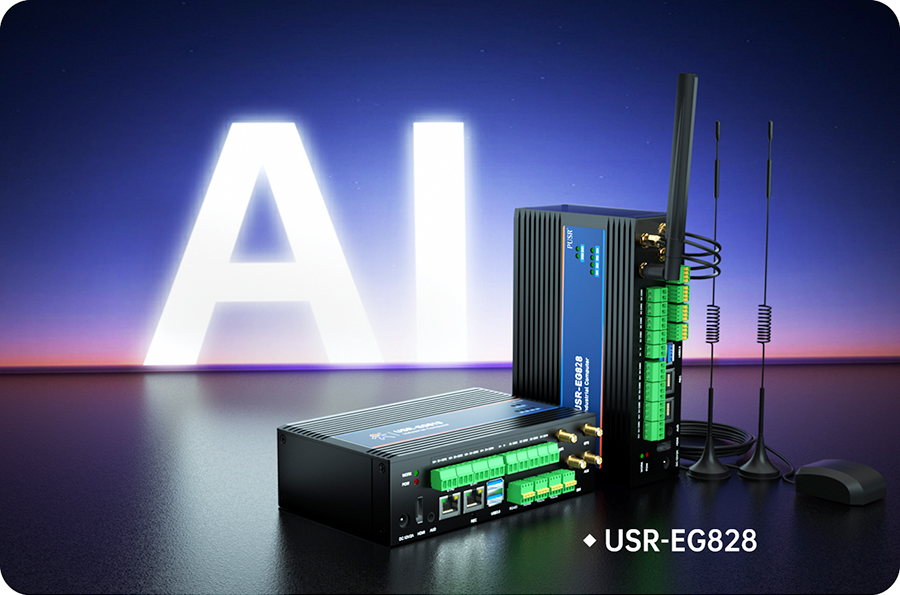
For centralized management of 200 intersections, the USR-EG828 industrial mini PC serves as a core hub with "small size, big power":
High performance: 4GB DDR4 memory + 32GB eMMC storage, supporting 4K video decoding for multi-device access.
Flexible expansion: Offers HDMI, LVDS, and other multimedia ports for multi-screen displays, adapting to various scenarios.
Open ecosystem: Pre-installed Ubuntu 20.04 and Docker support enable rapid integration of third-party algorithms.
Applications:
Legacy system upgrades: Compatible with existing signal controllers via protocol adapters, reducing upgrade costs.
New area deployments: Supports 5G/WiFi6 for wireless communication, cutting wiring costs and shortening construction cycles.
Emergency command: Built-in GPS/Beidou positioning quickly locates faulty devices, improving maintenance efficiency.
With digital twin and vehicle-road coordination technologies, traffic signal control will advance further:
Holographic intersections: Use lidar and cameras to build 3D digital models for millimeter-level perception.
Vehicle-road coordination: Communicate with vehicle terminals in real time, providing signal status and pedestrian awareness for L4 autonomous driving.
Autonomous decision-making: Reinforcement learning algorithms enable systems to optimize timing independently, reducing manual intervention.
When USR-EG828 industrial mini PCs operate steadily in signal cabinets at 200 intersections, traffic management logic is completely transformed—signal lights are no longer mechanical "red-green switches" but intelligent agents with perception, decision-making, and coordination capabilities. This change not only addresses efficiency, safety, and cost pain points but also shifts urban managers from "reactive response" to "proactive governance," paving a "digital road" for smart cities' future.
As a city traffic bureau director said, "Smart traffic isn't about showing off technology—it's about surviving and thriving in industry changes." When technology truly solves customer pain points, it becomes more than cold machinery—it becomes urban managers' most reliable partner.