Intelligent Livestock Farming: How Cellular WiFi Routers Solve the "Last Mile" Challenge in Animal Behavior Monitoring Data Transmission
Deep in the grasslands of Xilingol League, Inner Mongolia, herdsman Batel's flock of sheep is uploading real-time location and activity data via smart collars. However, a sandstorm three days ago disrupted base station signals, rendering monitoring equipment worth hundreds of thousands of yuan into mere "electronic decorations"—a common dilemma in China's push for intelligent livestock farming. As IoT technologies attempt to penetrate vast pastures and dense breeding sheds, three core challenges—data transmission stability, equipment deployment flexibility, and network management convenience—are hindering industry development.
China's livestock industry is transitioning from traditional experience-driven to data-driven operations. According to the Ministry of Agriculture and Rural Affairs, by 2025, 67% of large-scale farms will have adopted smart equipment, yet 32% of these sites suffer from incomplete data collection (below 70%) due to network issues. In a pig farm with 10,000 head in Shandong, a ¥500,000 environmental monitoring system generates over 200 hours of monthly data gaps due to 4G dead zones. In Xinjiang's cotton-field pastures, GPS collar signal degradation in Gobi Desert results in grazing route tracking errors exceeding 3 kilometers.
Behind these pain points lie extreme demands on networking equipment in livestock scenarios:
Environmental Adaptability: Equipment must operate stably in temperatures ranging from -40°C in northeastern pastures to 50°C in southern pig pens, while withstanding high humidity, corrosive gases, and mechanical vibrations.
Network Redundancy: Single network modes (e.g., 4G-only) cover less than 40% of remote areas, while wired network installation costs reach ¥20,000 per kilometer.
Deployment Simplicity: Farm technicians often lack networking expertise, requiring "plug-and-play" equipment with remote management capabilities.
Data Security: Sensitive information like animal health data and breeding parameters must be protected against hacking and leaks.
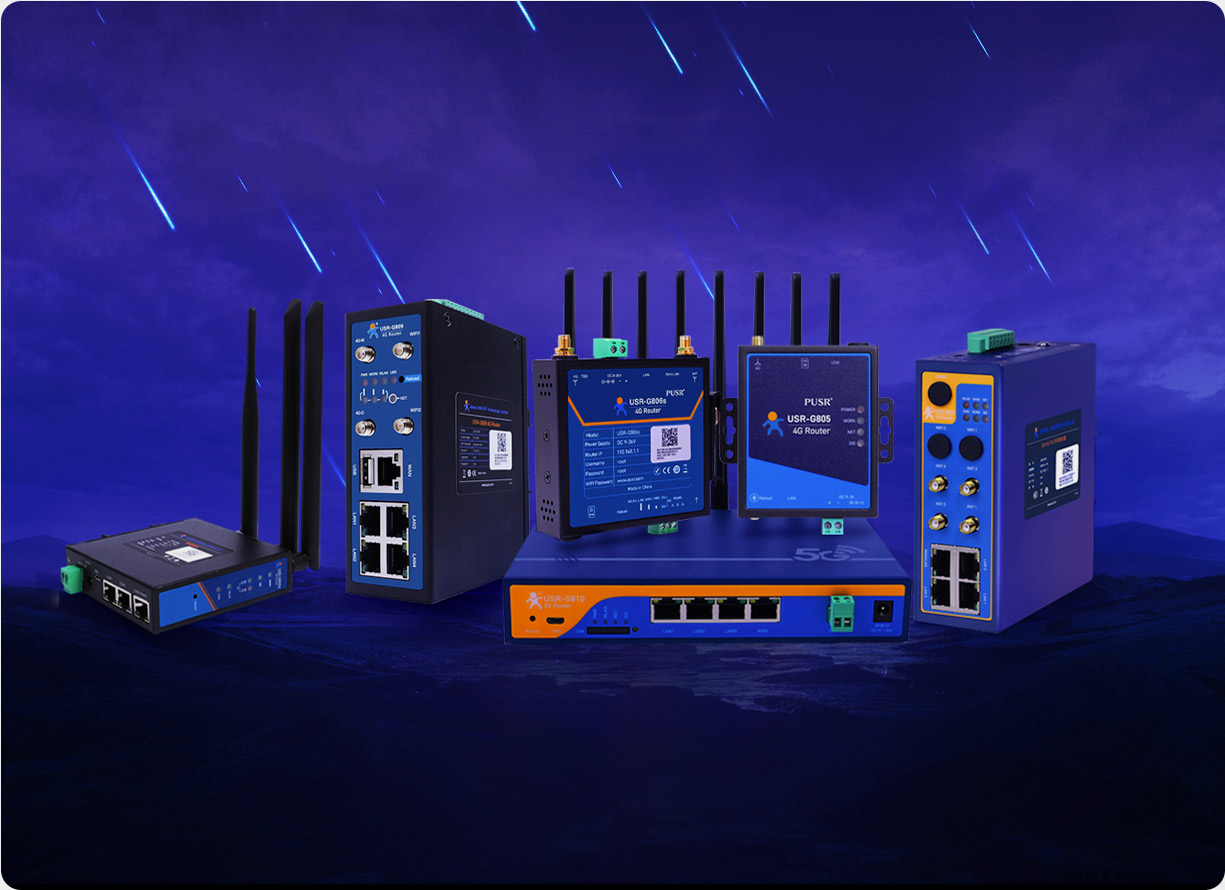
Traditional cellular WiFi routers frequently fail in livestock settings: A breeding enterprise using commercial routers for surveillance networks faced frequent reboots due to electrostatic interference, incurring over ¥100,000 in annual maintenance costs. Another pasture lost three consumer-grade 4G routers to summer heat. These failures spurred technological evolution toward "all-scenario adaptation"—represented by models like the USR-G806w, which is redefining connectivity standards for livestock IoT.
The USR-G806w features a fully metallic IP30-rated enclosure resistant to rain and sand, operates between -20°C and 70°C (ensuring reliability in Heilongjiang's winters and Hainan's summers), and includes reverse power protection and surge modules withstanding 3,000V electrostatic discharges and 6,000V electrical fast transient bursts. In a Gansu sheep farm, it operated fault-free for 180 days during sandstorms, achieving 99.7% data transmission success.
Its core innovation lies in multi-network intelligent switching:
Five-Mode Universal Connectivity: Supports 4G LTE (FDD/TDD), 3G, and 2G across all major carriers' frequency bands.
Triple-Link Backup: Ethernet, 4G, and Wi-Fi remain simultaneously active, with automatic failover to backup links (delay <200ms) when primary signal strength drops below thresholds.
eSIM Over-the-Air Programming: Built-in telecom SIM chips enable remote carrier plan switching, avoiding outages from single-carrier coverage gaps.
In a Sichuan mountain pasture, the USR-G806w used "4G + Wi-Fi relay" networking to transmit smart collar data to a hilltop relay station before 4G backhaul to the cloud, boosting data collection completeness from 62% to 98%.
Addressing farm technicians' limited networking knowledge, the device offers three simplified features:
Scan-to-Deploy: Adds devices via the "U-Cloud" platform scan, automatically generating visual network topologies.
Protocol Compatibility: Built-in Modbus and OPC UA industrial protocol converters enable direct connection to sensors and PLCs.
Remote Operations: Supports SSH, Web, and TELNET multi-platform management for remote status checks, firmware upgrades, and fault diagnostics.
In an Inner Mongolia dairy farm, technicians networked 20 smart collars and 5 environmental stations in 30 minutes—80% faster than traditional methods.
USR-G806w provides five-tier security for sensitive livestock data:
VPN Encryption Tunnels: Supports IPSec and OpenVPN to prevent public network interception.
Firewall Policies: Configurable IP blacklists/whitelists, port forwarding, and NAT/DMZ blocking unauthorized access.
SIM Card Locking: PIN-protected SIM cards prevent malicious removal/use.
Data Anonymization: Cloud platforms encrypt animal identifiers to prevent privacy leaks.
Audit Logs: Records all device operations and network access for compliance with China's Cybersecurity Classification Protection 2.0 standards.
Technological value must be validated through real-world applications. Below, we analyze how cellular WiFi routters drive productivity gains across three core scenarios: grazing management, precision feeding, and disease prevention.
In Xinjiang's Altay grasslands, the USR-G806w enables a "satellite + base station + LoRa" 3D monitoring network:
Smart Collars: Transmit sheep location and activity data via LoRa to relay routers.
Edge Computing: Router-embedded algorithms analyze data for abnormal behaviors (e.g., isolation, prolonged immobility).
Real-Time Alerts: When flocks approach pasture boundaries, the system sends APP alerts and activates electronic fence deterrents.
Route Optimization: Platform generates optimal grazing paths based on historical data, reducing overgrazing.
Post-implementation, the farm reduced sheep losses by 75%, improved pasture utilization by 30%, and cut management costs by 40% through reduced manual patrols.
In a Shandong pig farm with 10,000 head, the USR-G806w supports a "sensor + smart feeder + cloud platform" closed-loop system:
Data Collection: Barn sensors for temperature, humidity, and ammonia upload environmental data every 10 seconds via RS485 to the router.
Intelligent Decision-Making: Cloud platform generates personalized feeding plans based on pig weight, age, and environmental parameters.
Device Control: Router issues Modbus commands to smart feeders for dynamic feed quantity/frequency adjustments.
Feedback Loop: Weighing sensors monitor weight gain to optimize feeding models.
This approach improved feed conversion rates by 12%, shortened slaughter cycles by 8 days, and reduced disease transmission risks by 35% through minimized human intervention.
In a Hebei dairy farm, the USR-G806w enables a "wearable device + video surveillance + environmental monitoring" defense system:
Health Monitoring: Smart ear tags transmit cow temperature, rumination counts, and activity data via Bluetooth to the router.
Behavior Analysis: AI algorithms detect disease precursors (e.g., abnormal temperature spikes, reduced rumination).
Environmental Response: When ammonia levels exceed thresholds, the system activates exhaust fans and spray disinfection.
Quarantine Control: Electronic ankle tags restrict movement of suspected sick cows to prevent outbreaks.
Post-implementation, mastitis incidence dropped by 60%, veterinary drug use by 45%, and early warnings (72 hours prior) prevented mass culling losses.
When evaluating cellular WiFi routers, livestock users should assess adaptability across these dimensions:
Protection Rating: Prioritize IP30 or higher for dust/water resistance.
Temperature Range: Confirm operation between -40°C and 70°C.
Anti-Interference: Check EMC certification to avoid power equipment/agricultural machinery interference.
Multi-Network Support: Verify integration of 4G/5G, Wi-Fi, and Ethernet with carrier switching.
Transmission Latency: Prioritize edge computing-capable devices to reduce redundant data transfers.
Signal Enhancement: Check for high-gain antennas or external amplifier support.
Terminal Connections: Ensure single-device support for ≥50 sensors/controllers.
Protocol Compatibility: Verify Modbus, OPC UA, and other industrial protocol support.
Management Platform: Prefer cloud-based interfaces to simplify operations.
Total Cost of Ownership (TCO): Evaluate equipment prices, data costs, and maintenance expenses.
After-Sales Service: Confirm 24/7 technical support and remote area response times.
Case Validation: Prioritize brands with proven livestock deployments (e.g., USR-G806w used in multiple provincial modern agricultural parks).
Witnessing real-time smart collar data pulses on Inner Mongolia's grasslands, observing precision feed delivery in Shandong's pig barns, and sensing timely disease alerts in Hebei's dairy farms reveals a truth: intelligent livestock farming fundamentally breaks down data silos, enabling seamless information flow between fields and clouds. As the "nerve center" of this transformation, cellular WiFi routers must not only deliver robust technical performance but also deeply understand livestock scenarios—from insect-proof designs to salt-spray coatings, from livestock interface adaptations to breeding process integrations. Every detail determines technological success.
As demonstrated by USR-G806w in Xilingol League, when equipment adapts to grasslands like herders, senses animal needs like veterinarians, and orchestrates resources like managers, livestock farming's intelligent transition takes a critical step from "connection" to "empowerment." This step will ultimately converge into a mighty force driving China's agricultural modernization.