Smart Port Container Scheduling: ARM Industrial PC Support 5G+Edge Computing for Real-Time Decisions, Solving Industry Woes
At the automated terminal of Qingdao Port, in the monitoring room at 3 a.m., dispatcher Lao Zhang stares at the red alarm on the screen—due to a path conflict between the quay crane and the container truck, Berth No. 8 has been stalled for 12 minutes. Such scenarios are not isolated cases: 63% of port enterprises worldwide experience at least 3 operational interruptions per month caused by scheduling errors, with an average loss of 2 million yuan per incident. More critically, as port throughput grows at an annual rate of 5.8%, the fragility of traditional scheduling systems is accelerating its exposure.
At the Hairun Terminal of Xiamen Port, a 200,000-ton container ship requires the coordinated operation of 6 quay cranes and 36 container trucks. However, when unmanned container trucks (IGVs) and traditional container trucks coexist in a 300-meter-long operational area, any delay in one vehicle spreads like dominoes: quay cranes idle waiting, yard aisles become blocked, and the ship's time in port is extended. Data shows that in mixed traffic scenarios, the path planning accuracy of traditional scheduling systems is less than 65%, resulting in a 20%-30% decline in overall operational efficiency.
A tragic lesson occurred at a terminal in Tianjin Port: due to the scheduling system's failure to perceive the relative positions of the container truck and the quay crane in real-time, a 30-ton container fell, causing casualties and equipment damage. In a mixed environment of manned and unmanned operations, traditional scheduling systems rely on human experience to judge safe distances, but human reaction time (about 0.3 seconds) is far inferior to that of machines (milliseconds), leaving the port in a high-risk state.
A large port group invests 120 million yuan annually in upgrading its scheduling system, but the results are limited:
Hardware Redundancy: To cope with peak traffic, server configurations exceed actual needs by 300%, resulting in resource waste;
Data Silos: The data formats of TOS (Terminal Operating System), equipment management systems, and gate systems are not unified, requiring manual secondary entry;
Maintenance Costs: The failure rate of traditional industrial PCs is as high as 15% per year, with a single downtime repair cost exceeding 500,000 yuan.
Path dependence: Sticking with old systems avoids retraining costs.
High trial costs: Failure risks careers and KPIs.
Safety blame: Uncertainty over liability for AI errors.
Policy mandates: 60% automation by 2025 or lose subsidies.
Competition: Automated ports like Yangshan outperform traditional ones.
Customer demands: Delays cost millions in demurrage fees.
Traditional Wi-Fi/4G fail in ports due to high latency, low capacity, and poor reliability. 5G solves these with:
Ultra-low latency (<1ms) for remote crane control.
Massive connections (1M devices per cell).
Network slicing for isolated critical services.
Case Study: Guangzhou Port improved remote control success to 99.99% and efficiency by 35% with 5G.
Cloud-based systems suffer from delays, bandwidth issues, and security risks. Edge computing offers:
Local processing for millisecond responses.
Reduced data transfer (by 90%).
Enhanced security via on-site data storage.
Key Features:
Dynamic path planning using reinforcement learning.
Predictive maintenance with AI models.
Multi-vehicle coordination via V2X.
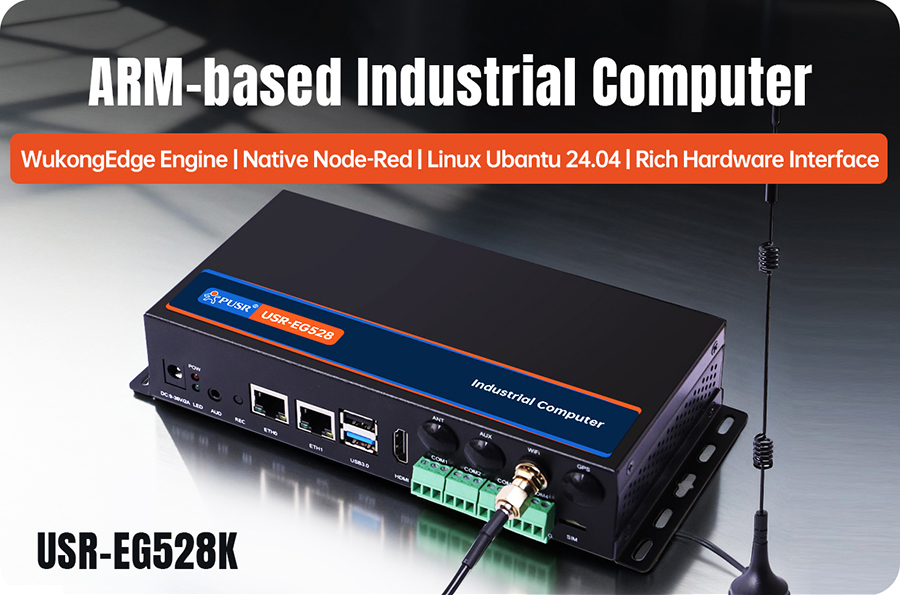
At Xiamen Port, the USR-EG528 drives intelligent scheduling with:
Fanless cooling for -30°C to 70°C operation.
Strong EMI protection for reliable data transmission.
Multiple interfaces for diverse device connections.
Lightweight AI for real-time object detection.
Time-series database for historical data analysis.
Low-code tools for custom algorithm development.
Protocol conversion for legacy systems.
Cloud synchronization via MQTT.
Digital twin support for scheduling simulation.
Results at Qingdao Port:
Truck wait times cut from 8 to 2 minutes.
Crane utilization increased from 68% to 85%.
Maintenance costs reduced by 60%, with zero scheduling accidents.
Advancements in 5G-A and 6G will enable:
Air-space-ground networks for drone monitoring.
Quantum encryption for secure communications.
Autonomous systems powered by large language models.
Conclusion: From Survival to Value Creation
With USR-EG528, ports like Xiamen now see smooth operations in digital twins, turning scheduling into a value driver. As one port leader said, "Smart scheduling isn’t about tech—it’s about surviving and thriving in change." When technology solves real problems, it becomes a trusted partner.