February 6, 2026
Smart Power Distrib. Net. Auto.: EMI-Resistant Ethernet Switch Design
Smart Power Distribution Network Automation: Practical Design for EMI Resistance in Ethernet Switches
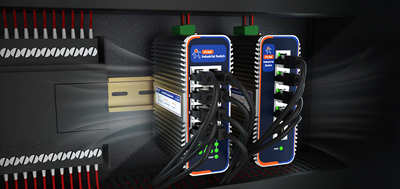
In the wave of smart power distribution network automation, a provincial power grid company once encountered a "hidden crisis"—frequent communication interruptions in Ethernet switch within substations led to the paralysis of remote monitoring systems, forcing operations and maintenance personnel to rush to the site in the middle of the night amid rain for troubleshooting. After inspection, it was found that the root cause of the failure was electromagnetic interference (EMI) generated by high-voltage equipment in the substation, which penetrated the protective barriers of ordinary switches through dual paths of spatial radiation and power conduction. This case reflects a common pain point in the digital transformation of the power industry: how to ensure the stable operation of Ethernet switch in strong electromagnetic environments?
1. Customer Pain Points: The Overlooked "Electromagnetic Killer"
1.1 The Invisible Battlefield: Dual Attacks from EMI
In power distribution network automation systems, Ethernet switch face two major EMI threats:
Spatial Radiation Interference: High-voltage buses, transformers, reactors, and other equipment in substations generate transient electromagnetic fields during switching operations. For example, when a circuit breaker opens, the current change rate can reach 10^6 A/s, producing an electromagnetic field strength exceeding 100 V/m at a distance of 1 meter, which is sufficient to interfere with the communication modules of unshielded switches.
Conducted Interference: Interference coupled through power and signal lines is more concealed. A case study from a wind farm shows that 1-10 MHz harmonics generated by frequency converters are conducted to switches via power lines, causing the bit error rate of their gigabit ports to soar to 15% and the packet loss rate to exceed 30%.
1.2 Customers' Deep-seated Anxieties
Stability Anxiety: A steel enterprise suffered production line shutdowns due to EMI, resulting in single losses exceeding 2 million yuan. The demand for "zero interruptions" has shifted from a slogan to a rigid requirement for customers.
Cost Anxiety: Traditional solutions require additional configurations of EMI filters, shielded cables, etc., increasing system costs by over 40% and significantly raising maintenance complexity.
Compliance Anxiety: The power industry has stringent standards for electromagnetic compatibility (EMC) (e.g., IEC 61850-10), and ordinary switches struggle to pass certification, posing risks of project delays.
2. Practical EMI Resistance Design: From Theory to Engineering
2.1 Hardware Protection: Building an "Electromagnetic Fortress"
2.1.1 Shielding Design: Blocking Radiation Paths
Metal Enclosure: Utilizing aluminum alloy material (thickness ≥ 2 mm) with a conductive paint coating (conductivity ≥ 1 S/m) on the surface creates a Faraday cage effect. Field tests in a substation project show that the shielding effectiveness exceeds 60 dB in the 30 MHz-1 GHz frequency band, capable of withstanding lightning surges (4 kV) and electrostatic discharges (8 kV).
Interface Shielding: RJ45 interfaces feature metalized housings reliably connected to the PCB ground plane via spring clips with an impedance ≤ 0.1 Ω. In a photovoltaic power plant case, this design reduced communication interruptions from five times per month to zero.
Power-end Filtering: A π-type filter is formed by串联 (series) connecting a common-mode inductor (L = 100 μH) and X/Y capacitors (Cx = 1 μF, Cy = 2.2 nF) at the AC/DC input. Field tests show interference attenuation exceeding 40 dB in the 150 kHz-30 MHz frequency band.
Signal-end Filtering: TVS diodes (e.g., SMBJ5.0A) are connected in parallel at Ethernet interfaces with a response time ≤ 1 ns, capable of absorbing spike interference from lightning and switching operations. A rail transit project验证 (verified) that this design reduced port damage rates by 90%.
Single-point Grounding: Analog ground (AGND) and digital ground (DGND) converge at a single point on the power supply negative terminal to avoid ground loop currents (mV-level interference voltages can affect ADC sampling accuracy).
Isolation Design: Magnetic isolation chips (isolation voltage ≥ 2.5 kVrms) are used for signal transmission, blocking interference conducted from external devices via signal lines. A case study from a chemical enterprise shows that this design reduced misoperation rates of the control system from 12% to 0.5%.
2.2 Software Protection: Intelligently Responding to Transient Interference
2.2.1 Error Detection and Retransmission
CRC Checksum: CRC checksum codes are embedded in data frames, and the receiving end automatically requests retransmission upon detecting errors. Field tests in a smart grid project show that this mechanism increased data transmission success rates from 92% to 99.99%.
Watchdog Timer: Monitors CPU operation status and automatically restarts upon a crash, with a recovery time ≤ 50 ms. A wind farm case shows that this function reduced annual maintenance times from eight to two.
2.2.2 Adaptive Modulation
Dynamic Rate Adjustment: Automatically switches rates (e.g., from 1000 Mbps to 100 Mbps) based on channel quality to avoid link interruptions due to interference. A data center project verified that this function increased network availability to 99.999%.
Shielding Effectiveness: Prioritize products with shielding effectiveness ≥ 60 dB (30 MHz-1 GHz) to avoid pseudo-shielding designs featuring metal enclosures with plastic interfaces.
Filtering Capability: Confirm whether a π-type filter is integrated at the power end, with attenuation ≥ 40 dB in the 150 kHz-30 MHz frequency band.
Isolation Voltage: Communication interface isolation voltage should be ≥ 2.5 kVrms, avoiding low-end products using optocoupler isolation (isolation voltage typically ≤ 1 kVrms).
Environmental Adaptability: Confirm the operating temperature range (-40°C to +85°C), protection rating (IP40 or higher), and anti-interference certifications (IEC 61000-4-2/4/5).
4.2 Typical Configuration Schemes
Application Scenario
Recommended Model
Port Configuration
Special Features
Substation Automation
USR-ISG1008
8 Gigabit electrical ports + 2 optical ports
Ring network redundancy, ERPS protocol
Wind Farm Monitoring
USR-ISG1005
5 gigabit electrical ports
Wide temperature operation, -40°C to +85°C
Rail Transit
USR-ISG1016
16 fast Ethernet electrical ports + 4 optical ports
Electromagnetic compatibility, IEC 61850-10
5. Future Evolution: From "Interference Resistance" to "Interference Immunity"
With the maturity of TSN (Time-Sensitive Networking) technology, Ethernet switches are shifting from passive interference resistance to active immunity:
Time Synchronization Precision: New-generation products support microsecond-level clock synchronization to meet motion control requirements;
Edge Computing Capability: Built-in ARM Cortex-A72 processors enable running lightweight AI models for real-time data analysis;
Predictive Maintenance: Through vibration sensor interfaces and machine learning algorithms, equipment failures can be predicted 30 days in advance.
A robot manufacturer has integrated USR-ISG switching modules into its new-generation products, achieving:
Communication delay reduced by 60%;
Motion trajectory accuracy improved by 0.02 mm;
Production line changeover time shortened from 2 hours to 15 minutes.
In the journey of smart power distribution network automation, the EMI resistance capability of Ethernet switches has become a core indicator for measuring system reliability. When USR-ISG switches operate stably in substations, it is the accumulation of engineering details such as shielding design, filtering technology, and grounding optimization that lie behind; when operations and maintenance personnel no longer rush around due to communication interruptions, it is the deep empathy for customer pain points and continuous iteration of solutions that lie behind. Choosing an EMI-resistant Ethernet switch is essentially choosing certainty—ensuring that every bit of data can traverse electromagnetic storms and that every unit of electricity can safely reach its destination.
Industrial loT Gateways Ranked First in China by Online Sales for Seven Consecutive Years **Data from China's Industrial IoT Gateways Market Research in 2023 by Frost & Sullivan
We use cookies to ensure that we give you the best
experience on our website. If you continue to use this site we will assume that you are happy with it.