Software-Defined Cellular Gateway: How to Let Precision Machining Equipment Upgrade Its Functions Like a Smartphone
This is a question you've probably never seriously thought about.
But it's forcing you to make a decision right now.
Here's the scenario —
In 2021, you spent 1.2 million yuan on a five-axis CNC machining center. At the time, it was the most advanced equipment on the shop floor. Three years later, a client suddenly sends an email:
"Our new product next quarter requires real-time upload of machining data via OPC UA protocol. Can your equipment integrate with that?"
You freeze.
You contact the machine tool manufacturer. They say: sure, we can add a data acquisition module — 80,000 yuan, plus two weeks of downtime for retrofit.
You contact an automation supplier. They say: we can do it, but we'd need to add an industrial PC to the machine and write a custom communication program — six-week project timeline, starting at 150,000 yuan.
You do the math: 80,000 + 150,000 = 230,000 yuan. And that's just for "being able to connect."
Your 1.2-million-yuan machine needs an extra 230,000 yuan just to keep up with a client's protocol requirement.
What makes you even more anxious — you know this won't be the last time.
Tomorrow the client might want AI quality inspection. The day after, predictive maintenance. The day after that, MES integration for full-process traceability.
Every time requirements change, your equipment needs "surgery." Every surgery means downtime, money, and waiting.
Have you ever asked yourself:
Why can your phone still upgrade to the latest OS after three years, but your machine tool is "locked in" after three years?
Your smartphone can keep upgrading — not because the hardware changes, but because the software iterates.
The OS can be OTA-upgraded. New features come through apps. Today it's a camera phone; tomorrow you install an app and it becomes a thermometer.
Hardware stays the same. Functions change. That's the essence of "software-defined."
But what about the equipment on your shop floor?
There's a passage in Corvalent's article that fits perfectly here:
"Emerging technologies like AI, IoT, and cloud computing are being integrated into industrial PCs, transforming them into powerful tools capable of advanced data processing and real-time monitoring."
AI, IoT, and cloud computing are redefining industrial computing devices.
The question is — can your machine tool "digest" these new technologies?
Most of the time, the answer is: no.
Because the functions of traditional industrial equipment are "soldered" into the hardware. To add a new function, you need new hardware. To add new hardware, you need downtime for retrofit.
That's not an upgrade. That's a blood transfusion.
And that's exactly what a software-defined cellular gateway is designed to solve —
Let your precision machining equipment, just like a smartphone, gain new capabilities without changing hardware — just upgrade the software.
Many people hear "software-defined" and think it's a vague concept.
Let's break it apart.
The traditional industrial equipment architecture looks like this:
Sensor → Dedicated Controller → Dedicated Communication Module → Host Computer
Every layer is dedicated hardware. Change the sensor, change the controller. Change the communication protocol, change the module. Want AI? Add an AI card.
Every new function adds a hardware layer. Every hardware layer adds a failure point, a maintenance cost, and a downtime retrofit.
Nalarobot's selection guide puts it plainly:
"Not every Industrial PC meets the necessary standards. Many fall short in performance or fail in challenging environments."
Not every industrial PC can keep up with change. Many devices "fall behind" at the very first requirement change.
The software-defined cellular gateway architecture looks like this:
Sensor → 【Software-Defined Cellular Gateway】 → Cloud / MES / SCADA
All protocol conversion, data processing, AI inference, and communication adaptation — all implemented in software inside this one "cellular gateway."
Protocol needs to change? Upgrade the software.
Need AI quality inspection? Install an AI model.
Need to connect to a new MES system? Change the configuration.
Need to support a new communication protocol? OTA push.
Hardware stays still. Functions change. Just like your phone.
Eurocoin's article mentions a key insight:
"Customization is often required, but many suppliers enforce high minimum order quantities. Choosing the right industrial PC supplier allows you to balance customization with cost efficiency."
Customization is necessary, but traditional customization costs too much.
That's where software-defined delivers its value: it moves "customization" from the hardware layer to the software layer. You don't need to customize a new device for every new requirement — you just need to "install a new app" on your cellular gateway.
I know what you're thinking.
"I get the theory, but my shop floor won't let me mess around."
That's the most real pain point.
Let's recreate a typical day on a precision machining shop floor:
| Scenario | Your Real Feeling | The Selection Dilemma Behind It |
|---|---|---|
| Client suddenly demands OPC UA data upload | "Here we go again — last time it was Modbus, now OPC UA" | Every protocol change means downtime; every downtime means money |
| Boss says to add AI quality inspection | "AI? I can't even collect all the data — what would I do AI on?" | Traditional controllers have no compute power; adding an AI card means hardware changes |
| New equipment needs MES integration | "This machine's controller is ten years old — it doesn't even have an Ethernet port" | Old equipment isn't incapable of networking — it just doesn't have the "brain" to translate |
| Shop floor wants predictive maintenance | "Vibration data exists, but who analyzes it? Can the industrial PC even handle it?" | Traditional industrial PCs either lack compute power or have too-high maintenance costs |
See the pattern?
Your shop floor doesn't lack equipment. What it lacks is a "changeable" middle layer.
A middle layer that lets old equipment speak new protocols.
A middle layer that lets old machine tools run AI.
A middle layer that lets all equipment uniformly connect to MES.
That middle layer is the software-defined cellular gateway.
And when selecting one, what are you most afraid of?
According to industry data cited by Nalarobot:
"Over 65% of organizations cite long-term reliability as a major factor in their purchasing decisions."
65% of organizations list "long-term reliability" as their #1 purchasing factor.
You're not afraid of "can it work today." You're afraid of "will it still work in three years?"
You're afraid that: today you install a cellular gateway, tomorrow the vendor stops updating it, the day after it doesn't support new protocols, and the day after that the vendor goes out of business.
You're not selecting a device. You're selecting a "partner" that can walk with you for five years.
Drawing on Eurocoin and Corvalent's selection logic, I've distilled the software-defined cellular gateway selection into five questions you must answer:
Your shop floor has Fanuc, Siemens, Mitsubishi, Heidenhain… every brand has different protocols.
If your cellular gateway only supports Modbus, you've only solved 10% of the problem.
What you need: OPC UA + MQTT + Modbus + Profinet + EtherNet/IP — full protocol coverage.
That way, no matter what protocol the client demands tomorrow, you don't touch the hardware.
The core of software-defined is "software is upgradable." But if the hardware compute power isn't enough, even the best software won't run.
What you need to check: Does the CPU support local AI inference? What's the compute power in TOPS? Can it run TensorFlow Lite or ONNX models?
Not every cellular gateway can run AI. Be sure to ask during selection.
This is the lifeline of "software-defined."
If your cellular gateway doesn't support OTA (over-the-air) upgrades, then "software-defined" is just empty talk.
What you need to confirm: Can firmware be updated remotely? Can AI models be pushed online? Can apps be deployed remotely?
A cellular gateway that can't do OTA is no different from a traditional industrial PC.
The environment of a precision machining shop is not an office.
Temperature: 40°C+ in summer, possibly -10°C in winter.
Humidity: coolant vapor, cutting fluid splashes.
Vibration: constant vibration from machine operation.
Dust: metal shavings, grinding dust.
Nalarobot's cited data stings:
"Around 21% of all equipment failures come from unsuitable environmental conditions."
21% of failures come from environmental mismatch.
What you need: fanless design, IP40+ protection, wide-temp operation (-40°C~75°C), vibration-resistant.
If the cellular gateway itself can't survive two years, how can you talk about long-term reliability?
This is the most easily overlooked — but most lethal — question.
Many cellular gateways have a product lifecycle of only 2–3 years. After 3 years, the vendor stops supplying, and your entire solution "runs out of food."
Eurocoin's article says it well:
"Selecting the right industrial PC requires balancing performance, durability, and long-term reliability."
What you need to confirm: How long will this product line be supplied? How long will firmware updates continue? How long will technical support continue?
Choosing a product that will still exist in three years is ten times more important than choosing the cheapest product today.
Framework covered. Let's talk product.
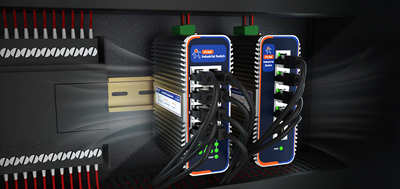
TheUSR-M300 cellular gatewayis one of the solutions I've seen with the highest match for the "software-defined precision machining" scenario.
I'm not saying it's the only choice. Selection always depends on your own site.
But if you go through those five questions one by one, the USR-M300's answers c:
| Must-Answer Question | USR-M300's Answer |
|---|---|
| Full protocol coverage? | OPC UA / MQTT / Modbus / Profinet / EtherNet/IP — Fanuc, Siemens, Mitsubishi, Heidenhain all covered |
| Can it run AI? | Local AI inference ≥8 TOPS, supports TensorFlow Lite/ONNX — AI quality inspection and predictive maintenance run directly on the cellular gateway |
| Can it do OTA? | Firmware OTA upgrades + AI model online push + app remote deployment — true "software-defined" |
| Can it survive the shop floor? | Fanless passive cooling, -40°C~75°C, IP40 protection, anti-corrosion coating — mounted directly next to the machine |
| Will it last? | Industrial-grade long lifecycle supply, same-architecture continuous iteration — not a "sell and disappear" consumer product |
The most critical point —
Its power consumption is <15W.
What does that mean?
It means you're not using a "power hog" to help you save power. You're using a device that costs less than 130 yuan/year in electricity to help you save hundreds of thousands every year.
There's a line in Corvalent's article I strongly agree with:
"Understanding your software requirements is essential when evaluating industrial PC hardware requirements."
Understanding your software requirements is the starting point of selection.
The design logic of the USR-M300 starts from "software requirements" —
It's not a "can do a little of everything" universal cellular gateway. It's a software-defined node that says:"Whatever your software needs, I can become that."
Let's go back to that opening scenario.
Client demands OPC UA protocol. You have two choices:
| Solution | Cost | Downtime | Future Upgrades |
|---|---|---|---|
| Traditional: Add dedicated module | 80,000–230,000 yuan | 1–2 weeks | Every upgrade repeats this process |
| USR-M300: Software upgrade | Cellular gateway deployment (~10,000–30,000 yuan/unit) | 0 downtime | OTA push, upgrade complete in 10 minutes |
If you have 40 machines and expect 5 functional upgrades over the next three years:
| Traditional Solution | USR-M300 Solution | |
|---|---|---|
| Initial deployment | 230,000 yuan | 120,000 yuan (40 × 3,000) |
| 5 upgrades | 5 × 230,000 = 1,150,000 yuan | 5 × 0 = 0 (OTA) |
| Downtime loss | 5 × 2 weeks × 40 machines = 400 machine-days | 0 |
| Three-year total cost | 1,380,000 yuan + downtime loss | 120,000 yuan |
1,380,000 vs. 120,000.
This isn't about "saving a little money." This is about "can you keep up with your clients."
I know what your last concern is.
"The concept is great, but my shop floor isn't a lab. I need something I can install today, use tomorrow, and still have working the year after."
That's exactly why I recommend the USR-M300.
It's not a "future concept." It's a real-world choice you can deploy today, upgrade tomorrow, and still be supplied the year after.
Eurocoin's article ends with:
"For OEMs and system integrators, investing in reliable industrial PC solutions ensures stable operation, reduced maintenance, and long-term cost efficiency."
For OEMs and system integrators, investing in reliable industrial PC solutions means investing in stability, low maintenance, and long-term cost efficiency.
And in the dimension of "software-defined," what the USR-M300 gives you isn't a device. It's a platform that can "grow up" with your business.
Your CNC doesn't need replacing.
Your protocols don't need rewriting.
Your AI doesn't need extra hardware.
You just need the right cellular gateway — and let the software do the rest.
Just like your phone —
Hardware stays the same. Functions never get obsolete.