A New Engine for Container Scheduling in Smart Ports: The Collaborative Breakthrough of 5G + MEC Edge Computing and industrial LTE router
Against the backdrop of continuous growth in global trade, China's port throughput has consistently ranked among the top in the world for many years. However, traditional port operation models are facing severe challenges: container scheduling relies on manual experience, resulting in inefficient equipment collaboration; massive amounts of data need to be transmitted back to the cloud for processing, leading to decision-making delays due to network latency; multiple systems exist as isolated data islands, lacking precise support for resource allocation. A large port once experienced an increase of 4 hours in daily container detention time due to response delays in its scheduling system, resulting in direct economic losses exceeding one million yuan. In this context, the integrated deployment of 5G + MEC edge computing and industrial LTE router is emerging as the core solution to address the challenges of container scheduling in smart ports.
Port operations involve more than ten types of heterogeneous systems, including terminal operating systems (TOS), equipment management systems (EMS), and logistics tracking systems (LTS). The inconsistent data formats and naming conventions hinder information flow. For example, a port once experienced scheduling conflicts between quay cranes and container trucks due to data asynchrony between TOS and EMS, causing a 3-hour operational halt in a single incident.
Under traditional architectures, data such as container locations and equipment statuses need to be uploaded to the cloud for analysis before control instructions are sent back. Before the coverage of 5G networks, actual measurements at a port showed that the end-to-end latency from data collection to instruction issuance exceeded 200ms, failing to meet the real-time control requirements of automated quay cranes (industry requirement ≤ 50ms).
Manual scheduling relies on empirical judgment and cannot dynamically optimize equipment paths and task assignments. Survey data from a port revealed that, under traditional models, the idle running rate of container trucks reached 35%, and the waiting time for quay cranes accounted for 22%, directly increasing the cost per container operation by 18%.
The 5G + MEC solution deploys edge computing nodes (MECs) locally at ports,sinking tasks such as data preprocessing and AI algorithm inference to the network edge. Its core architecture consists of three layers:
Perception Layer: Connecting quay cranes, container trucks, sensors, and other equipment via 5G industrial LTE router to achieve multi-protocol data collection (supporting over 150 industrial protocols such as Modbus and OPC UA);
Edge Layer: The MEC platform integrates lightweight AI models (e.g., TensorFlow Lite) to analyze equipment status, container locations, and other data in real time, generating optimized scheduling instructions;
Application Layer: Interfacing with systems such as TOS and EMS to provide applications such as 3D visual scheduling dashboards and intelligent path planning.
Data Integration: The MEC platform standardizes data formats and interface standards, breaking down system barriers. For example, Shandong Port Technology achieved millisecond-level data queries by deploying the TDengine time-series database, supporting real-time monitoring and anomaly warnings;
Low-Latency Control: 5G network slicing technology allocates dedicated resources for scheduling instructions, combined with local MEC processing, compressing end-to-end latency to within 20ms. Actual measurements at SDIC Jingtang Port showed that after the deployment of 5G + MEC, the response time for remote control of quay cranes decreased from seconds to milliseconds;
Intelligent Optimization: Reinforcement learning-based scheduling algorithms dynamically match optimal equipment paths. A case study at an electronics factory demonstrated that AI predictive maintenance models reduced equipment downtime by 42% and improved scheduling efficiency by 30%.
As the bridge between equipment and the MEC platform, industrial LTE router need to possess three capabilities:
Multi-Protocol Adaptation: Supporting industrial protocol conversions such as Modbus RTU/ASCII and OPC UA to be compatible with legacy equipment;
Edge Computing: Integrating lightweight AI chips to enable localized data processing (e.g., equipment anomaly detection and data compression);
Security Protection: Supporting functions such as VPN encryption, firewalls, and access control to ensure secure data transmission.
Remote Quay Crane Operation: Connecting quay crane PLCs to the MEC platform via 5G industrial LTE router to enable "one-person, multiple-machine" operation. In a case study at SDIC Jingtang Port, after operators were relocated from the field to the scheduling center, the labor cost per quay crane decreased by 60%;
Intelligent Container Truck Scheduling: The router collects data such as GPS, speed, and battery level from container trucks, and the MEC platform dynamically plans paths based on stream computing. Actual measurements by Shandong Port Technology showed that AGV scheduling efficiency improved by 50%-70%, and logistics turnover time decreased by 30%;
Safety Warning System: The router connects devices such as wind speed sensors and cameras, and the MEC platform analyzes the data in real time to automatically trigger alarms. For example, when wind speeds exceed safety thresholds, the system sends warning messages within 1 minute to ensure safe operations in adverse weather conditions.
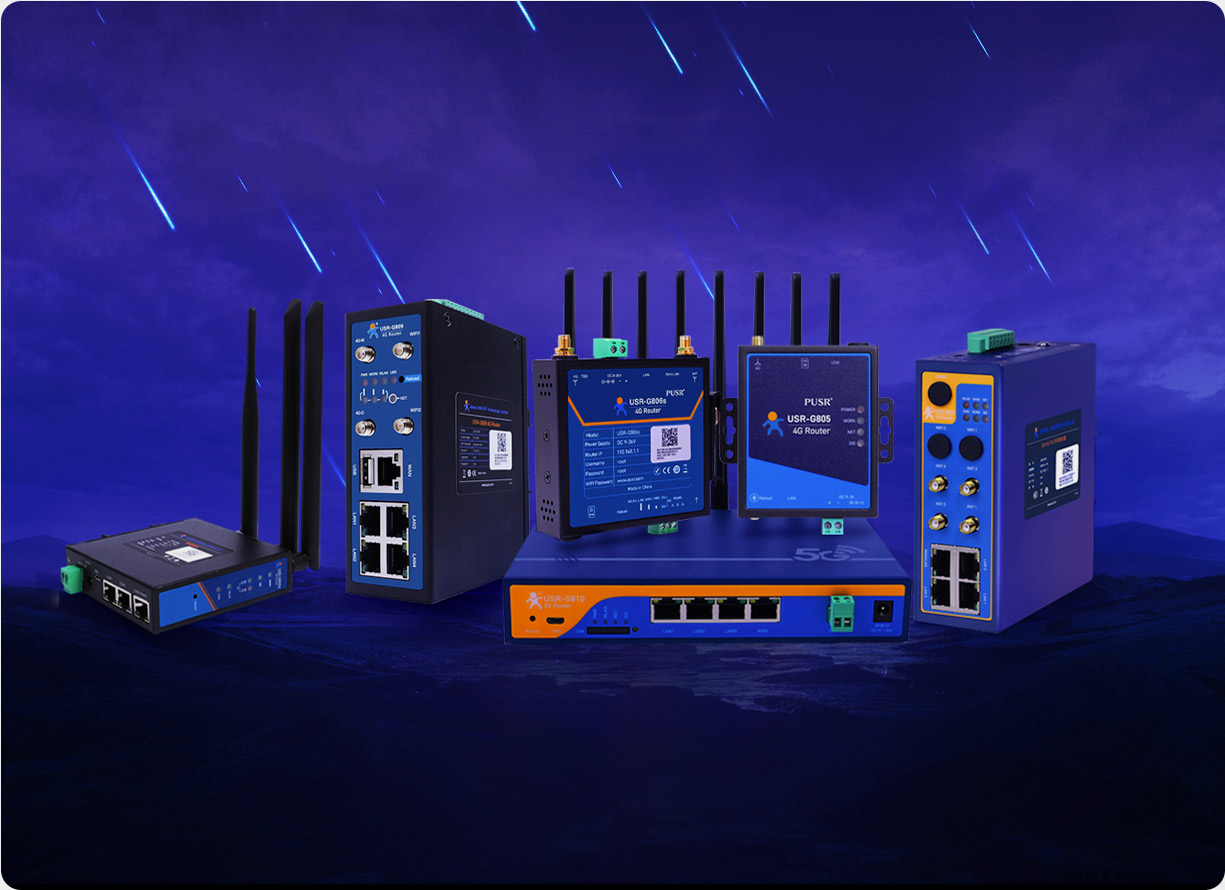
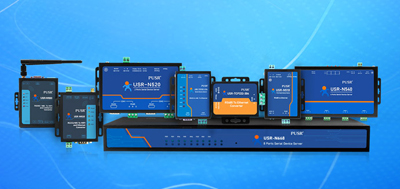
Among numerous industrial LTE router, the USR-G809s has become the preferred solution for port customers due to its stability and functional integration:
Fully Industrial Design: Metal casing (IP30 protection), wide operating temperature range (-40°C to 75°C), and electromagnetic interference resistance (EMC Level 3 filtering) to adapt to the high-temperature, high-humidity, and high-vibration environments of ports;
Multi-Network Integration Capability: Supporting multi-standard access such as 5G/4G/Wi-Fi and compatible with SA/NSA dual-mode 5G networks to ensure stable connections in complex scenarios;
Protocol Conversion and Edge Computing: Built-in Modbus to MQTT conversion function, supporting the deployment of lightweight AI models to enable localized preprocessing of equipment data and reduce cloud load;
Security and Operations and Maintenance: Supporting VPN encryption, firewalls, and the USR Cloud Management Platform to provide functions such as remote configuration and fault diagnosis, reducing operations and maintenance costs.
Case Study: Blast Furnace Monitoring Project at a Steel Plant
After deploying the USR-G809s, temperature sensor data from the blast furnace body was uploaded in real time to the MEC platform via a 5G network, combined with AI algorithms to predict temperature anomalies. After the system went live, the accuracy of fault warnings increased to 98%, equipment downtime due to high temperatures decreased by 70%, and annual maintenance costs were reduced by over 2 million yuan.
Select 1-2 key scenarios (e.g., a single quay crane or specific container truck routes) for pilot testing, focusing on verifying:
5G network coverage quality (measured signal strength ≥ -85dBm);
MEC platform processing capacity (supporting the processing of 100,000 pieces of equipment data per second);
Optimization effects of scheduling algorithms (reducing the idle running rate of container trucks by ≥ 15%).
Network Construction: Deploy 5G macro base stations and indoor distribution systems to cover terminals, yards, and warehousing areas;
MEC Platform: Adopt containerized deployment to support elastic scaling and meet future business growth needs;
System Integration: Open API interfaces with systems such as TOS and EMS to achieve data interconnection and interoperability.
Establish a digital twin model of the port to train AI scheduling algorithms using historical data;
Regularly evaluate metrics such as scheduling efficiency and equipment utilization to dynamically adjust optimization strategies;
Explore the application of new technologies such as 5G RedCap and TSN to further reduce latency and costs.
With the deep integration of 5G and edge computing, port scheduling systems are evolving from "automation" to "autonomy." In the future, digital twin ports will become a reality: through 3D simulation and real-time data mapping, scheduling personnel can "see the entire picture at a glance" to achieve optimal resource allocation; vehicle-road collaboration technology will further optimize the collaboration efficiency between container trucks and quay cranes, driving ports toward the goals of "zero waiting, zero accidents, and zero emissions."
At this moment, do you wish to bid farewell to the "experience-driven" era of port container scheduling?
The USR-G809s industrial LTE router has validated its value in multiple ports across the country, from steel plants in cold northern regions to coastal hub ports. We offer customized solutions and 7×24-hour technical support. Click the button to have a one-on-one conversation with experts from PUSR, obtain an exclusive industry white paper, and receive a free product trial. Let 5G + MEC edge computing become the "acceleration engine" for your port's digital transformation!