The Impact of Antenna Material on Signal Transmission in PUSR Industrial VPN Router: In-Depth Analysis and Selection Guide
In industrial IoT scenarios, the stability of wireless signals directly determines equipment collaboration efficiency, data acquisition accuracy, and production safety levels. However, complex environments such as metal shelving, large motors, and high-frequency electromagnetic interference often lead to issues like signal attenuation, high packet loss rates, and latency fluctuations in traditional routers. As a core component in industrial communication, the choice of antenna material often becomes the key to breaking through signal transmission bottlenecks. This article will systematically analyze the impact of antenna materials in PUSR industrial VPN router on signal transmission from the perspectives of material science, electromagnetic field theory, and real-world engineering cases, providing enterprises with a basis for selection decisions.
As the "converter" in wireless communication systems, the core function of an antenna is to convert electromagnetic wave energy into electrical current signals and vice versa. The physical properties of the material (such as conductivity, magnetic permeability, and surface roughness) directly affect the antenna's radiation efficiency, directivity, and anti-interference capabilities, thereby determining the coverage range, penetration power, and stability of signal transmission.
According to electromagnetic field theory, the radiation efficiency of an antenna is positively correlated with the material's conductivity. High-conductivity materials (such as copper and silver) can reduce current transmission losses, allowing more energy to be converted into electromagnetic wave radiation. For example:
Engineering Case: A car manufacturing plant using traditional routers with steel antennas experienced a signal strength of -75dBm at a distance of 30 meters. After switching to copper antennas, the signal strength improved to -62dBm, and the packet loss rate dropped from 12% to 2%.
Magnetic permeability (μ) determines the antenna's ability to respond to magnetic fields. High-magnetic-permeability materials (such as ferrites) can enhance the antenna's absorption of magnetic fields in specific directions, thereby optimizing directivity and reducing multipath interference. For example:
Engineering Case: A logistics warehouse using PUSR USR-G809s routers with ferrite-loaded antennas achieved seamless signal coverage in dense shelving areas, reducing AGV navigation positioning errors from ±50mm to ±10mm.
Humidity, salt spray, and chemicals in industrial environments can corrode antenna surfaces, leading to a decrease in conductivity. For example:
Engineering Case: An offshore oil platform using PUSR routers with gold-plated antennas experienced no signal attenuation over 5 years of continuous operation in extreme environments with temperatures ranging from -40°C to +70°C and humidity at 95%.
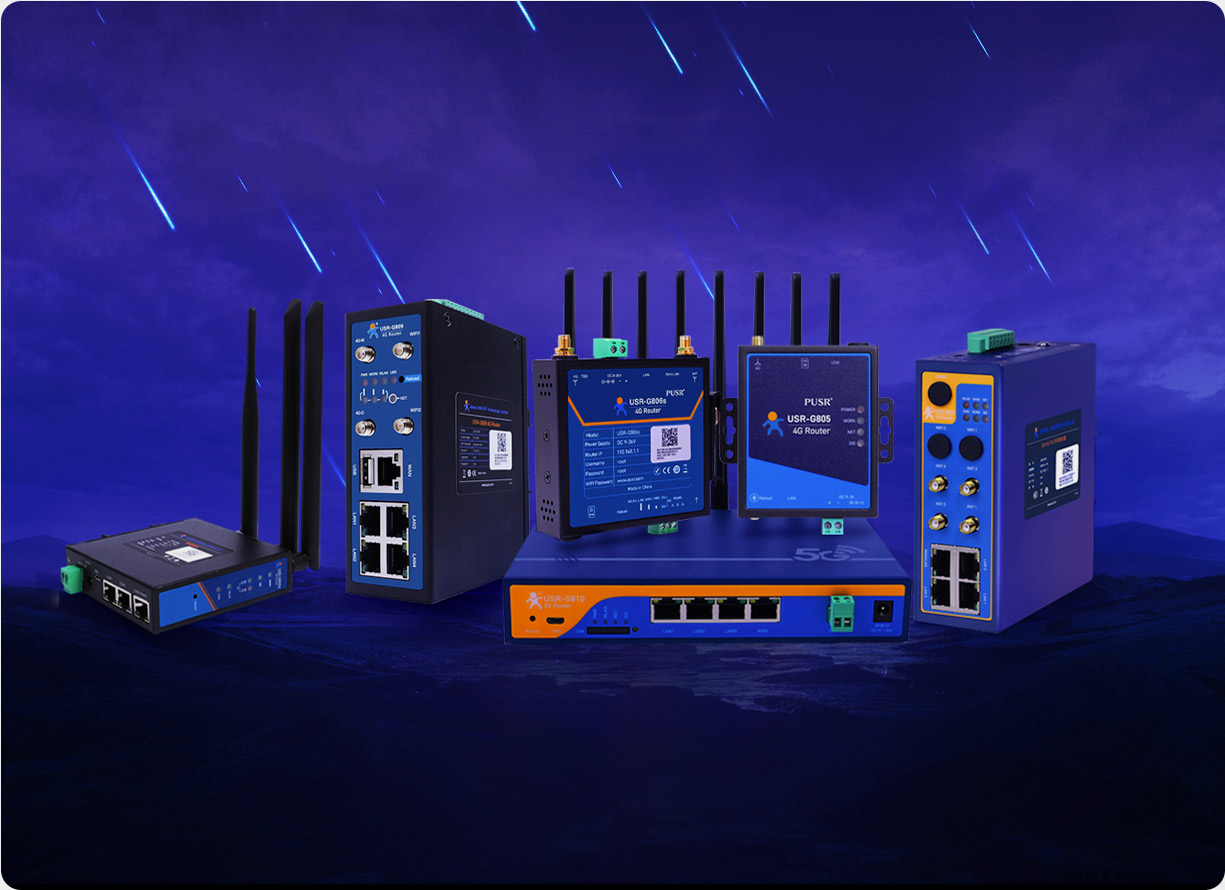
As a leading brand in industrial communication, PUSR integrates the latest advancements in material science, electromagnetic simulation, and manufacturing processes into its antenna design. Taking the 4G industrial VPN router USR-G809s as an example, its antenna system adopts "copper-based composite material + ferrite loading" technology, achieving a qualitative leap in signal transmission performance.
The antenna body of the USR-G809s uses a copper-based composite material (with a copper content of ≥95%). Through nanoscale grain refinement technology, the conductivity is increased to 5.8×10⁷ S/m, approaching the level of pure copper, while the weight is reduced by 30%, facilitating installation on mobile devices or in space-constrained scenarios.
On the surface of the antenna's radiation elements, PUSR applies a micron-scale ferrite coating. By optimizing the coating thickness (0.1mm) and distribution through electromagnetic simulation, the following effects are achieved:
The antenna housing of the USR-G809s features an IP67-rated protective design, with a three-proofing coating (moisture-proof, salt spray-proof, and corrosion-proof) applied to the surface. It has passed high- and low-temperature cycling tests ranging from -40°C to +85°C, ensuring long-term stable operation in harsh environments such as chemical plants and power stations.
When selecting antenna materials for industrial VPN routers, enterprises need to consider factors such as transmission distance, environmental interference, device mobility, and cost. The following are selection recommendations for typical scenarios:
As PUSR's flagship product, the 4G industrial VPN router USR-G809s not only achieves technological breakthroughs in antenna materials but also provides a full-scenario solution for industrial IoT through "5G + Wi-Fi 6 + LoRa" triple-mode communication, edge computing, and high-precision synchronization technology. Its core advantages include:
Typical Application Scenarios:
The optimization of antenna materials represents not only progress in material science but also a key step in the transition of industrial communication from "connection" to "intelligence." Through the innovative application of copper-based composite materials, ferrite loading, and three-proofing processes, PUSR has endowed industrial VPN routers with stronger environmental adaptability, more precise directivity, and more stable signal transmission capabilities. For enterprises, choosing the USR-G809s means not only selecting a high-performance router but also opting for a full lifecycle solution covering design, deployment, and operations and maintenance.