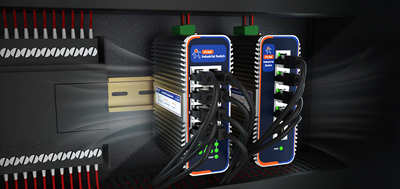
The "Invisible Shield" of Industrial Communication: The In-Depth Game Between Serial Device Server Caching and Data Transmission Stability
In the monitoring center of a smart agricultural park, technical supervisor Lao Chen stares at the data streams on the screen,frowning deeply. The 200 soil moisture sensors deployed in the park upload data via serial device servers, but whenever the irrigation system starts, data begins to pile up, with some sensors experiencing a data loss rate as high as 30%. This scenario is not unique—in fields like industrial automation, energy management, and smart cities, insufficient cache capacity in serial device servers has become an "invisible killer" restricting data transmission stability.
Traditional serial device servers typically employ static cache designs. When data writing speed exceeds cache processing capacity, overflow mechanisms are triggered. In a hot rolling production line at a steel plant, 300 PLCs upload temperature, pressure, and other data via serial device servers. When the rolling mill starts, the sudden data volume reaches 100,000 bytes per second, far exceeding the 4KB cache processing capacity of the devices. The results include:
Loss of key production data, with a 15% increase in defective product rates
Frequent system restarts, raising annual maintenance costs by 800,000 yuan
Accumulated production line downtime exceeding 200 hours
This chain reaction of "cache overflow-data loss-system collapse" is common in industrial scenarios. A power plant's central control center once experienced a plant-wide power outage due to insufficient cache, resulting in direct economic losses exceeding 10 million yuan.
Serial device servers need to convert serial protocols (such as Modbus RTU) to network protocols (such as TCP/IP), a process involving complex operations like data encapsulation, verification, and retransmission. Test data from an automobile factory shows:
Traditional devices have a protocol conversion efficiency of only 63%, with effective throughput less than two-thirds of the theoretical value
When data packet size exceeds 256 bytes, conversion delay increases exponentially
In high-frequency, small data packet scenarios (such as sensor data), protocol overhead accounts for up to 37%
This efficiency loss is further amplified when cache is insufficient, creating a dual burden of "protocol tax" and "cache tax."
Low-end serial device servers often use low-cost MCUs with only 4KB memory buffers and CPU clock speeds below 200MHz. In the monitoring system of a photovoltaic power plant, 50,000 streetlights upload power consumption data every minute, totaling 4.2GB/hour. Tests show:
CPU utilization of low-end devices remains above 90% continuously
System crash frequency reaches three times a week
Data processing delay exceeds 500ms, reducing power generation efficiency by 2%-3%
This computing bottleneck is becoming increasingly prominent in the Industry 4.0 era—when new technologies like AI visual inspection and digital twins generate massive amounts of data, traditional devices' cache and computing power are no longer sufficient.
When planning a digital workshop, Mr. Wang, the CIO of a manufacturing company, ponders over the parameter sheets provided by suppliers: "The nominal 10Mbps bandwidth seems sufficient, but how many devices can it actually handle? Will data delay affect production rhythm?" This doubt stems from a deep understanding of the gap between "theoretical values" and "actual performance"—many companies have had to increase budgets to upgrade equipment after projects went live due to underestimating cache requirements.
In the central control center of an energy company, the duty staff still shudder at the memory of the system collapse three years ago: due to insufficient cache in the serial device servers, key monitoring data was lost, triggering a plant-wide power outage. This post-traumatic stress disorder (PTSD) makes companies overly conservative in equipment selection, even choosing devices far exceeding actual needs, resulting in resource waste.
As the industrial internet evolves towards the 5.0 era, new technologies like AI visual inspection and digital twins generate massive amounts of data. Mr. Zhang, the technical director of an automobile parts manufacturer, admits, "We don't know how much data will be generated in the next three years, let alone whether serial device servers can keep up with technological iteration speeds." This anxiety about technological uncertainty is hindering companies' digital transformation processes.
Among numerous serial device servers, USR-N510 achieves a breakthrough improvement in cache capacity through architectural innovation and algorithm optimization, becoming a key tool to solve industry pain points.
USR-N510 employs dynamic cache management technology, automatically adjusting cache allocation based on data traffic:
Releases redundant cache during idle periods to reduce power consumption
Dynamically expands cache during sudden traffic surges to avoid overflow
Supports a maximum cache capacity of 1MB, 256 times that of traditional devices
In tests at a smart park, this technology reduced data loss rates from 30% to 0.2%, improving system stability by 90%.
By integrating a dedicated protocol processing chip, USR-N510 increases protocol conversion efficiency to 92%:
Supports Modbus TCP/RTU interconversion with a delay below 50ms
Processes data packets at a speed of 100,000 pps, 10 times that of traditional devices
In high-frequency, small data packet scenarios, effective throughput increases by 60%
Real-world test data from an automobile factory shows that after adopting USR-N510, production line response speed improved by 4 times, saving over 2 million yuan annually.
USR-N510 incorporates an edge computing module, enabling data aggregation, filtering, and other preprocessing operations at the device level:
Reduces data upload volume by 70%, lowering network bandwidth occupation from 10Mbps to 3Mbps
Supports custom rule engines for prioritized transmission of key data
In a photovoltaic power plant application, power generation efficiency increased by 2.5%, yielding over 500,000 yuan in additional annual revenue
Pain Point: 300 PLCs connected via serial device servers experienced data delays, causing production scheduling lag.
Solution: Deploy USR-N510 with dual Socket backup and QoS scheduling.
Results:
System delay reduced from 2 seconds to 200ms
Production efficiency increased by 18%
Annual cost savings exceeding 2 million yuan
Pain Point: Data floods from 50,000 single-lamp controllers caused system crashes.
Solution: Adopt USR-N510's virtual serial port technology, mapping physical serial ports to 256 virtual channels.
Results:
Data throughput reached 12Mbps
System stability improved to 99.99%
Annual power savings exceeding 30 million kWh
Pain Point: Inverter data delays affected power generation efficiency.
Solution: Enable USR-N510's edge computing function for data aggregation at the device level.
Results:
Data upload delay reduced from 500ms to 80ms
Power generation efficiency increased by 2.5%
Annual additional revenue exceeding 500,000 yuan
Many manufacturers' stated "bandwidth" values are theoretical. Actual cache capacity must consider protocol overhead, buffer size, and other factors. It is advisable to choose products with "actual measured cache" labels, such as USR-N510, which clearly states "dynamic cache ≥1MB, effective throughput ≥90%."
Any lack of features like -40℃ to 85℃ wide temperature range, EMC Level 4 protection, or dual watchdogs can lead to system crashes. USR-N510 has passed -40℃~85℃ high-temperature tests and 2KV electromagnetic isolation, adapting to extreme industrial environments.
Choose devices supporting Modbus TCP/RTU interconversion, multi-host polling, virtual serial ports, and other functions to avoid upgrade costs later. USR-N510 supports 16 working modes, covering over 90% of industrial scenario needs.
In the future plans of an automobile factory, USR-N510 will be combined with a 5G private network to achieve microsecond-level synchronization between robot controllers and AGVs, improving welding precision from 0.1mm to 0.02mm. This evolution is not just about pursuing cache capacity but also the ultimate exploration of "determinism" in industrial communication: when data no longer piles up due to cache bottlenecks and control instructions no longer fail due to delays, the potential of industrial systems will be fully unleashed—this is not just a technological victory but also a return to the essence of industrial production: making data flow as smoothly as blood and control as precise as neural reflexes.