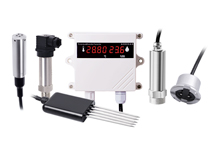
Water quality sensors sit beside the outfall, a level transmitter stands at the edge of the treatment tank, and gas probes outside the workshop sample the air around the process. In many sites the measurement points were installed long ago. The disagreement comes later: some of the data reaches the company's own reports, some stays inside the acquisition software, and by the time the connectivity acceptance arrives it turns out that environmental data has to reach the platform in a standard format — with no time left to rebuild the link.
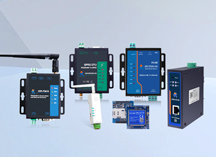
Connecting environmental monitoring equipment means clearing three gates: collecting everything, reporting it in the standard format, and keeping the link stable. The topology diagram for this application lays the structure out plainly — water quality, gas and level sensors at the bottom, an edge IoT gateway in the middle, an IoT platform at the top, and one capability on the gateway that is easy to overlook: support for connecting to environmental platforms over the HJ212 protocol. The sections below take the PUSR USR-N720 as the example.
Sensors used in environmental monitoring mostly expose RS485 with Modbus RTU. Before any wiring, build a point list: group the monitoring factors by discharge outlet — water quality in one group, gas in another, level and equipment status in a third — and record the register address and range for each. The USR-N720 provides two independent RS485 ports and one Ethernet port, and both serial ports can work at the same time, so sensors from different outlets or different batches can hang on separate buses, each with its own baud rate, without holding each other back. A single unit handles acquisition and edge computing for 1000 data points, which leaves ample headroom for the monitoring factors and status values of one site. Sampling intervals are best set by purpose: data reported to the platform follows the interval the platform requires, while trend data for production management is fine at one round every five to ten minutes, and there is no reason to run everything at the highest rate. Where a site also meters the power consumed by its environmental treatment equipment, the gateway collects DL/T645-2007 meter data on the same unit. One thing worth confirming early: a few older probes speak a proprietary protocol rather than Modbus, so the register map should be requested from the manufacturer before ordering, not after delivery.
This is where environmental monitoring parts company with ordinary data acquisition. HJ212 is the data transmission standard for pollutant online monitoring systems, and the version in force is the 2017 revision. It is a string protocol: a message consists of a header, the length of the data segment, the data segment itself, a CRC check and a trailer, while the parameters needed for the connection — the device identifier, the access password and so on — are issued by the platform. Handling the interface in-house means writing the message assembly, parsing and CRC work, which is rarely a short job. The USR-N720 is specified for connecting to environmental platforms over HJ212, so the conversion happens on the gateway and the platform simply receives data in the standard form. The same unit converts Modbus RTU/TCP to MQTT and reports in JSON, with the JSON fields customizable, so a company's own system can receive data in its own format instead of adapting to the gateway's.
The USR-N720 supports up to five connections: two TCP, two MQTT and one PUSR Cloud, and SSL/TLS encryption can be enabled on both the MQTT and TCP channels. A common arrangement runs two lines in parallel — one to the environmental platform, which satisfies the connectivity and reporting requirement, and one into PUSR Cloud for visual monitoring, alarm handling and private deployment. Staff who want to watch level trends, or be notified when a level goes too high, use the second line, and the two do not interfere. Sites without wired broadband can take the cellular version with 4G, which supports both Ethernet and cellular connections.

Monitoring points sit in awkward places, and network fluctuation is normal. Environmental data has one property that makes this matter: a gap in transmission is a missing record, and data that cannot be filled in afterwards is difficult to explain during acceptance or in a later review. The USR-N720 caches data to an SD card while offline and uploads it automatically once the link recovers. On reliability, there is a hardware and software watchdog, a metal housing, DC 9–36V wide input and a -40°C to +85°C operating range, in an 86 × 30 × 98.5 mm case that mounts on DIN rail or wall, leaving room for it in the corner of a control cabinet. The gateway is built on domestic core components and the HarmonyOS operating system, worth noting for projects with autonomy requirements. Day-to-day maintenance runs through PUSR Cloud remote management, so changing parameters or upgrading firmware does not require a site visit.
First, the HJ212 version and connection parameters. The 2005 and 2017 versions coexist, so the platform should be asked which one applies, and parameters such as the device identifier and password follow whatever the platform issues. Second, where alarm conditions live. Judgements such as a monitoring factor exceeding its limit are best computed on the gateway using edge computing and reported proactively, rather than waiting for the platform to poll; notification and response are kept as two separate levels, so that frequent triggering does not end with nobody reading the alerts. Third, the disconnect drill. Pull the network cable once before going live and confirm that the data filled in afterwards is complete. This is the step most often skipped, and also the one most often made up for during acceptance.
Environmental monitoring connectivity rarely breaks down at the sensors; it breaks down at the data outlet. An edge IoT gateway that clears the three gates — collecting everything, reporting it in the standard format, keeping the link stable — leaves only long-term operation to arrange.