The "Brain" of AGV in Extreme Temperature/Dust Environments: The Protection Grade and Heat Dissipation Cutting-Edge Technology of Fanless Industrial PC
In heavy industrial scenarios such as automobile manufacturing, metallurgy, building materials, and chemical engineering, AGVs (Automated Guided Vehicles) are evolving from "supporting roles" to "core productivity." However, the extreme environments in these scenarios—high temperatures (e.g., over 80°C in metallurgical workshops), low temperatures (e.g., below -30°C in cold chain warehouses), and high dust levels (e.g., dust concentrations exceeding 500 mg/m³ in cement plants)—pose a constant threat, akin to the "Sword of Damocles," to the stability of the AGV's "brain," the fanless industrial PC. Once the industrial PC fails due to overheating or short-circuits from dust intrusion, it can lead to production line stagnation at best and safety accidents at worst, with losses often reaching the million-dollar range.
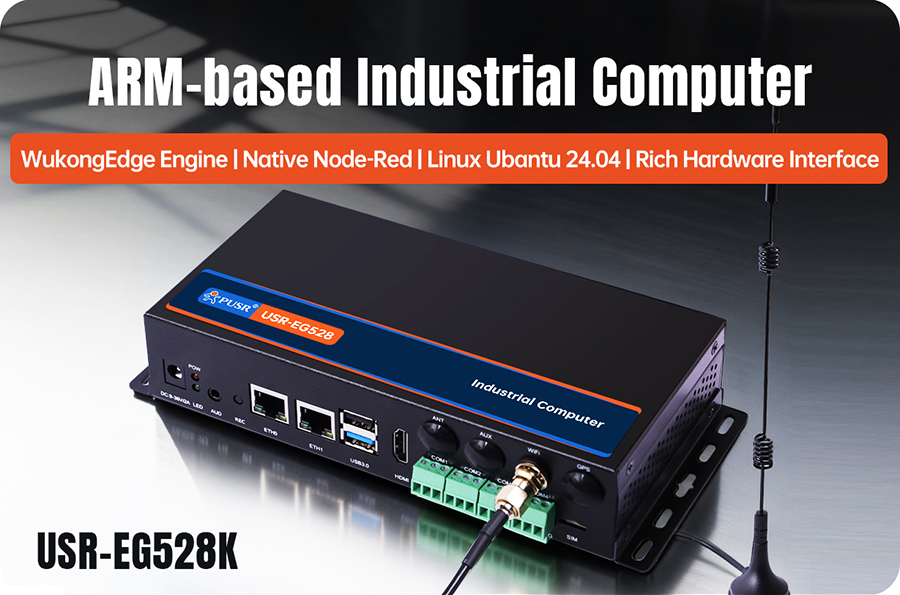
This article delves into the three major technical bottlenecks of AGV industrial PCs in extreme temperature and dust environments, explores how to overcome these challenges through protection grades and heat dissipation cutting-edge technology by considering industry pain points and customer psychology, and recommends a proven solution—the USR-EG528 fanless industrial PC.
In high-temperature workshops such as metallurgy and foundry, AGVs frequently shuttle between furnaces (with surface temperatures exceeding 100°C) and cooling zones, experiencing drastic temperature fluctuations. Traditional industrial PCs relying solely on natural heat dissipation or ordinary fans may see core components (e.g., CPU, memory) temperatures rapidly rise above 85°C, triggering hardware protection mechanisms (e.g., frequency reduction, shutdown) and causing AGVs to "go on strike." A steel enterprise once experienced the shutdown of three consecutive AGVs beside furnaces due to industrial PC overheating, disrupting molten iron transportation for two hours and incurring direct losses exceeding $2 million.
The heat dissipation challenge in high-temperature environments essentially stems from an imbalance in "heat generation, conduction, and release":
Heat generation: When AGVs operate under heavy loads (e.g., transporting 5-ton steel coils) or at high speeds, the CPU load rate of the industrial PC exceeds 90%, leading to a surge in power consumption.
Heat conduction: Traditional aluminum heat sinks have a low thermal conductivity coefficient (about 200 W/m·K), failing to rapidly transfer heat from the chip to the casing.
Heat release: In high-temperature workshops, the low air density reduces natural convection efficiency, making it difficult for ordinary fans to form effective air channels and causing heat to accumulate inside the chassis.
Fanless industrial PC need to adopt a "passive + active" hybrid heat dissipation solution, such as the heat dissipation design of the USR-EG528:
Phase change material (PCM) filling: Graphene composite phase change materials with a thermal conductivity of 1500 W/m·K (7.5 times that of aluminum) are filled between the CPU and heat sink. These materials melt from solid to liquid at a chip temperature of 65°C, absorbing a large amount of heat and delaying temperature rise.
Dual turbo fans + three-dimensional air channels: Two high-temperature-resistant turbo fans (operating temperature range: -40°C to 105°C) are built in, coupled with a three-dimensional air channel design (inlet at the bottom, outlet at the top), creating a "suction effect." Even at an ambient temperature of 80°C, the internal chassis temperature can be controlled below 60°C.
Dynamic temperature control algorithm: Temperature sensors continuously monitor the temperatures of the CPU, memory, and hard drive, automatically adjusting fan speeds (e.g., increasing to 5000 RPM when the temperature exceeds 70°C) to balance heat dissipation and energy consumption.
After adopting the USR-EG528, an aluminum manufacturer reported that AGVs operated continuously for 12 hours without shutdown in an 85°C high-temperature workshop, with the CPU temperature stabilized at 58°C, 27°C lower than that of traditional industrial PCs. Additionally, the fan lifespan increased from one year to three years.
In low-temperature scenarios such as cold chain warehouses and polar research stations (below -30°C), AGVs need to start quickly after prolonged exposure to low temperatures. Traditional industrial PCs not adapted for low temperatures may experience:
Cold start failure: Increased viscosity of capacitors and electrolytes at low temperatures prevents the power supply from functioning normally.
Performance degradation: The CPU frequency automatically decreases due to low-temperature protection mechanisms (e.g., from 2.8 GHz to 1.2 GHz), reducing task processing speed by 60%.
Material embrittlement: Plastic casings and connectors may shrink at low temperatures, potentially causing poor contact or cracking.
A cold chain logistics enterprise once experienced cold start failure of industrial PCs, leaving AGVs "stranded" in a -25°C warehouse for six hours, affecting the shipment of 1,200 tons of frozen products and incurring customer claims exceeding $50,000.
The impact of low-temperature environments extends far beyond "failure to start":
Electrical performance: The ESR (Equivalent Series Resistance) of capacitors increases with decreasing temperature, leading to increased power supply ripple and potentially triggering hardware protection.
Mechanical performance: Differential cold shrinkage rates between connector pins and socket metals may increase contact resistance, causing heating or even arcing.
Chemical performance: The internal resistance of lithium batteries surges at low temperatures, reducing output power by over 50% and affecting the industrial PC's endurance.
Fanless industrial PCs need to adopt a dual approach of hardware selection and software strategy, such as the low-temperature solution of the USR-EG528:
Wide-temperature component selection: Automotive-grade capacitors (operating temperature range: -40°C to 125°C), low-temperature electrolytes (freezing point: -50°C), and metallized polypropylene film capacitors (resistant to low-temperature shock) ensure stable electrical performance at -30°C.
Structural preheating design: A graphene heating film (power: 10W) is added between the power supply module and motherboard, controlled by temperature sensors to automatically heat the interior to above 0°C within 10 minutes when the ambient temperature drops below -10°C.
Low-temperature performance optimization: The BIOS adjusts the CPU voltage and frequency curve to maintain a 2.0 GHz main frequency at -20°C, with task processing speed decreasing by only 15% (compared to 60% for traditional industrial PCs).
After adopting the USR-EG528, a polar research station reported an increase in cold start success rate from 60% to 98% for AGVs in -35°C environments, with no performance degradation during eight hours of continuous operation at -25°C, ensuring the timely transportation of research supplies.
In high-dust scenarios such as cement plants, mines, and flour mills (with dust concentrations exceeding 500 mg/m³), AGVs need to operate continuously for months amidst dust. Traditional industrial PCs relying solely on ordinary dust filters may see dust gradually infiltrate the chassis, covering the motherboard, heat sinks, and even chip pins, leading to:
Short circuit failures: Conductive dust (e.g., metal powder, carbon powder) forms conductive paths in humid environments, causing motherboard short circuits.
Heat dissipation failure: Insulating dust (e.g., cement powder, flour) accumulates on heat sinks, forming an insulating layer and causing excessive temperature rise.
Poor contact: Dust entering connectors disrupts signal transmission or causes data errors.
A cement plant once experienced motherboard short circuits in five consecutive AGVs within three months due to dust intrusion in industrial PCs, incurring repair costs exceeding 30,000andlosingordersexceeding2 million due to production line shutdowns.
Traditional dust prevention solutions often fall into the trap of "passive defense":
Excessively large dust filter pore sizes: Ordinary dust filters with pore sizes ≥0.5 mm cannot block PM10 (diameter ≤10 μm) dust.
Over-sealing design: Complete sealing makes heat dissipation difficult, necessitating high-power fans that accelerate dust intake.
Excessively long maintenance intervals: Dust filters require monthly cleaning, but in practice, maintenance is often delayed, leading to dust accumulation.
Fanless industrial PC need to adopt a composite dust prevention solution of "active defense + passive cleaning," such as the dust prevention design of the USR-EG528:
Positive pressure dust prevention system: Dual turbo fans continuously blow filtered air into the chassis (air pressure ≥50 Pa), creating a slightly positive pressure environment that prevents external dust from entering.
Three-stage filtration design: The air inlet is equipped with primary (intercepting particles >50 μm), medium (intercepting particles >10 μm), and HEPA high-efficiency filters (intercepting particles >0.3 μm), achieving a filtration efficiency of 99.97%.
Passive dust removal structure: The motherboard is tilted at 15°, allowing dust to automatically slide into a bottom dust collection box under gravity. The heat sink surface is coated with a nano-dust-repellent coating (contact angle >150°), making dust adhesion difficult.
After adopting the USR-EG528, a flour mill reported that AGVs operated continuously for six months in an 800 mg/m³ dust environment, with dust accumulation inside the chassis less than 0.1 g (compared to over 10 g in traditional industrial PCs) and no short circuits or heat dissipation failures, reducing maintenance costs by 90%.
In overcoming the three major technical bottlenecks, the USR-EG528 fanless industrial PC has emerged as an industry favorite for its "all-scenario adaptability":
Protection grade: IP65 protection (dustproof, water spray resistant), certified to MIL-STD-810G military standards, adaptable to -40°C to 85°C wide-temperature environments.
Heat dissipation cutting-edge technology: Phase change materials + dual turbo fans + three-dimensional air channels ensure stable operation in high-temperature environments.
Dust prevention design: Positive pressure dust prevention + three-stage filtration + passive dust removal meet long-term usage needs in high-dust scenarios.
Ecosystem openness: Pre-installed with Linux system, supporting Python/C++ secondary development, providing API interfaces for AGV scheduling, navigation, and obstacle avoidance.
Cost-effectiveness advantage: Priced at one-third of similar products from imported brands, with a three-year warranty, reducing the total cost of ownership (TCO) for customers.