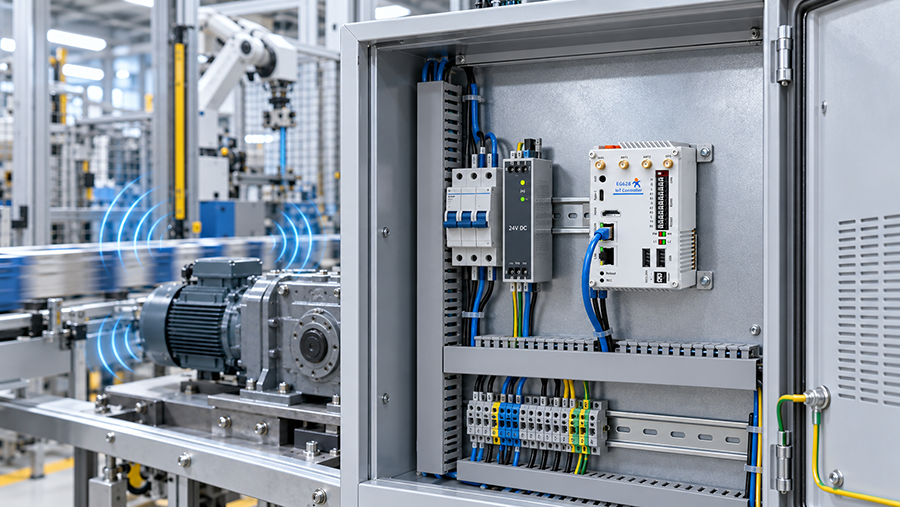
On a transporter chassis, an AGV body, or a mobile inspection cart, vibration resistance in a fanless industrial pc is not a matter of one number saying "good enough" — it is several concrete things done right. Competitors tend to select an industrial computer as a computing device: how many TOPS, how many cameras it can take. That framing is fine for vision applications, but for deployments that only do acquisition and control, the answer lies elsewhere.
Vibration resistance breaks into three things
Sustained vibration is the low-frequency back-and-forth during operation, covered by IEC 60068-2-6 and usually expressed in Grms. Shock is a short-duration high acceleration, covered by IEC 60068-2-27, such as 10G @ 11 ms. Long-term reliability means vibration does not stop a machine immediately, but loosens connectors and fatigues solder joints, with problems surfacing months later.
Fanless design and solid-state storage.Fans and mechanical hard drives are the first components to fail under vibration. A fanless design moves heat through the enclosure, and storage based on SSD or eMMC leaves no moving parts at all.
Wide-range power input with reverse polarity protection.Power on a vehicle comes from a battery or an onboard supply, where voltage moves with load and regenerative braking feeds back into the rail. A wide input range (9–36V or 12–36V) with reverse polarity protection absorbs that; a model rated only for "12V operating voltage" drops out the moment the rail dips.
Metal enclosure plus dual watchdog.An aluminum housing is rigid and resists impact, while hardware and software watchdogs restart the system after a hang without waiting for someone to travel to the site.
Isolated I/O.Ground loops become more troublesome under vibration, and without isolation on RS-485, CAN, or DI/DO, noise interferes with data directly. Isolated interfaces read more reliably on a moving chassis.
Mounting decides half the outcome.Bolted down, on rubber pads, away from a rack resonance point, versus clipped loosely into a plastic bracket — the difference in behavior is complete. Confirm whether the model supports DIN rail, wall, or embedded mounting, and add damping pads where needed.
ARBOR builds around Jetson AGX Orin, GMSL cameras, and Hailo or MemryX accelerators, with the perception–decision–action loop as the main axis. Sintrones emphasizes 14th-generation Core i9/i7 with a discrete GPU and up to 8 GbE ports including PoE. In the TSL checklist, the only entries that bear on this question are the vibration and shock standards, deterministic I/O, and the 5–7 year supply cycle.
Those directions are correct for vision-heavy AGVs. Many sites, however, are not running multi-camera SLAM but rather "read a few serial ports, drive a few actions, report data upward" — whether the interfaces line up and whether data stays stable is what counts.
Where Windows and more I/O are needed, choose x86. Take the X86 industrial pc USR-EC300 as an example: Intel i5-7200U, six serial ports (two switchable between RS232 and RS485), two gigabit Ethernet ports, HDMI plus VGA for dual display, fully aluminum fanless housing, DC 12-36V, -20 to 60°C with a wide-temperature SSD, 2Grms operating vibration and 10G @ 11 ms operating shock, a 255-level watchdog, and desktop or embedded mounting.
Where Linux and a smaller footprint are wanted, choose ARM. Take the ARM fanless industrial pc USR-EG228: RK3506J triple-core Cortex-A7, two RS485 ports plus two CAN FD ports, two fast Ethernet ports, fanless aluminum housing, DC 9-36V with reverse polarity protection, -25 to 75°C, dual watchdog, expandable TF card slot, and Ubuntu 22.04 with Node-RED preinstalled.
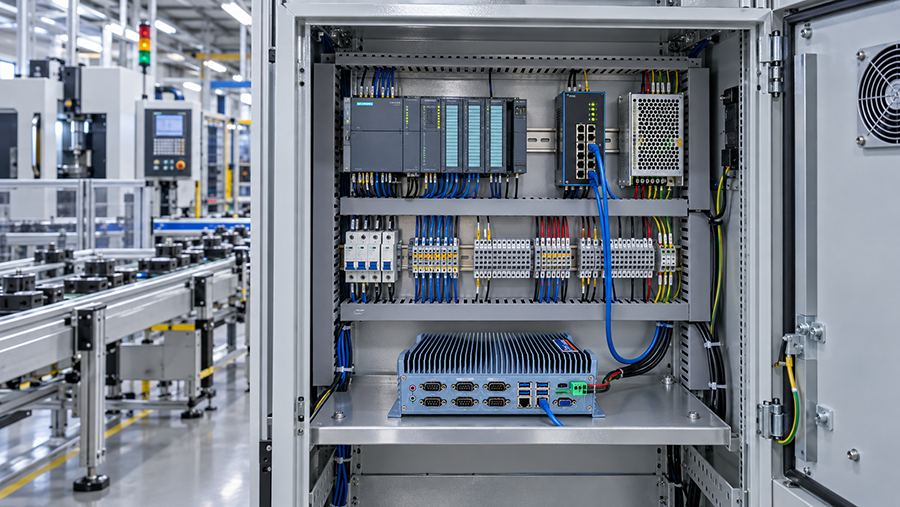
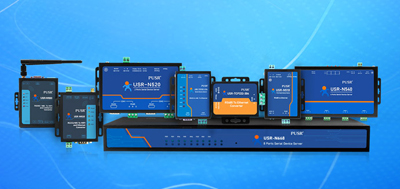
Note: In the picture, the EC300 has been enlarged for better visibility. For the actual size, please click the link to view USR-EC300.
Vibration resistance is not about buying a machine labeled "shockproof"; it is about confirming fanless design, solid-state storage, wide input with reverse polarity protection, a metal enclosure, isolated I/O, and the mounting method one item at a time. Put that list on the request-for-quotation form, and the model and specifications narrow by themselves. That is what a fanless industrial pc has to deliver on a chassis that never stops moving.
1. What is an embedded PC?
An embedded PC is a compact computer designed for industrial or vehicular environments, typically fanless with wide-voltage and wide-temperature tolerance, installed directly inside equipment to handle acquisition, control, or edge computing, and built to run continuously without server-room conditions.
2. Which operating systems are supported?
ARM models come with Linux preinstalled (Ubuntu 22.04/24.04) along with Node-RED and support secondary development; x86 models ship with Windows (10/11) as standard, with Linux optional. The host system follows what the host software requires, and legacy Windows-only software still calls for an x86 platform.
3. Can the memory be expanded?
x86 models usually provide a SO-DIMM slot (up to 32GB on the USR-EC300), while ARM models generally use fixed onboard memory. On the storage side, ARM models offer a TF card slot and x86 models provide mSATA or a 2.5-inch drive bay, with limits set by each model's specifications.
4. Is there a recommended embedded PC for machine vision IPC?
Where multiple cameras and vision compute are required, an x86 model with a discrete GPU or NPU and enough Ethernet ports is the choice; for inspection and control work that does not run heavy vision, an ARM model is sufficient.
5. What type of GPU is supported?
ARM models use integrated graphics output (HDMI and similar) with no discrete GPU, which suits HMI and light graphics; x86 models use CPU integrated graphics or a selected discrete option, and multiple high-frame-rate cameras require checking both port bandwidth and compute.
6. What is the difference between embedded, desktop, and laptop computers?
An embedded computer is built for continuous operation, wide temperature and voltage ranges, fanless cooling, and vibration resistance, with I/O customized to industrial needs; desktop and laptop machines target office environments with far lower requirements on voltage, temperature, and vibration.
7. Which application scenarios suit these embedded PC?
AGV and AMR, transport vehicles, mobile inspection, production-line acquisition and control, machine vision inspection, and energy monitoring — industrial sites that need compact, stable, continuously running computing.
8. What I/O interfaces do these embedded PC provide?
Common interfaces are RS232/RS485 serial ports, CAN and CAN FD, multiple Ethernet ports, and USB, with HDMI or VGA and DI/DO on some models.