A typical warehouse campus: three storage buildings plus a row of loading docks, with more than two hundred meters of open yard between the farthest two. Fiber reaches only the first building; the quote for re-opening the pavement to the other two goes up the chain and the project stalls there. Then someone proposes LoRa for everything: long range, cheap nodes, a battery that lasts years.
That judgment is half right. Wireless on a campus is not one technology but three separate legs: backbone, access, and the exit to the outside. The data volumes on the three legs differ by three orders of magnitude. Stretching one technology across all of them ends either with dead coverage or with money spent where it was not needed. Planning an Industrial Network usually starts by splitting it exactly this way.
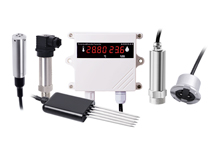
The range and battery life of LoRa are bought by keeping quiet: a few dozen bytes per transmission, throughput in the tens of kbps, hundreds of nodes per gateway. That channel suits temperature and humidity sensors, water and electricity meters, door contacts, level sensors, smoke detectors.
AGV dispatch commands, transactions from handheld scanners, and video from dock cameras cannot travel this road. Not because the signal is too weak, but because the channel is too narrow. So the first question is not which wireless to choose; it is how many classes of data the campus carries.
Low-rate telemetry: one reading every few minutes, a few dozen bytes. With hundreds of points running on batteries, LoRa fits. With only a few dozen points next to existing access points, plain Wi-Fi saves a whole gateway layer.
Real-time and mobile: AGVs, forklift terminals, handheld scanners, inspection tablets. These need not bandwidth but uninterrupted roaming. Wi-Fi is mandatory, and a controller must run it centrally.
Video and bulk transfers: dock and in-warehouse cameras, inventory sync. Wi-Fi 6 at minimum, or simply cable; narrowband will not carry it.
A single copper run ends at one hundred meters. Between buildings and across the yard, use fiber, which also separates the ground potential of the two sides. This leg carries the most traffic and is the last place to save money.
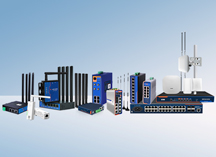
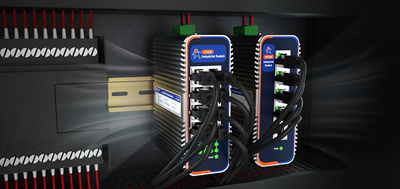
Access points need PoE, and a few of them call for one switch to aggregate. That is the usual job of the Industrial Ethernet Switch on a campus: -40 to 85 degrees Celsius, dual redundant power inputs from 9.6 to 60 V, 6 kV surge protection, IP40 housing, DIN-rail mounting, and up to 30 W per PoE port, so APs hang straight off the switch without a mains run to each one.
A warehouse is full of metal racking; the nominal coverage radius shrinks between the shelves, so the number of positions follows field measurements. An outdoor tri-band Wi-Fi 6 AP such as the AP530X brings 27 dBm of transmit power, 256 clients per unit, an IP67 housing, 802.3at power, and a built-in 2 kV surge protector, and it mounts on the roof structure or a pole.
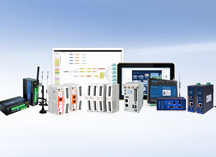
What actually decides the experience is not the AP but the controller. Past two APs, SSID, subnets and the gateway should sit on one AC, with the APs bridging only. The AC1000 manages up to 200 APs in bypass mode, and its fast-roaming feature actively drops weak-signal clients, so an AGV or a scanner crosses APs without dropping a session.
An AGV moving from the ground floor to the mezzanine has only the freight elevator. The shaft is reinforced concrete around a metal car; signals struggle both ways, and with the doors closed the car becomes a shielded room. The fix is to place coverage points at the shaft entrance and on the car roof so the two overlap, letting the handover happen while the car runs steadily instead of at the moment its doors open or close.
Loading docks behave the same way. Doors stay open, trucks keep coming, and terminals run on both sides of the threshold, which makes the dock mouth the most toggle-prone spot in the building.
Legacy equipment in a warehouse often has nothing but a serial port: temperature controllers, weighbridges, scales, old PLCs. A pure cellular plan gets expensive exactly here: one card and one monthly fee per device, and the cost runs away as the count grows. Thirty serial devices on thirty cards mean thirty monthly fees; merging them into one Wi-Fi network is a one-time converter cost, with a single card left at the exit.
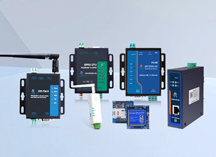
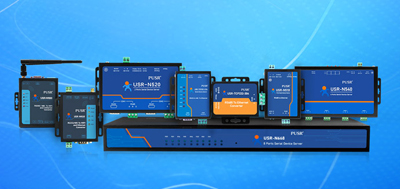
The USR-W630s pulls such devices into the same Wi-Fi: one RS232 plus one RS485, dual Ethernet ports, four modes (AP, STA, AP+STA, bridge), up to four hundred meters line-of-sight on the 5.8 GHz band, local collection of up to 1,000 points with Modbus RTU/TCP conversion, -25 to 75 degrees Celsius, wide-voltage 9 to 36 V input with reverse-polarity protection, dual watchdogs, and status visible through SNMP and a cloud platform while it sits inside the distribution box.
Only one exit leads outward, and usually broadband already exists there, or one more line can be pulled. Where it cannot, a single SIM serves as the main uplink. Everything else stays inside this intranet, touching neither the public internet nor any data plan.
That is the price point between "cellular everywhere is too costly" and "all-wireless feels risky": spend on coverage and backbone, and size the exit by the number of links, not the number of devices.
The order: count the classes of data first, cable the backbone wherever cable can go, let APs cover and an AC handle roaming, merge serial devices into the same network, and keep a single exit. In an Industrial Network, segmentation decides the budget earlier than any model number does. The real waste is rarely the wrong Industrial Ethernet Switch; it is buying all three legs as one.
1. The campus already runs a LoRa gateway. Is Wi-Fi still needed?
Depends on the data class. LoRa carries only low-rate telemetry; AGVs, scanners and cameras need real-time transfer and bandwidth that a narrowband channel cannot give. Both coexist commonly: telemetry on LoRa, real-time services and serial devices on Wi-Fi.
2. Why not cellular for everything?
It works when the device count is small. As it grows, cards and monthly fees scale linearly, and so do the failure points. Cellular fits one uplink at the campus exit, not one link per device.
3. How many APs are enough?
Measure by warehouse density, not by the datasheet. Metal racking and stacked goods both compress coverage. A common practice: place a few points along the racking aisles in one building, test signal and roaming handover, then extend the pattern to the rest.
4. Must the APs pair with an AC?
Up to two, each can stand alone. From three on, a controller is advised: SSID, subnets and the gateway in one place, APs bridging only, so mobile clients do not drop while re-acquiring addresses.
5. The legacy device only has RS485. How does it join?
Through a serial-to-Wi-Fi converter onto the same network. Copy all four serial parameters and the Modbus station address from the field manual; one mismatch shows up as a link that connects but carries no data.
6. Will wireless slow down AGV real-time control?
The impact comes from roaming and interference, not bandwidth. Roaming is handled by the controller, which coordinates handovers and drops weak-signal clients; interference is limited by using the 5.8 GHz band and by keeping positions clear of metal obstruction. Before go-live, run continuous traffic at the worst spot; that says more than a single successful ping.
7. Is the switch really necessary?
Access points need PoE and an aggregation point, and cross-building runs need fiber ports. Once the AP count grows, one switch costs less than separate power and uplinks per AP. Size it by total PoE budget and port count.
8. What gets verified before go-live?
Three items: signal and roaming at the worst position, uplink switchover time after pulling the main link, and a continuous data run from a serial device to watch disconnects and rec