Manufacturing network managers across industries are hitting the same point when upgrading: the industrial router in use today works well and the cellular link stays up, but when the plant is ready to roll out SCADA and bring field data into one place for centralized management, the current device simply runs out of features—no VLANs, so production, office, and camera traffic share one flat network; PLCs and meters still talk RS485, but the router has no serial port to attach them; and when a device quietly drops offline, nobody on site or at headquarters notices.
The direction is clear from these conversations: selection criteria are shifting from "can it get online" to "can it manage the field network." Industrial router that ride cellular data while providing local Wi-Fi access are usually searched for ascellular wifi router. When it comes to the hardware itself, there are only a handful of points worth checking.
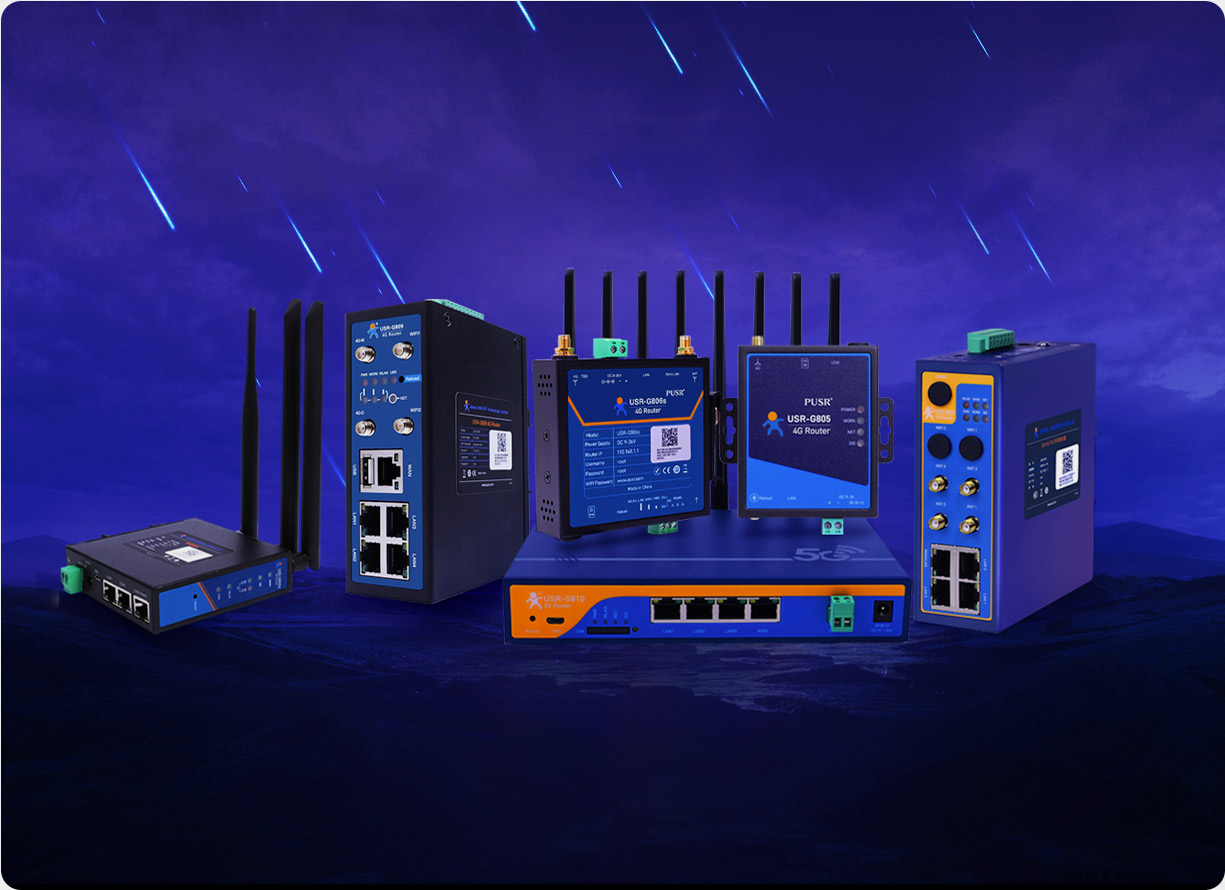
A basic 4G router drops every device onto the same subnet; one infected terminal or a broadcast storm can take down the entire production network. SCADA servers, PLCs, cameras, and office terminals should each live in their own segment. Check how many gigabit ports the device has and whether VLANs can be created. A gigabit edge router like the USR-G809s provides multiple gigabit LAN ports and can isolate production equipment, surveillance, and office traffic by business need.
The most expensive part of a SCADA retrofit is usually not the router—it is replacing equipment. Many PLCs, meters, and instruments on site still use RS232/RS485 interfaces and the Modbus RTU protocol, and wholesale replacement is rarely realistic. A router with serial ports can bridge the gap: the USR-G809s offers both RS232 and RS485, with built-in protocol libraries such as Modbus TCP/RTU, so legacy devices keep their original wiring while their data flows into the new network and reaches the SCADA or cloud platform.
When SCADA data crosses the public network back to headquarters or the cloud, an encrypted tunnel is a baseline requirement, not a bonus. Check how well the device supports mainstream VPNs such as IPSec and OpenVPN—ideally it can act as a client to several servers at once and import certificates and configuration files in one click. Across PUSR's G series, VPN support is standard on every model.
Field equipment often runs unattended for months, and an hour of downtime costs very differently from a week of it. Devices that push status proactively deserve priority: offline alarms, weak-signal alarms, and traffic-overrun alerts delivered by email or SMS—discovered before the next site inspection, not during it.
Once the number of sites grows from one or two to dozens, logging into each device to configure settings and upgrade firmware no longer works. The real dividing line for a managed router is the remote management platform behind it: bulk configuration, remote reboot and upgrade, and an at-a-glance status view of every device, backed by a hardware watchdog for self-recovery. The USR-G809s and USR-G816 both work with the PUSR remote management platform; most operations can be completed in the web UI.
Turn the five points above into a checklist: does it support VLANs? Does it have serial ports and Modbus conversion? How are VPNs configured? Where do offline alarms go? How is the remote platform deployed and billed? Working through these items usually makes the choice clear.
One requirement is easy to overlook: many terminals on site can only connect over Wi-Fi—barcode scanners, handhelds, and some instruments. That is where acellular wifi routerwith built-in wireless coverage comes in. The USR-G806w fits this role, using 4G plus dual-antenna Wi-Fi to serve local access; for heavy video backhaul or headroom for future bandwidth, the 5G USR-G816 is worth a look; and to cover serial ports, VLANs, protocol conversion, and remote management in one device, the USR-G809s is the more complete choice.
There is no single right answer in router selection, but the evaluation framework is reusable: decide first how many network segments the site needs, which legacy devices have to connect, and where the data goes—then run through the five points above, and the choice rarely goes wrong.