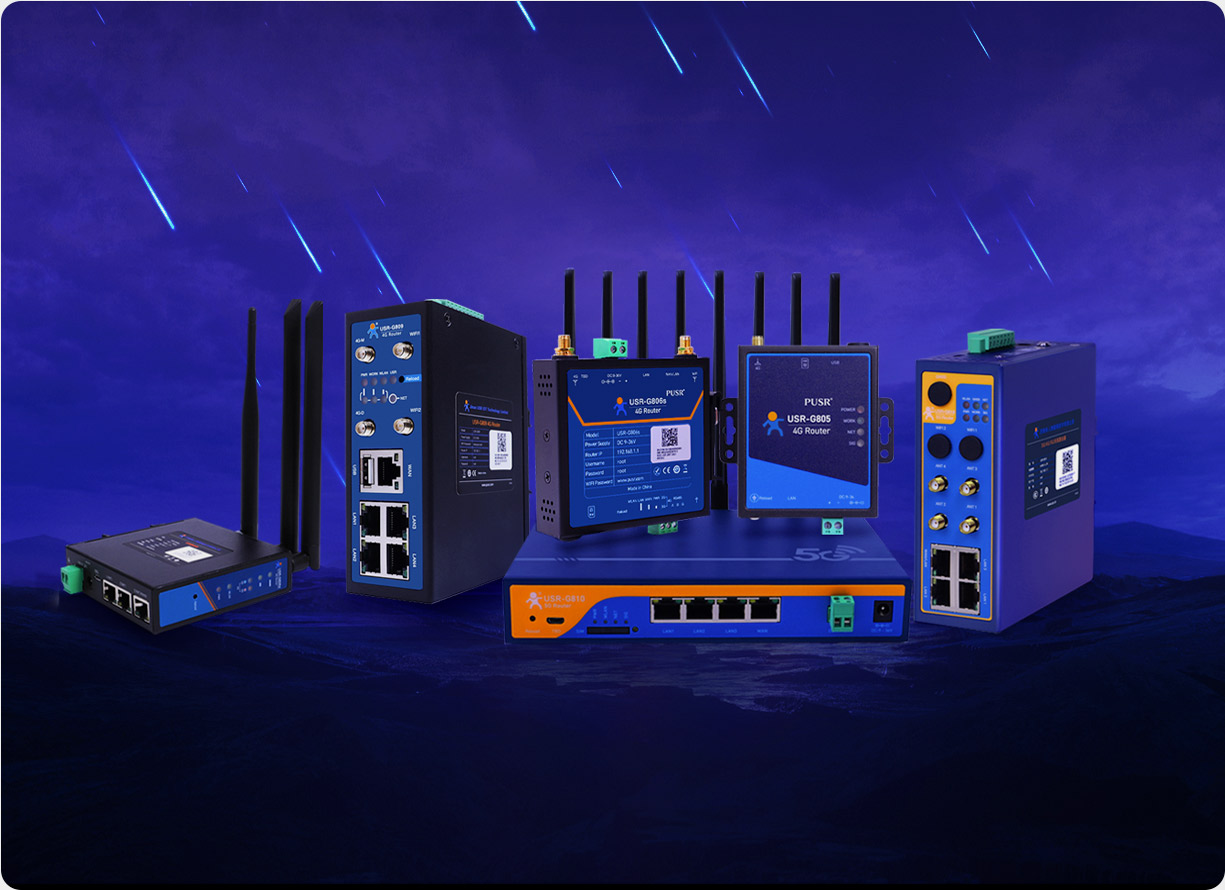
Many factories and remote sites face the same issue when deploying cellular routers: the devices connect, but managing them becomes chaos.
On-site, three roles need access. Production engineers adjust parameters. IT operations check logs. Outsourced technicians need temporary debugging access. With a consumer-grade router, either everyone shares one admin account — mistakes happen and no one knows who made them — or each device must be logged into individually, wasting thirty minutes a day巡检 across dozens of sites.
In these scenarios, three features matter more than bandwidth numbers when selecting an Industrial Cellular Router: remote management, permission control, and VPN.
Consumer routers also support remote login, but most just offer "open a browser, type an address, see the management page." Enterprise sites need answers to three questions:
Can I see everything in one place?Logging into dozens of scattered devices individually wastes more time than it saves. An Industrial Cellular Router with a remote management platform shows all device statuses, signal levels, SIM card info, and data usage from one dashboard — no per-device login required.
Can I operate remotely?Adjusting parameters, pushing firmware updates, rebooting a hung device — sending someone to the site every time costs far more than the router itself. A remote management platform supports parameter changes, firmware upgrades, and reboots without on-site visits.
Can I catch problems early?Devices go offline. Signals weaken. Data plans get exceeded. Finding out only when production stops is already too late. Routers with real-time alerting push email or SMS notifications when anomalies occur, with repeated push support so critical alerts are not missed during shift changes.
A common scenario is mobile inspection vehicles equipped with industrial cameras and sensors, streaming data via 4G/5G. When these vehicles enter mountainous areas or cross base stations, connections drop frequently. If monitoring relies solely on cloud polling, no one knows about outages. A router with local threshold settings sends alerts directly from the device when signals weaken, without waiting for cloud verification.
Consumer cloud platforms typically share one set of credentials. Admin, operator, and guest permissions exist only as manual agreements. This model breaks down for enterprise IT/OT operations:
Production engineers need to adjust parameters but don't need system logs. IT operations need network status and firmware versions but shouldn't directly control devices. Outsourced technicians require temporary access that gets revoked when the project ends.
When evaluating routers, look for:
Tiered permission levels.Administrator, operator, and visitor tiers are the minimum baseline. Different roles see different menus and have different capabilities. Avoid situations where everyone operates from the same backend.
Individually assigned accounts.Each user has a unique login with traceable actions. When something goes wrong, you know who made the change instead of blaming a shared credential.
Temporary accounts with expiry dates.After an outsourced technician finishes debugging, a temporary account can be disabled or deleted, removing access immediately.
These may seem like software-level details, but they directly affect operational efficiency and security. With clear permissions, daily maintenance no longer requires the IT team to configure every device, and field teams can use the functions they need within their authorized scope.
Many sites need to send on-site data back to headquarters or let engineers remotely debug equipment. Exposing device ports directly to the public internet is a high-risk practice — a single firewall misconfiguration can expose an entire site network.
VPN works differently. It establishes an encrypted tunnel, routing all remote traffic through it and opening zero ports on the public internet.
Mainstream Industrial Cellular Routers support five VPN protocols: IPsec, OpenVPN, PPTP, L2TP, and GRE.
Among these, OpenVPN is most commonly used in enterprise deployments. It operates in three modes: as a client connecting to a server, as a server for multi-party access, and with one-click import of .ovpn configuration files and PKCS#12 certificate files — no manual parameter entry required. It works with CloudConnexa, OpenVPN Access Server, pfSense, OPNsense, and open-source OpenVPN servers.
In mobile scenarios, VPN offers an additional benefit: tunnels automatically rebuild during link handoffs. A vehicle-mounted device switching from 4G to 5G keeps its VPN connection alive, allowing remote debugging to continue without interruption.
Not all features are needed for every deployment. Evaluate based on actual use:
Step one: assess management scale.For five or fewer sites, individual web login may be acceptable. Beyond twenty sites, or when centralized monitoring and alerts are required, a remote management platform and real-time alerting become essential.
Step two: assess remote access frequency and security level.Occasional parameter checks without encrypted tunnels can use a remote management web page alone. When on-site data must connect back to headquarters, or customer security policies mandate encrypted channels, five-protocol VPN support is the baseline.
Step three: assess alerting needs.Without alerting, outages are often discovered only after production stops. Routers with dual-channel email and SMS push alert on-site staff immediately, with repeated push for critical notifications.
5G offers higher bandwidth and lower latency, but not every scenario needs it.
Standard data collection, remote monitoring, and PLC debugging — 4G provides sufficient bandwidth and latency, with mature coverage and lower data costs. Video transmission, heavy data volumes, or latency-sensitive applications are where 5G's advantages become clear.
Decide on data requirements and local coverage first, then choose 4G or 5G. That approach is more practical than picking based on peak speed alone.
When selecting an Industrial Cellular Router, connectivity methods (4G/5G/Ethernet/Wi-Fi) determine "whether it connects." Remote management, permission control, and VPN determine "whether it stays under control."
Get these three things clear, and selection becomes less about comparing port counts on a spec sheet and more about matching device capabilities to on-site needs.
An Industrial Cellular Router is a rugged networking device that uses cellular networks (4G or 5G) to connect remote equipment, sensors, and systems to cloud platforms or control centers. It is built for harsh environments with metal enclosures, wide temperature range, and industrial-grade interfaces like RS485/RS232.
Consumer routers are designed for office or home use in controlled environments. Industrial Cellular Routers operate from -20°C to +75°C or wider, support DIN rail or wall mounting, accept wide-voltage DC power (DC 9-36V), have dual SIM failover, and include VPN, remote management, and real-time alarms for enterprise use.
WAN failover means the router can automatically switch from one network connection to another if the primary link fails. For example, when the 4G signal drops, the router can switch to a wired Ethernet backup, or switch from one SIM card to another. This keeps remote sites online without manual intervention.
Five protocols are standard: IPsec, OpenVPN, PPTP, L2TP, and GRE. OpenVPN is commonly used in enterprise deployments because it supports flexible configurations, certificate-based authentication, and can connect to third-party OpenVPN servers or cloud platforms.
A remote management platform is a centralized web interface that allows administrators to monitor, configure, and troubleshoot multiple Industrial Cellular Routers from one dashboard. Features typically include device status monitoring, remote firmware upgrades, configuration backup, and real-time alerts via email or SMS.
Dual SIM provides redundancy. If one carrier's network fails or the signal degrades, the router switches to the second SIM automatically. For mission-critical sites like SCADA, water treatment, or transportation, dual SIM is highly recommended.
Enhanced OpenVPN is an improved version of standard OpenVPN support in some Industrial Cellular Routers. It allows one-click import of .ovpn configuration files and PKCS#12 certificate files, so administrators do not need to manually enter complex parameters. It also works with popular OpenVPN servers like CloudConnexa, pfSense, and OPNsense.
When configured thresholds are exceeded — such as the device going offline, signal strength dropping below a set level, or cellular data usage exceeding a limit — the router sends an alert via email or SMS. Some models support repeated push to ensure the notification is received, even during shift changes or busy periods.
Yes. Many models include RS485/RS232 serial ports, which can connect to Modbus RTU devices, meters, RTUs, and legacy PLCs. The router reads serial data and forwards it over cellular to a cloud platform or control center, enabling remote monitoring without replacing existing equipment.
4G LTE remains a cost-effective and widely available solution. For most remote monitoring, telemetry, and PLC access scenarios, 4G bandwidth and latency are sufficient, and coverage is mature. 5G is worth considering when the application requires video transmission, very high data volume, o