industrial lte router deployed in remote locations commonly operate at unattended sites — solar inverter cabinets, cold-chain warehouses, field pump stations, engineering vehicles. In these environments, power supply is far from ideal. A 24V DC bus can produce voltage spikes when motors start and stop. Off-grid systems charge and discharge throughout the day, causing the bus voltage to swing between ten and thirty volts. Rural power grids themselves are inherently unstable. Under these conditions, routers restart frequently, which may cause data loss or, in the worst case, permanent hardware damage.
A welding shop at an automobile manufacturing plant once experienced repeated router restarts due to voltage fluctuations. AGV vehicles lost network connectivity and stopped moving, causing over 150,000 RMB in production downtime in a single day. The same pattern appears at port cranes, electric arc furnaces in steel mills, and remote mining sites — when large equipment starts or stops, instantaneous voltage spikes can reach multiples of the rated voltage. Standard networking equipment simply does not have the power protection to survive these events.
Consumer routers typically support only a single voltage input — 12V or 24V — and fail outside that range. Even some industrial lte router lack surge protection circuits, leaving capacitors and chips on the motherboard exposed to destructive spikes.
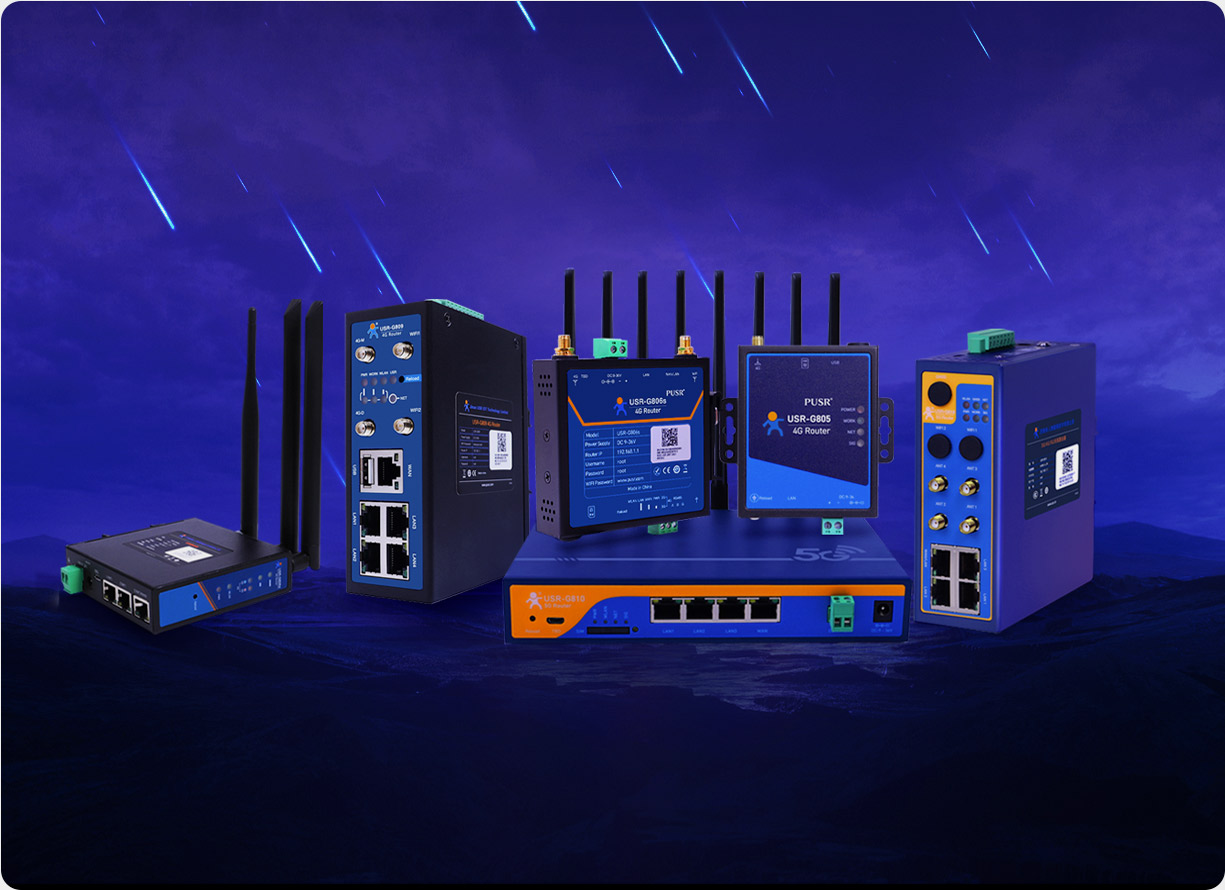
industrial lte router are designed from the ground up for the worst power conditions. PUSR USR-G816 5G industrial lte routerr, for example, accepts DC 9-36V wide-voltage input, covering the common 12V, 24V, and 36V power systems found in industrial sites, and is also compatible with 24V vehicle power systems.
The engineering logic behind wide-voltage design is straightforward: a wider input window, higher voltage tolerance margin, combined with reverse-polarity protection diodes, TVS transient suppression, over-current and under-voltage protection — all working to keep power disturbances away from the motherboard. During testing, when input voltage was ramped from 9V to 36V, the USR-G816 maintained stable operation with network latency fluctuation under 5ms and zero packet loss.
PUSR USR-G806w 4G industrial lte router also features wide-voltage power supply design with redundant 2-pin terminal block and DC jack inputs, operating temperature range from -20°C to +70°C, and has been deployed in intelligent robots, self-service shared devices, and vehicle-mounted applications.
Voltage spikes in industrial settings come not only from motor start-stop cycles, but also from lightning induction and aging power lines. The USR-G816 features a four-stage protection circuit at the power input:
In testing, the USR-G816 withstood ±4kV surge voltage — double the industry standard of ±2kV. The device passed IEC 60068-2-27 impulse voltage testing (no damage at ±2kV) and IEC 60068-2-14 damp heat cycle testing (10 cycles at 55°C, 95% RH with no failures).
Connecting power cables with reversed polarity is a common field mistake, especially at temporary test stations or remote sites. Without reverse-polarity protection, the current flows directly into the motherboard — the fuse blows, or the board is destroyed.
Both USR-G816 and USR-G806w include built-in reverse-polarity protection. When power leads are connected backward, the device automatically cuts the circuit and prevents motherboard damage. For equipment deployed in remote locations, a single service visit often costs several times the price difference between a cheap router and an industrial-grade one.
The USR-G816 also supports dual power redundancy (optional dual power module):
Low-power design keeps normal operating consumption at just 10W, reducing load on the power system.
Wide temperature and wide voltage are baseline capabilities for industrial lte router , but not the only factors to consider. When selecting a router, pay attention to these points:
Q1: What is the difference between consumer and industrial lte routerrs regarding power supply?
Consumer routers typically support only 5V USB or a single DC voltage (e.g. 12V), with no reverse-polarity, over-voltage, or surge protection. industrial lte router accept 9-36V wide-voltage input and include multiple power protection mechanisms, allowing continuous operation even under severe voltage fluctuation.
Q2: Does an industrial lte routerr restarting frequently always mean a network problem?
Not necessarily. Unstable power is a common cause. When input voltage drops below the device's minimum operating voltage, the router reboots. Troubleshooting should begin by monitoring the site's power voltage fluctuation range, then check cellular link quality and chip operating temperature.
Q3: Is USB-C power suitable for industrial deployment?
USB-C power (5V) works for temporary commissioning and portable scenarios, but not for long-term industrial use. A 2-meter USB cable at 0.5-0.7A current can drop up to 150mV, which often causes the router to brownout and restart. Industrial sites should use terminal block or DC jack wide-voltage power supply instead.
Q4: Is a wider wide-voltage range always better?
A wider range means stronger environmental adaptability, but it also depends on component selection and thermal design. When selecting a router, look at actual test data rather than spec sheet numbers alone. PUSR USR-G816 supports 9-36V wide voltage and has passed IEC impulse voltage testing.
Q5: How important is reverse-polarity protection?
Very. Reversed power leads are a common field mistake. A router with reverse-polarity protection auto-cuts the circuit to prevent damage. Without it, the device can be destroyed. For remote sites, the repair cost far exceeds the price of the router itself.
Q6: Do industrial lte router need dual power redundancy?
For critical applications (production lines, remote pump stations, medical sites), dual power redundancy is a sensible choice. USR-G816 supports optional dual power modules with 10ms switchover for zero interruption. For less critical scenarios, a hardware watchdog provides automatic recovery.
Q7: How can I tell if there is a voltage surge problem at an industrial site?
Look for these signs: the router restarts when large motors start or stop, the device behaves abnormally after thunderstorms, or scorch marks appear on the power port. Use a multimeter or surge protector (SPD) to monitor bus voltage — instantaneous spikes exceeding twice the rated voltage indicate a problem.
Q8: What power-related advantages does a 5G industrial router offer over 4G?
5G industrial router consume more power and therefore demand stricter power requirements. The USR-G816 achieves this through low operating consumption (10W) and comprehensive power management design, delivering 5G speeds without adding to the power burden. Wide-voltage input and multi-level protection keep