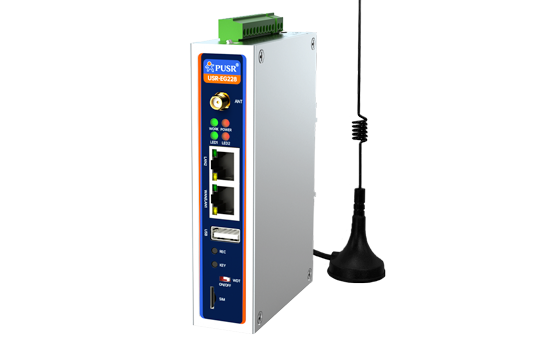
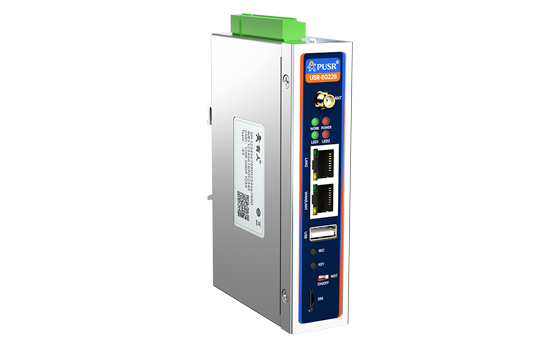
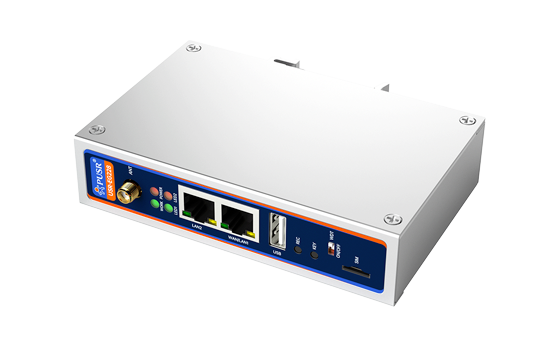
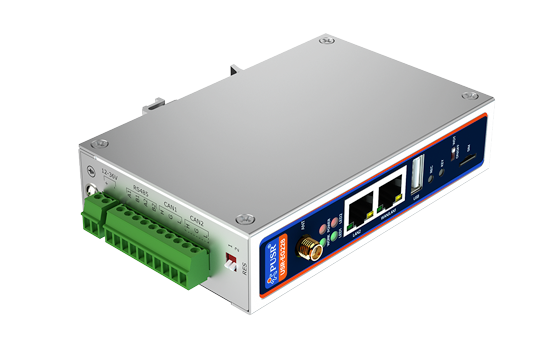
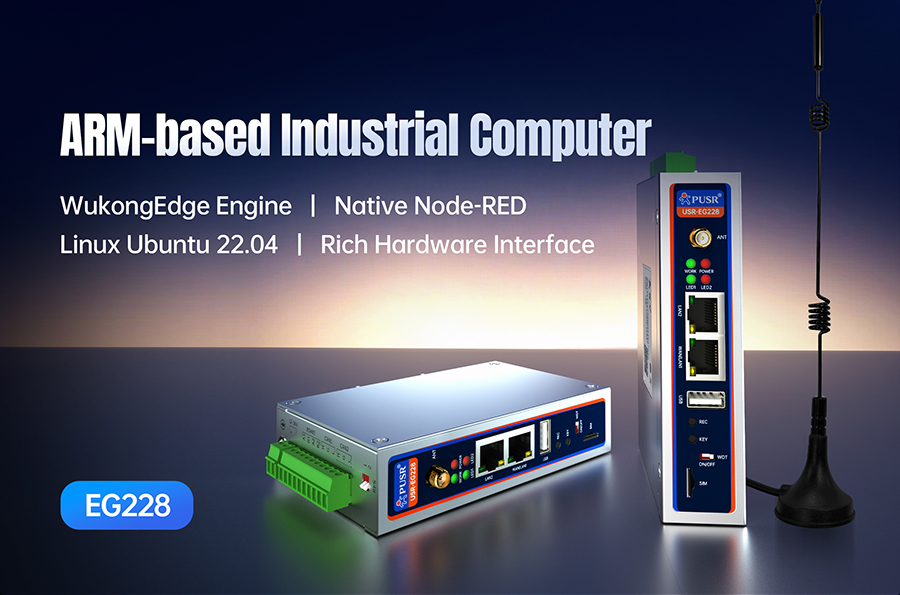
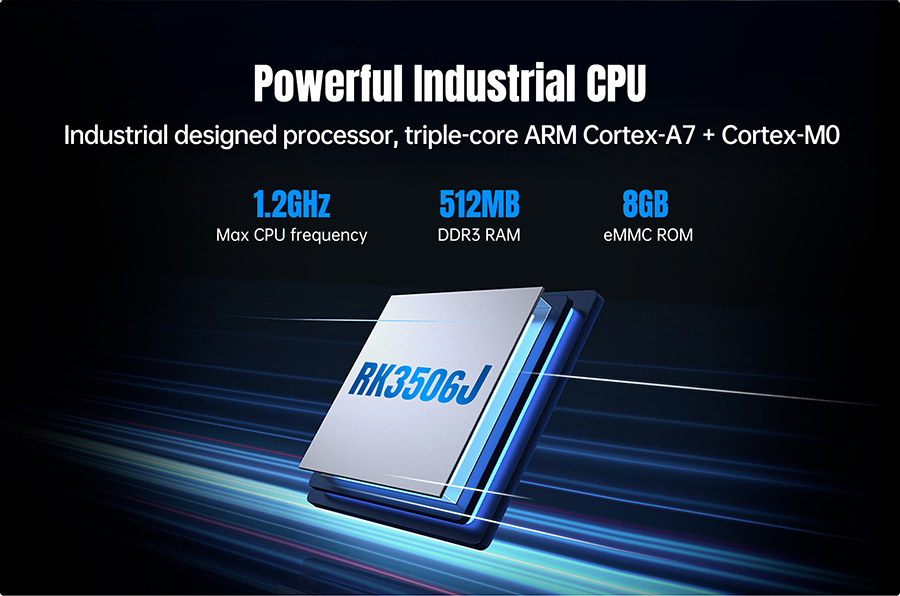
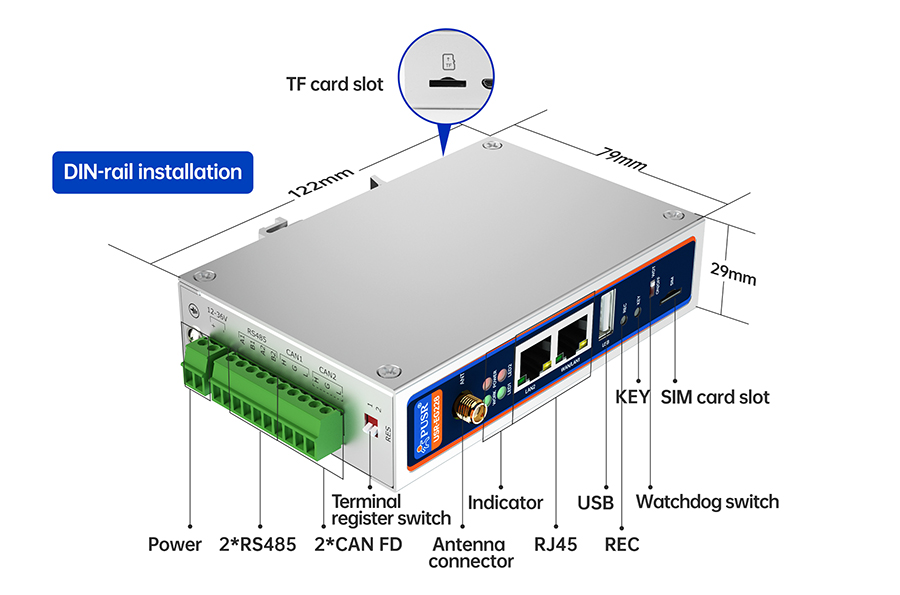
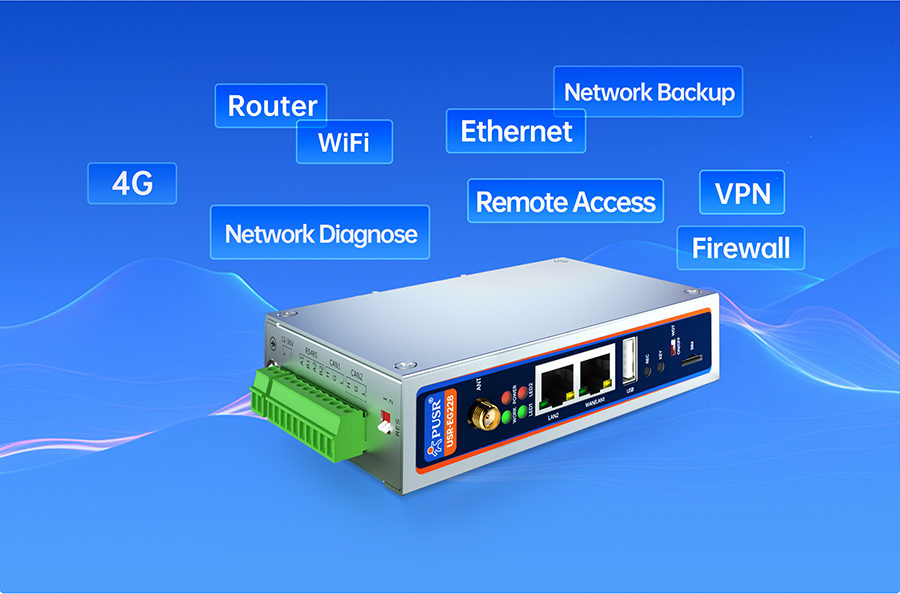
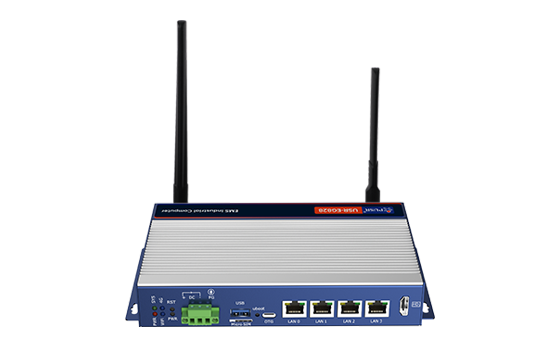
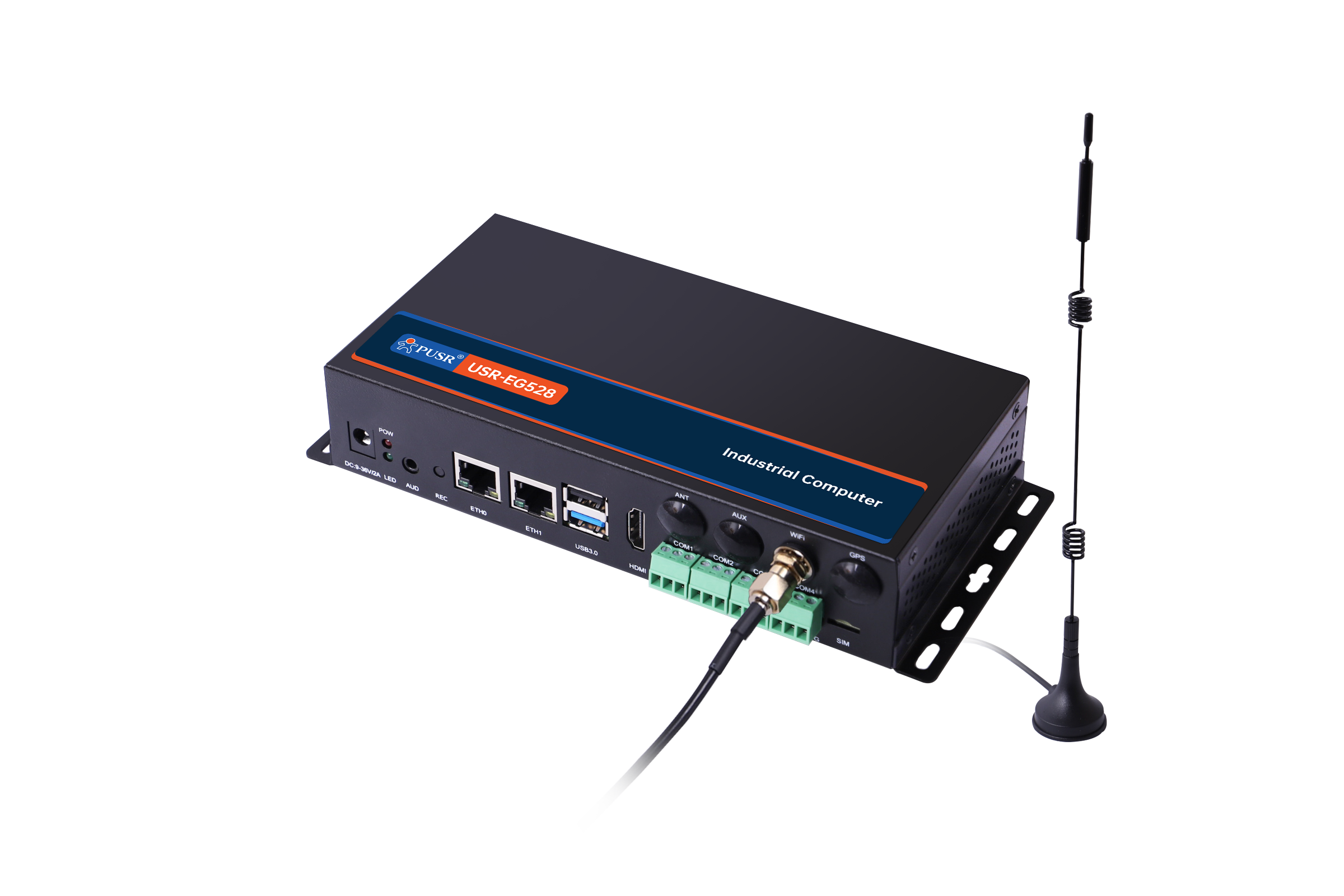
USR-EG228 is an ARM-based Linux industrial control computer. It is equipped with an industrial-grade RK3506J triple-core Cortex-A7 + Cortex-M0 processor with a main frequency of 1.2 GHz. It supports various networking methods such as 4G, Wi-Fi, and Ethernet. The device comes with 1×USB, 2×RS485, and 2×CAN FD.
BUY
BUY
IPC Based ARM
Cortex-A7@1.2GHz, RAM 512M, ROM 8G
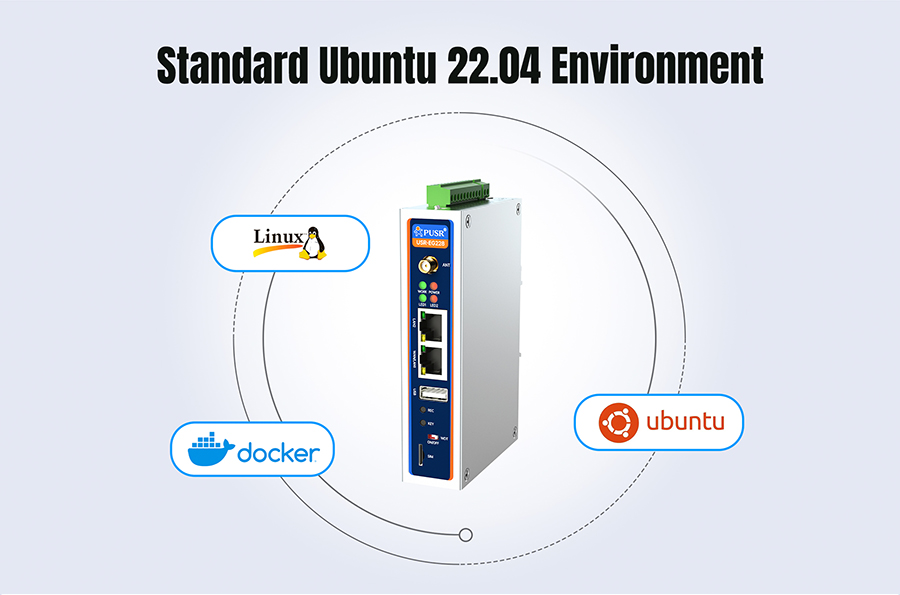
Ubuntu OS
Ubuntu 22.04 environment, original Node-RED
ARM-based Industrial ComputerWukongEdge Engine | Native Node-RED | Linux Ubuntu 22.04 | Rich Hardware InterfaceUSR-EG228 is an ARM-based Linux industrial control computer. It is equipped with an industrial-grade RK3506J triple-core Cortex-A7 + Cortex-M0 processor with a main frequency of 1.2 GHz. It supports various networking methods such as 4G, Wi-Fi, and Ethernet. It features a rich set of I/O interfaces, including 1×USB, 2×RS485, and 2×CAN FD. On the firmware side, it comes with standard Ubuntu 22.04, and is equipped with the WukongEdge edge computing engine. With simple configuration, it can complete data collection, edge computing, and cloud reporting. The device is pre-installed with the latest version of Node-RED, with drag-and-drop programming, and business logic can be implemented immediately. The high-performance CPU, various networking methods and hardware interfaces, along with the carefully designed firmware functions, enable this device to be applied in various industrial sites, quickly achieving data collection, monitoring, and analysis applications.
Powerful Industrial CPUIndustrial designed processor, triple-core ARM Cortex-A7 + Cortex-M0.
Rich Hardware Interface2 * fast Ethernet, 2 * RS485, 2 * CAN FD, 1 * USB, suitable for various industrial scenarios.
Standard Ubuntu 22.04 Environment
Pre-configured with a complete set of development tools and APIs
Includes comprehensive hardware driver documentation.
Provides installation guides for common applications (Docker, ToDesk, etc.).
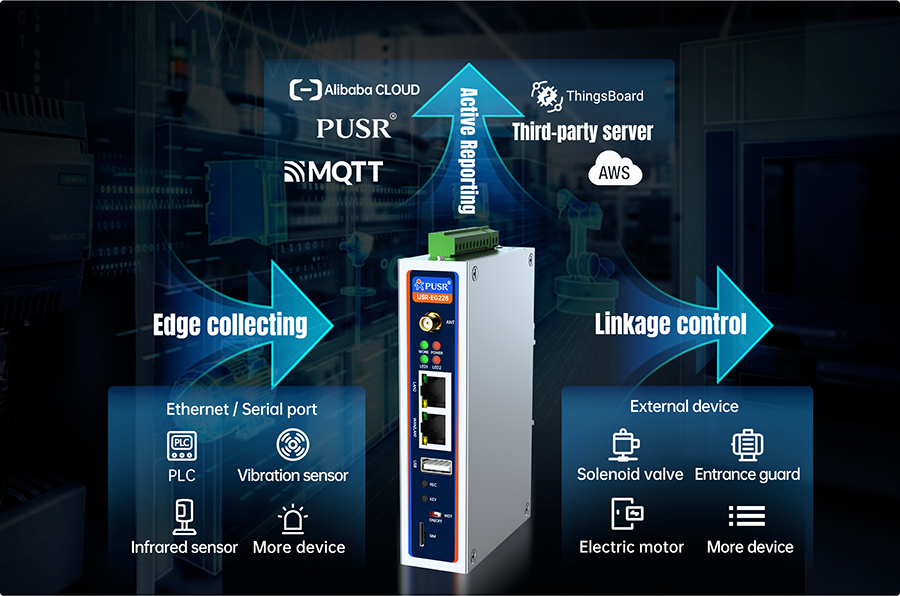
Powerful Edge Computing CapabilitiesThe built-in WukongEdge engine simplifies the configuration of networks, data acquisition, and reporting. It enables rapid establishment of data north-south channels, facilitating the rapid synchronization of terminal sensing and data center.
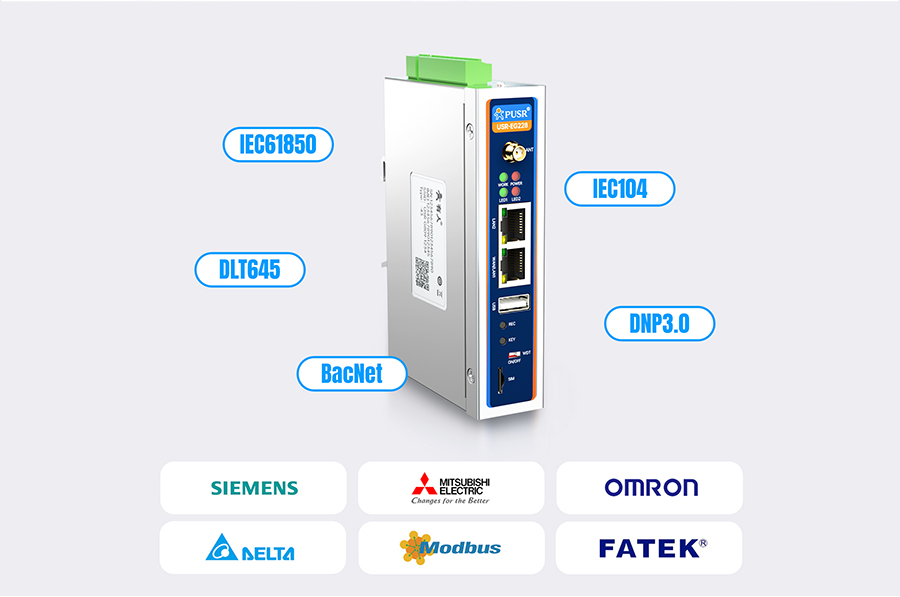
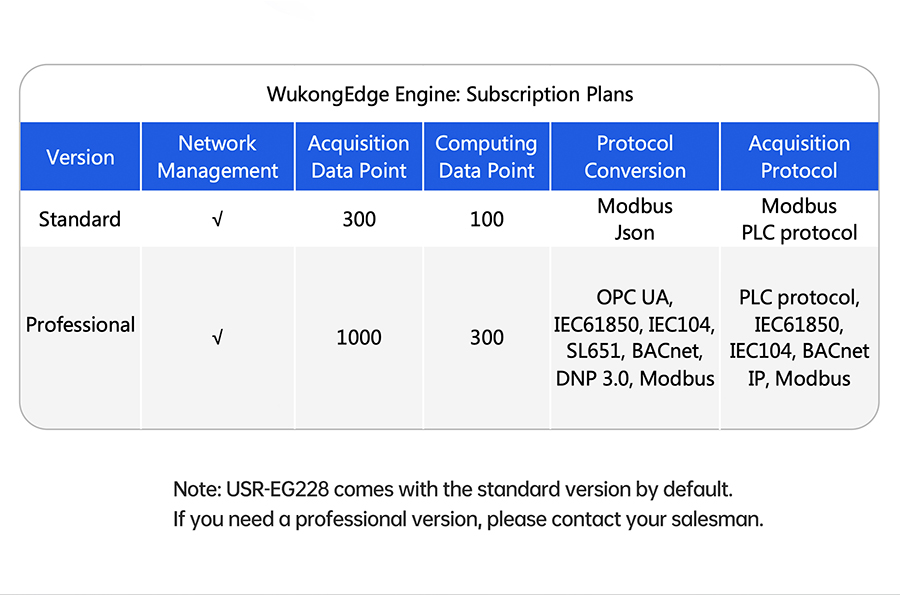
Wide protocol support: Capable of acquiring and converting a vast array of industrial protocols including IEC 61850, IEC 104, DLT645, DNP3.0, and BacNet.
Extensive PLC Compatibility: Seamless communication with major PLC brands such as Siemens, Mitsubishi, Omron, Modbus, Delta, and Fatek.
Multi-network Backup, Stable and Secure
Multi-network Redundancy: supports 4G, WiFi, and Ethernet for Internet connectivity
Secure network: integrated routing, VPN, and firewall capabilities to enable secure and highly efficient network communication.
Built-in Security: integrated routing, VPN, and firewall capabilities to enable secure and highly efficient network communication.
Value-Added ServicesUnlock the full potential of your edge with our versatile service tiers.
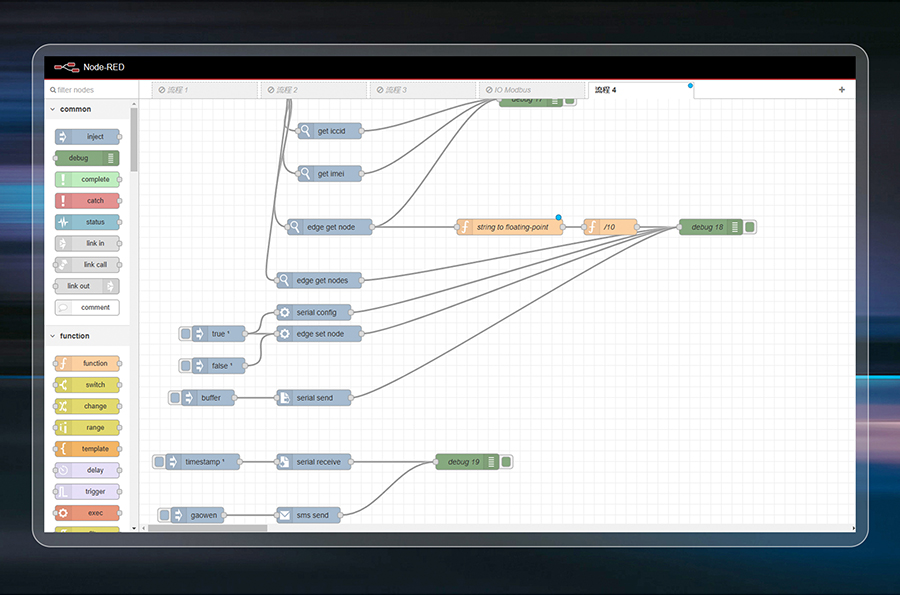
Native Node-RED, Flexible DevelopmentWith the built-in Node-RED visual programming tool and the WukongEdge engine, users can effortlessly build data processing workflows through a drag-and-drop interface---eliminating the need to deal with underlying data collection logic. Deploy faster and stay ahead.
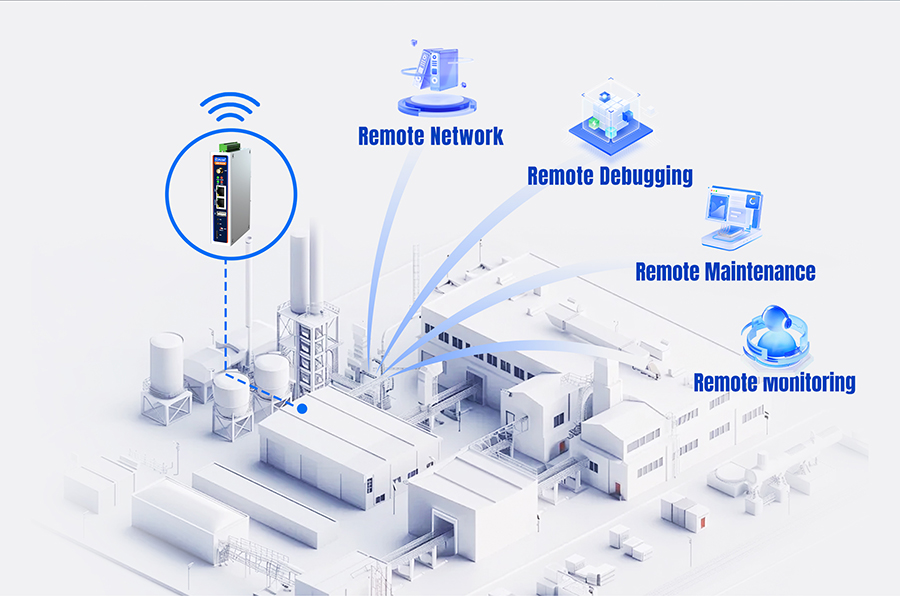
Remote Management and MonitoringAccess our PUSR cloud platform to perform remote device configuration, Node-RED programming, and commercial-grade operational maintenance—all without leaving your desk.
High Reliability Design
Aluminum Housing: Ensures effective heat dissipation for sustained performance.
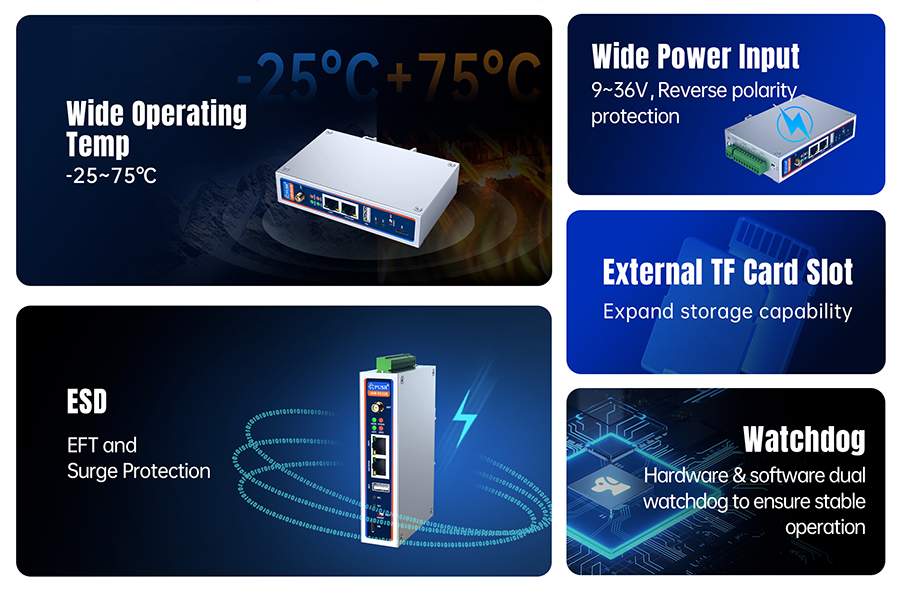
Wide Power Input: DC 9-36V with reverse polarity protection.
Wide Operating Temp: -25℃ ~ +75℃ for industrial applications.
High EMC Protection: Guarantees stable operation in harsh environments.
In today's world where Industry 4.0 and the Internet of Things (IoT) are deeply integrated, the requirements for equipment at industrial sites have shifted from single functions to composite demands that integrate "computing, communication, and control." The USR-EG228 arm industrial PC launched by PUSR redefines the performance boundaries of edge devices with its core features such as an industrial-grade CPU, WukongEdge edge engine, native Node-RED, visual programming, and multi-interface expansion. This article will delve into the core value of this product from three dimensions: technical architecture, functional advantages, and application scenarios.
1. Arm Industrial PC: The "Nerve Center" of Industrial Automation
1.1 Definition and Core Features
An arm industrial PC is a compact computing device specifically designed for industrial environments, with the following core features:
Low power consumption and high reliability: Utilizing an ARM architecture processor, it consumes only one-third of the power of an x86 architecture processor. Meanwhile, it adapts to harsh industrial scenarios through features such as fanless design, a wide operating temperature range (-40℃~85℃), and electromagnetic interference resistance.
Real-time performance and determinism: It supports RTOS (Real-Time Operating System) or hard real-time extensions to ensure millisecond-level response to control instructions.
Modular expansion: It provides a rich set of I/O interfaces (such as serial ports, CAN, and network ports) and communication protocols (such as Modbus and Profinet), enabling flexible connection to sensors, actuators, PLCs, and other devices.
1.2 Hardware Architecture of USR-EG228: Balancing Small Size and High Performance
The USR-EG228 adopts an ARM Cortex-A55 quad-core processor (with a main frequency of 1.8GHz), paired with 1GB DDR4 memory and 8GB eMMC storage. Its design logic lies in:
Balance between performance and power consumption: The A55 architecture provides sufficient computing power while keeping power consumption below 5W, making it suitable for long-running industrial scenarios.
Compact design: With dimensions of only 120mm×100mm×35mm, it can be easily embedded into cabinets, equipment interiors, or mobile terminals.
Industrial-grade protection: The enclosure is made of aluminum alloy, supporting an IP40 protection rating, which is dustproof and splash-resistant, and can withstand mechanical stresses such as vibration and shock. Typical scenario: In smart electricity meter concentrators, the USR-EG228 is embedded into the meter box due to its compact size. It collects electricity consumption data from hundreds of households in real time and uploads it to the cloud via a 4G network. At the same time, it communicates with local display terminals through an RS485 interface.
2. Industrial-Grade CPU: The "Performance Foundation" of Edge Computing
2.1 Core Advantages of ARM Cortex-A55
The ARM Cortex-A55 processor equipped in the USR-EG228 offers advantages in three major dimensions:
Leading energy efficiency ratio: Compared to the previous-generation A53 architecture, the A55 reduces power consumption by 15% at the same performance level or improves performance by 20% at the same power consumption level, making it suitable for battery-powered or heat-dissipation-constrained scenarios.
Multi-core parallel processing: The quad-core design can simultaneously handle tasks such as data acquisition, protocol conversion, and edge computing, avoiding task blocking.
Enhanced hardware security: It supports ARM TrustZone technology, dividing the system into a secure world (for storing keys and certificates) and a non-secure world (for running user applications) to prevent data leakage.
2.2 "Customized Optimization" for Industrial Scenarios
The CPU of the USR-EG228 has undergone the following optimizations for industrial needs:
Real-time extension: Through RTOS (such as FreeRTOS) or hard real-time patches (such as PREEMPT_RT), the task switching delay is compressed to the microsecond level, meeting real-time requirements for motion control and robot joint adjustment.
Anti-interference design: The CPU core integrates an EMI (Electromagnetic Interference) filtering module to prevent system crashes caused by noise interference from motor startups and inverter operations.
Long-life support: Using industrial-grade chips (such as NXP i.MX 8M Mini), it supports a lifecycle of over 10 years, avoiding equipment obsolescence due to chip discontinuation. Typical scenario: In CNC machine tools, the CPU of the USR-EG228 parses G-code instructions in real time, controls spindle speed and feed rate, and communicates with servo drives through a CAN interface to ensure machining accuracy of ±0.01mm.
3.WukongEdge Edge Engine: The "Local Accelerator" for Data Processing
3.1 Core Value of Edge Computing
In traditional industrial architectures, data needs to be uploaded to the cloud for processing, which presents issues such as high latency, high bandwidth costs, and privacy risks. The WukongEdge edge engine sinks data processing capabilities to the device side through functions such as local computing, protocol parsing, and rule engines. Its advantages include:
Low-latency response: For example, in fault prediction scenarios, the edge engine can analyze vibration sensor data in real time and trigger an alarm within 0.1 seconds to avoid equipment downtime.
Bandwidth savings: Only critical data (such as outliers) is uploaded, with raw data stored locally, reducing traffic costs.
Data privacy protection: Sensitive data (such as production formulas) does not need to leave the local site, avoiding the risk of cloud leakage.
3.2 Edge Computing Capabilities of USR-EG228
The USR-EG228 is equipped with a built-in WukongEdge engine, supporting the following functions:
Multi-protocol parsing: It is compatible with over 20 industrial protocols such as Modbus RTU/TCP, Profinet, OPC UA, and MQTT, enabling connection to devices from different brands without the need for additional gateways.
Rule engine: Users can configure trigger conditions (such as "temperature > 80℃") and actions (such as "start the fan") to achieve automated control.
Lightweight AI inference: It supports the deployment of TensorFlow Lite models, such as identifying product defects through cameras or detecting abnormal equipment sounds through sound sensors. Typical scenario: In smart agricultural greenhouses, the edge engine of the USR-EG228 analyzes data such as soil moisture, light intensity, and CO₂ concentration in real time. When the moisture level falls below the threshold, it automatically triggers the irrigation system while uploading the data to the cloud to generate planting reports.
4. Native Node-RED: An "Industrial Tool" for Low-Code Development
4.1 Core Logic of Node-RED
Node-RED is a flowchart-based programming tool developed by IBM, with the following core logic:
Visual programming: It constructs data processing flows by dragging and dropping nodes (such as input, processing, and output) and connecting lines, without the need for coding.
Modular expansion: The community provides over 1,000 pre-built nodes (such as HTTP requests, database read/write, and email sending), covering common industrial needs.
Cross-platform deployment: It supports running on embedded devices, PCs, and cloud servers, enabling "one-time development, multi-end deployment."
4.2 Native Integration Advantages of USR-EG228
The USR-EG228 has a built-in Node-RED runtime environment, with the following advantages:
Zero-configuration startup: After power-on, the device automatically loads pre-configured industrial nodes (such as Modbus read/write and CAN communication), which users can use directly.
Resource optimization: Optimized for the ARM architecture, it occupies only 200MB of memory and can run smoothly on low-specification devices.
Offline development: It supports importing/exporting flow files via USB or local networks, without relying on cloud services. Typical scenario: In intelligent logistics sorting systems, engineers quickly build sorting logic by dragging and dropping nodes such as "barcode scanner input node → database query node → sorting instruction output node" in Node-RED, without writing C/C++ code.
5. Visual Graphical Programming: Lowering the Barrier to Industrial Automation
5.1 Core Function: Transition from Code to Graphics
The USR-EG228 provides a web-based visual programming interface, with the following core functions:
Flowchart editing: Users access the device's IP through a browser and drag and drop nodes (such as sensor reading, logical judgment, and device control) and connect them in a graphical interface.
Real-time debugging: It supports single-step execution, variable monitoring, and log output to help quickly locate problems.
Permission management: Different user roles (such as operators and engineers) can be set to restrict editing permissions and avoid misoperations.
5.2 "Cost Reduction and Efficiency Improvement" in Industrial Scenarios
The application value of visual programming in industry is reflected in:
Shortened development cycle: Traditional PLC programming takes weeks, while visual programming takes only hours.
Reduced training costs: Operators do not need to learn ladder diagrams or C language and can complete simple logic configuration by dragging and dropping nodes.
Facilitated collaborative development: Engineers can achieve team collaboration by sharing flowchart files (.json format). Typical scenario: On small-scale automated production lines, operators configure logic such as "when a photoelectric sensor detects a product, start the cylinder to push the material" through a visual interface, without relying on professional PLC engineers.
6. Dual 100Mbps Ethernet Ports: "Redundancy and Expansion" for Industrial Networks
6.1 Hardware Design: "Double Insurance" with Dual Network Ports
The USR-EG228 provides two 10/100Mbps Ethernet ports, with the following design logic:
Link redundancy: Through STP (Spanning Tree Protocol) or VRRP (Virtual Router Redundancy Protocol), it automatically switches to the backup network port when the primary one fails, ensuring uninterrupted network connectivity.
Functional isolation: One network port connects to the intranet (such as PLCs and sensors), and the other connects to the extranet (such as the cloud and monitoring centers), avoiding cross-interference of internal and external network data.
Bandwidth expansion: By using link aggregation (LACP), the two network ports are bound into a single logical interface to achieve 200Mbps bandwidth, meeting the needs of high-definition video stream transmission.
6.2 Typical Application Scenarios
Industrial ring network: In large factories, the USR-EG228 serves as a ring network node, connecting adjacent devices through dual network ports to form a self-healing network where a single-point failure does not affect overall communication. Video surveillance: One network port connects to cameras, and the other connects to NVRs, enabling local storage and remote access to video data. Dual-cloud access: One network port connects to a private cloud (such as a local server), and the other connects to a public cloud (such as AWS), achieving local data backup and cloud analysis.
7. Dual RS485 + Dual CAN FD: The "All-Round Translator" for Industrial Protocols
7.1 RS485: The "Standard Interface" in Traditional Industry
RS485 is the most commonly used serial communication interface in the industrial field, with the following advantages:
Long-distance transmission: The maximum transmission distance is 1200 meters (at a baud rate of 9600bps).
Multi-device networking: A single bus can connect up to 32 devices (distinguished by addresses).
Strong anti-interference ability: Differential signal transmission makes it suitable for environments with strong electromagnetic interference from motors and inverters.
The USR-EG228 provides two independent RS485 interfaces, allowing simultaneous connection to devices with different protocols (such as one interface connecting to Modbus RTU meters and the other to Profibus-DP sensors).
7.2 CAN FD: The "High-Speed Channel" for Automotive and Industrial Applications
CAN FD (Controller Area Network with Flexible Data Rate) is an upgraded version of the CAN protocol, with the following advantages:
Speed improvement: The maximum rate is increased from 1Mbps to 5Mbps, meeting high real-time requirements.
Data length expansion: The single-frame data is extended from 8 bytes to 64 bytes, reducing communication frequency.
Compatibility: It supports mixed networking with traditional CAN devices. The USR-EG228 provides two CAN FD interfaces, which can be applied in: Automotive electronics: Connecting ECUs, battery management systems (BMS), and motor controllers. Industrial robots: Connecting joint drives and vision sensors to achieve multi-axis synchronous control.
7.3 Typical Application Solutions
Smart buildings: Connect temperature and humidity sensors and lighting controllers via RS485, and connect elevator controllers and air conditioning units via CAN FD for centralized monitoring. Energy management: Collect electricity meter data via RS485 and connect photovoltaic inverters and energy storage systems via CAN FD to optimize energy scheduling.
8. 4G/5G + WiFi + Ethernet: "Triple Protection" for All-Scenario Communication
8.1 Comparison and Complementarity of Communication Methods
The USR-EG228 supports three communication methods: 4G/5G cellular, WiFi, and Ethernet, with the following complementarity:
Communication Method
Advantageous Scenarios
Limitations
4G/5G
Mobile devices, remote areas, no wired networks
Traffic costs, latency (about 50ms for 4G)
WiFi
Short-distance, high-speed (up to 1.2Gbps)
Weak wall-penetration ability, susceptible to interference
Ethernet
Stable, low latency (<1ms), large bandwidth
Requires wiring, poor flexibility
8.2 Multi-Scenario Application Solutions
Mobile monitoring: Deploy the USR-EG228 on AGV trolleys, connect to the local network via WiFi, and upload data to the cloud via 4G for "local control + remote management." Emergency communication: In disaster sites such as earthquakes and floods, the device quickly restores communication via 5G while providing temporary networks for rescue equipment via WiFi. Hybrid networking: In factories, Ethernet connects fixed equipment (such as PLCs), WiFi connects mobile terminals (such as PDAs), and 4G serves as a backup link to ensure high network availability.
9. An "All-Round Player" in the Industrial IoT
The core value of the PUSR USR-EG228 arm industrial PC lies in its design concept of "small size, high performance, full interfaces, and easy development." It provides stable computing power through an industrial-grade CPU, achieves localized data processing with the WukongEdge engine, lowers the development threshold with native Node-RED and visual programming, meets complex protocol requirements with dual network ports, dual RS485, and dual CAN FD, and covers all-scenario communication with 4G/5G + WiFi + Ethernet. Whether in smart manufacturing, smart energy, smart transportation, environmental monitoring, or agricultural automation, the USR-EG228 can provide a "highly reliable, low-latency, and easy-to-deploy" edge computing solution, becoming an "all-round hub" in the industrial IoT era.
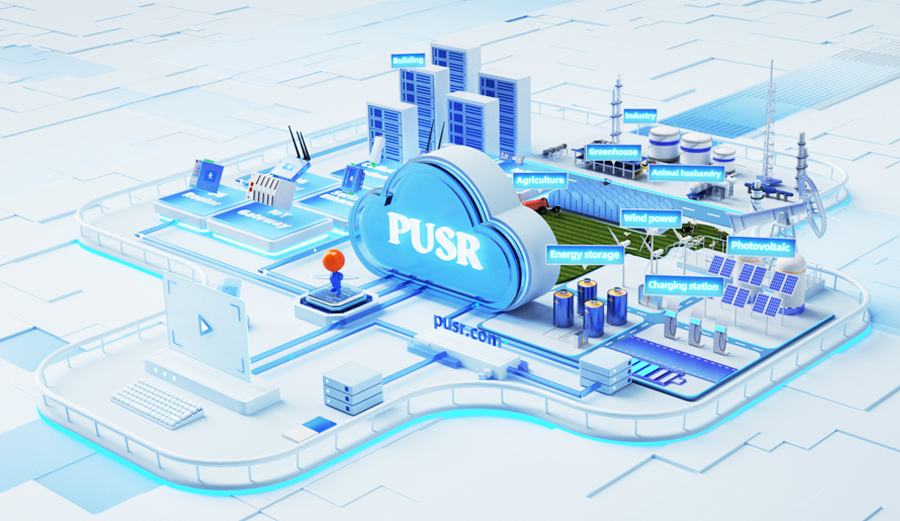
Industrial loT Gateways Ranked First in China by Online Sales for Seven Consecutive Years **Data from China's Industrial IoT Gateways Market Research in 2023 by Frost & Sullivan
We use cookies to ensure that we give you the best experience on our website. If you continue to use this site we will assume that you are happy with it.