From -40℃ to 70℃, Communication Never Drops in Substation Extreme Environments — What Makes the Industrial Wireless Router So Tough?
Mohe, Heilongjiang, January 17, 2024, minus 42℃
That night, the wind in Beiji Village howled down to minus 42 degrees.
Inside the communication cabinet of a certain 110kV substation, the indicator light on an ordinary router went dark. Not the kind of dark where it blinks once and comes back on. Completely dead.
When operations technician Old Liu received the alarm, he was warming himself by an electric heater in the duty room. He threw on his cotton-padded coat, trudged through ankle-deep snow to the communication cabinet, pulled open the door, and touched the router — it was ice-cold. Not cool. Ice-cold. A layer of frost had formed on the plastic casing.
Reboot. No response. Reboot again. Still nothing.
That night, the station-level data from that substation was down for a full six hours. The dispatch center couldn't see a single data point. It wasn't until the next morning, when the temperature climbed back to minus 28 degrees, that the router finally came back to life on its own.
Old Liu later wrote one line in his work log: "If the equipment can't handle the cold, no amount of technology will save you."
That one line speaks for the hearts of 80% of substation operations staff across China.
People in power communications don't fear technical challenges the most. Technical challenges have standard answers. What they fear most is — your equipment can't survive the environment.
Where are China's substations located?
On the Gobi Desert in Inner Mongolia, where summer ground temperatures hit 70℃ and winter plunges to minus 40℃. On the Tibetan Plateau, at 5,000 meters altitude, where UV radiation can make plastic brittle. On the coast of Hainan, where salt mist corrosion can rust a metal casing in three years. In the forests of Northeast China, where humidity exceeds 90% and condensation can short-circuit the PCB.
These places aren't laboratories. They're the reality your substations face every single day.
What's the operating temperature range of an ordinary router? 0℃ to 40℃. Commercial grade. Fine in an office. Put it in a substation communication cabinet? That's gambling with your life.
You might think: "It's just temperature, right? Just add an air conditioner."
Add an air conditioner. Sure. A substation communication cabinet has at least a dozen devices. An air conditioner for each one? Who pays the electricity bill? Who fixes it when it breaks? Remote stations don't even have maintenance staff — if the AC fails, every device goes down.
So the real question isn't "should we add an AC?" It's "can your equipment survive on its own?"
If it can survive, you don't need an AC. No AC means no people needed. No people needed means no budget needed. No budget needed means your leader won't ask why you spent so much.
This is the true meaning of the industrial wireless router — it's not about making your network faster. It's about making sure your network is still there in the most extreme environments.
Old Liu's station later replaced the equipment. Not the air conditioner — the router. They swapped in an industrial wireless router.
The brand doesn't matter. What matters is: that winter, at minus 42 degrees, that router's indicator light never went dark. Not a single packet of data was lost. The dispatch center had no idea it was minus forty-something outside.
I later got my hands on the technical specs of that device. I tore it apart and found it got four things right:
Ordinary devices are rated at minus 20℃ to 60℃, but that's the "can power on" temperature, not the "can operate normally" temperature. Many devices start throttling the CPU at minus 15℃, and throughput drops by half at 60℃.
True industrial-grade wide-temperature means zero performance degradation across the full range. Minus 40 degrees — full speed. Plus 70 degrees — full speed. You can't achieve this just by throwing money at components. It's the result of chip selection, PCB design, and thermal structure working together.
Plastic casings become brittle in extreme cold — touch them and they crack. They deform in extreme heat — even the ventilation holes can warp. Metal casings don't fear cold, don't fear heat, don't fear UV, and they shield against EMI. In a high-voltage substation environment, a metal casing isn't an option. It's a must.
Hardware watchdog, software watchdog, link watchdog. If any single link fails, automatic reboot. It doesn't wait for you to notice — it knows it's dead and brings itself back to life. At minus 40 degrees in Mohe, you're not running to the site at midnight to reboot anything. The equipment has to save itself.
90% of people don't know this. Ordinary aluminum electrolytic capacitors lose capacity sharply at low temperatures and their lifespan plummets at high temperatures. Industrial-grade devices use solid-state capacitors or automotive-grade capacitors — stable capacity across the full temperature range, with a lifespan 3 to 5 times longer than ordinary capacitors.
You see — there's no black magic here. It's just every single component selected to the harshest standard. But it's these four things combined that let a router survive a winter in Mohe.
Done with cold. Let's talk heat.
What's 70℃? Put an egg on a car's hood — that's roughly the temperature.
But here's what most people don't know: in substations across Xinjiang, Gansu, and Inner Mongolia, the internal temperature of communication cabinets can easily soar above 65℃ in summer. Why? Because the cabinets are usually installed outdoors, in direct sunlight. The cabinet is metal — it absorbs heat. Inside are a dozen devices, each one generating heat. No air conditioning, no fans — all that heat just sits there.
Ordinary routers start having problems above 60℃. First they throttle. Then they drop packets. Then they die. You think it's a network problem. It's actually the equipment heat-dying.
Even scarier — a heat-dead device won't tell you it's heat-dead. It just quietly stops working. By the time you notice, the data has been down for hours.
How does an industrial wireless router solve this?
Two approaches. First: every component is selected to wide-temperature or even automotive-grade specs — surviving high temperature from the root. Second: the thermal structure is designed "fanless" — not that there's no fan, but it doesn't depend on one. The metal casing acts as the heatsink. Thermal grease conducts the heat out. No moving parts means no failure points.
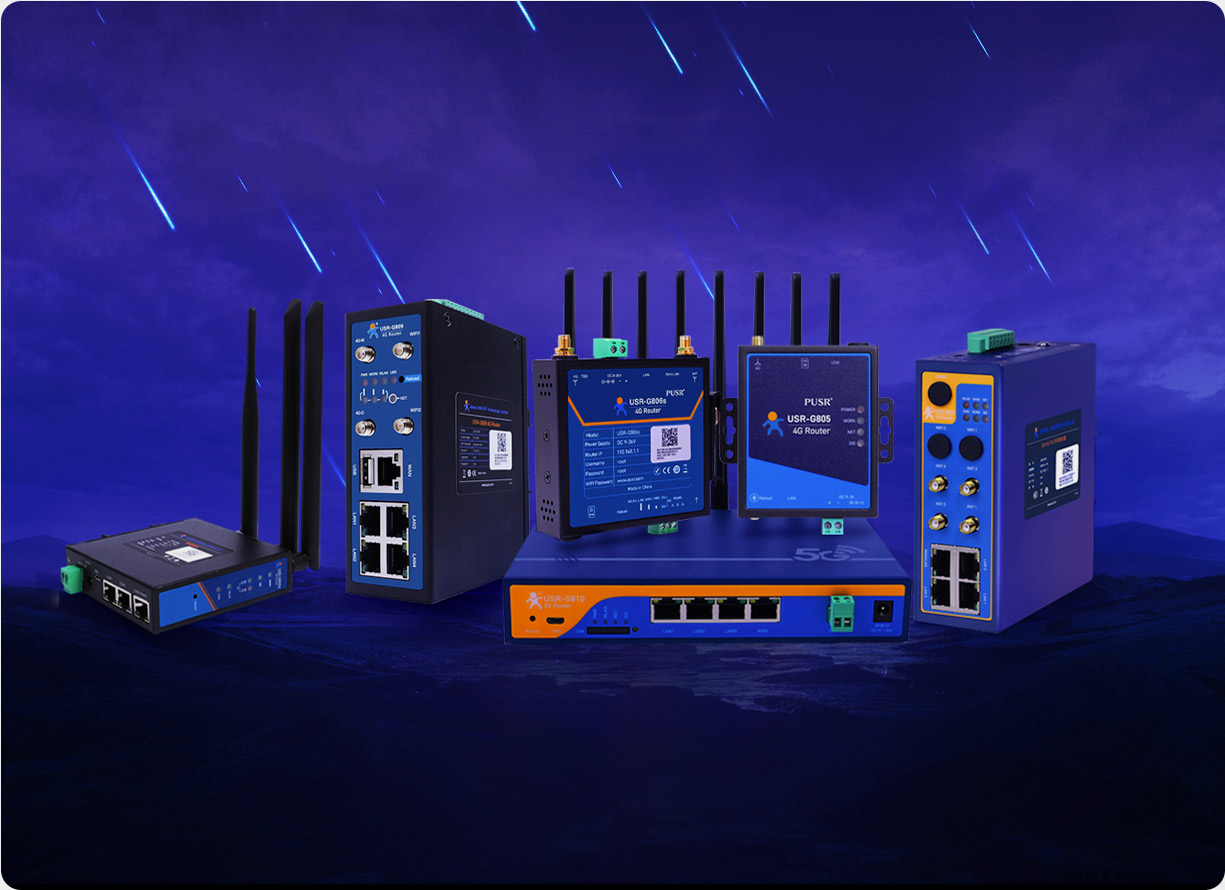
PUSR's G806w from PUSR does exactly this. Full metal casing, fanless design, operating temperature minus 40℃ to 70℃. In a field test at a photovoltaic substation in Northwest China, the cabinet internal temperature hit 68℃ — the device still ran at full speed, zero packet loss. Not the most expensive, but in that temperature range, it held up against everything.
When most people select equipment, they only ask one question: "Can it power on at this temperature?"
It can power on. But powering on doesn't mean it can work. Working doesn't mean it can work for long.
A device powers on at minus 40 degrees but dies after a month. Is that "working"?
A device doesn't crash at 70 degrees but its capacitors bulge after six months. Is that "working"?
What you should really be asking is: at this temperature, how many years can this device run stably?
The answer hides in two places:
Consumer-grade, industrial-grade, automotive-grade, military-grade — each step up doubles the temperature tolerance and lifespan. For unmanned substation scenarios, you need at least industrial-grade, preferably automotive-grade.
Check whether full temperature cycling tests have been done.
Most industrial wireless routers only test to minus 20℃ to 60℃. A few go to minus 40℃ to 70℃. The ones that do are almost always custom-built for power, transportation, and petrochemical industries.
I've seen too many projects where the equipment arrives on-site and turns out to be wrong. Either it can't handle the temperature, or the EMI is too severe, or the mounting method doesn't match. Back-and-forth returns, the whole schedule gets blown.
So before you place the order, think through these five questions:
Don't look at averages. Look at extremes. Mohe in winter: minus 42 degrees. Turpan in summer: 70 degrees. Wherever your station is, select based on its extremes.
Outdoor cabinets run 10 to 15 degrees hotter than indoor ones. Direct sunlight adds another 10 degrees. You think 60 degrees is enough — you might actually need 70.
Remote stations often only have one carrier with signal. If that one goes down, everything goes down. Dual-SIM or even triple-SIM auto-switchover is a must-have for remote stations.
If your station is more than 100 km from the nearest O&M point, remote management isn't optional — it's mandatory. Remote reboot, remote upgrade, remote log viewing — these features can save your life when it matters.
An industrial wireless router costs three to five times more than an ordinary router. But it can last five years without replacement. An ordinary router is cheap, but you might be replacing it every year. On the total cost, the industrial wireless router is actually cheaper.
The power industry has a trait: you only care when something goes wrong. When nothing goes wrong, you make do.
Making do with communication equipment in an office? Worst case, the network is a little slow. Making do with communication equipment in a substation? Could mean the dispatch center can't see data, protection signals can't get through, and the entire station's monitoring goes dark.
You're not selecting a router. You're selecting something that, between minus 40 degrees and 70 degrees, in an unmanned remote station, in a high-voltage environment with maximum EMI, will still quietly and reliably transmit your data.
This thing doesn't need to be smart. Doesn't need to be fast. Doesn't need to be expensive.
It only needs to do one thing: when you need it most, it's still there.
That router in Mohe — Old Liu later gave it a nickname. He called it "the iron lump."
He said: "This thing is just like us power people. Doesn't fear the cold, doesn't fear the heat. Just built to last."
Rough words, but solid truth.
Your substation needs an "iron lump" too. Not the best one. But the toughest one. The kind that doesn't die at minus 40 and doesn't collapse at 70.
Leave the rest to time to prove.