February 23, 2026
How Cellular WiFi Router Unlock Remote Monitoring and Quality Traceability
"Digital Nerve" in Food Processing: How Cellular WiFi Router Unlock Remote Monitoring and Quality Traceability At a large dairy processing plant, production halted at 3 AM when a filler's temperature sensor failure ruined a batch, causing over ¥500,000 in losses. Worse, without real-time data, quality control couldn't pinpoint the issue, leading to a full recall and reputational damage. This scenario reflects food processing's digital transformation challenges: isolated equipment, fragmented data, and inefficient traceability—three "invisible killers" hindering high-quality development.
1. Three Dilemmas in Food Processing: From Reactive Fixes to Systemic Collapse
Food processing lines involve complex processes like fermentation, sterilization, filling, and packaging, with 40% higher equipment failure rates than traditional manufacturing. Yet, most firms rely on manual inspections, causing:
Delayed fault detection: A meat processor found equipment issues took 2 hours to detect manually, while cellular WiFi router-based systems cut response time to 5 minutes.
High downtime costs: Hourly losses reach ¥200,000 in beverages and ¥350,000 in dairy.
Inefficient repairs: Without historical data, technicians take 4.2 hours per fix—triple the industry benchmark.
1.2 Data Black Hole in Quality Traceability: 60% Lower Recall Efficiency
Food safety laws mandate end-to-end traceability, but traditional systems suffer from:
Data silos: Production, quality, and logistics data are scattered across ERP, MES, and WMS systems. One firm needed 2+ hours to manually integrate data from 7 systems per batch.
Information distortion: 3% manual entry errors led to a ¥10M+ loss when incorrect labels caused customs seizure.
Slow response: Quality complaints took 6 hours to trace issues, while cellular WiFi router-linked systems reduced this to 10 minutes.
1.3 Psychological Barriers in Decision-Making: From "Cost Anxiety" to "Value Recognition"
Food processors face three mental hurdles in digital adoption:
Short-term cost sensitivity: Cellular WiFi routers are seen as expensive, with one SME owner stating, "A system costs half a production line."
Technical trust issues: A CIO feared, "A router crash is worse than equipment failure."
Limited value perception: Routers are viewed as mere "network devices," not strategic "data hubs."
2. Cellular WiFi Routers: The Solution from Equipment Networking to Data Empowerment
2.1 Real-Time Monitoring: Making Equipment "Talk"
Routers enable full equipment awareness through:
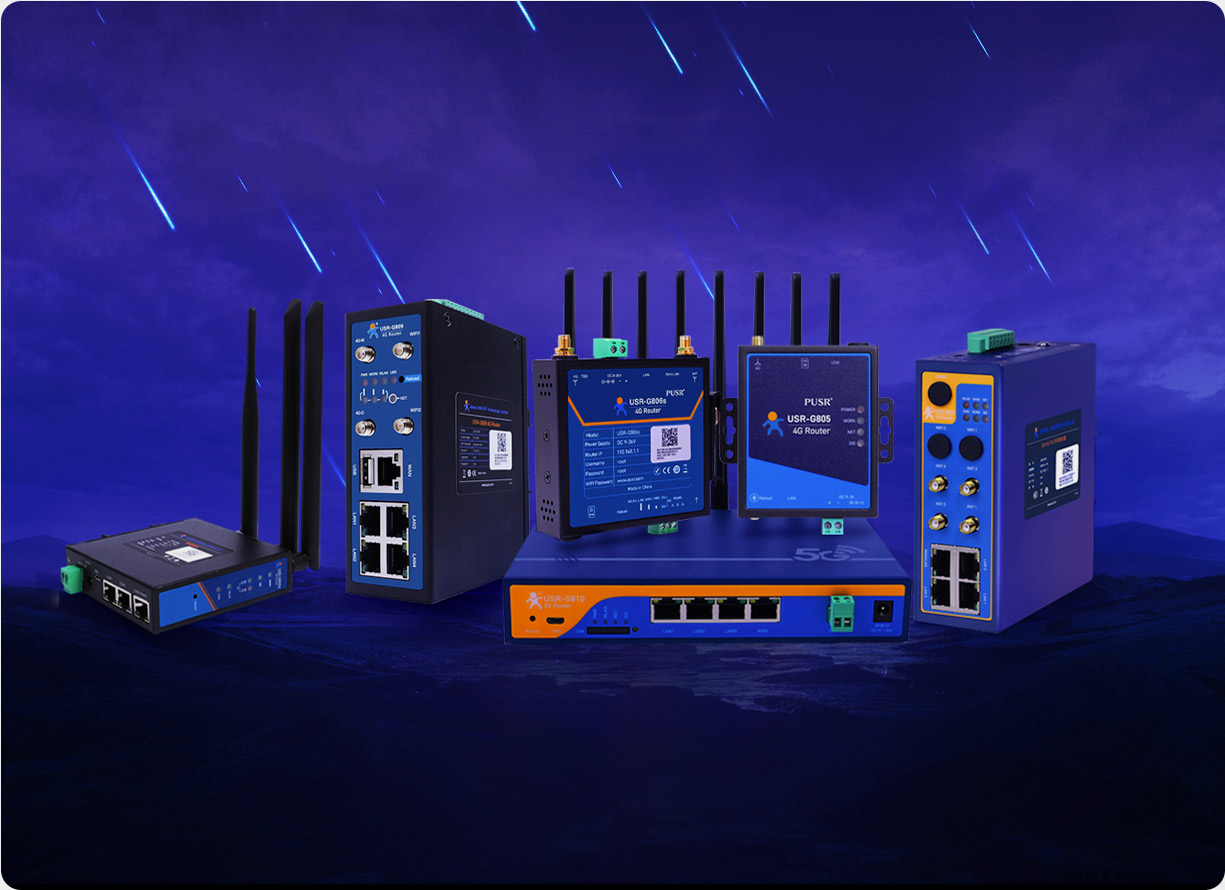
Multi-protocol conversion: Supporting 20+ industrial protocols (e.g., Modbus, Profinet). A dairy unified fermentation tank, filler, and packer protocols via USR-G809s for standardized MQTT data collection.
Edge computing: Built-in quad-core processors preprocess data locally. A meat processor used edge analytics to compare temperature sensor data with historical models, predicting failures 2 hours early.
5G/WiFi6 dual-mode: 1ms latency in 5G SA networks. A beverage firm reduced visual inspection system latency from 200ms to 30ms, improving defect detection by 15%.
Time synchronization: IEEE 1588v2 ensures ±50μs accuracy across subnets. A seasoning firm linked batches to equipment, operators, and environmental parameters using precise timestamps.
Data encryption: SM4 algorithm secures transmissions, meeting EU GDPR and US FDA standards for an exporter.
Cloud-edge collaboration: A bakery uploaded oven temperature/humidity data to Alibaba Cloud via MQTT, optimizing processes with AI and boosting pass rates by 12%.
2.3 Quantifiable Customer Value: From "Cost" to "Investment"
Routers deliver measurable benefits:
Reduced downtime: A frozen food firm cut annual equipment stops from 48 to 12 hours, saving ¥2M+.
Faster traceability: An infant formula maker met the "1-hour trace" mandate by slashing batch trace time from 2 hours to 5 minutes.
Lower quality costs: A meat processor reduced waste from 3% to 0.8%, saving ¥5M+ annually.
3. USR-G809s: The "Digital Partner" for Food Processing
Among routers, USR-G809s stands out with:
Industrial-grade design: -35°C to 75°C operation and IP67 rating suit extreme environments like freezers. A seafood firm deployed it at -18°C with zero failures.
Protocol compatibility: 20+ built-in libraries support direct PLC, sensor, and vision system connections. A seasoning maker unified 12 reactors from different brands.
Security: IPsec VPN, firewalls, and access control pass Level 3 cybersecurity certification, meeting EU BRC food safety standards for exporters.
4. Digital Transformation Path: From Local Optimization to Systemic Reconstruction
4.1 Phase 1: Equipment Networking and Data Collection
Goal: Real-time capture of equipment status, production parameters, and environmental data.
Implementation: Deploy routers to connect PLCs and sensors, building a data collection layer.
Example: A dairy used USR-G809s to upload fermentation tank temperature and pH data to MES for precise control.
4.2 Phase 2: Data Integration and Traceability Systems
Goal: Build a "one-item-one-code" traceability system with end-to-end data flow.
Implementation: Link routers to ERP and WMS systems via a data mid-platform.
Example: A meat processor integrated farming, slaughter, processing, and logistics data for farm-to-table traceability.
4.3 Phase 3: Intelligent Decision-Making and Predictive Maintenance
Goal: Enable AI-driven fault prediction and process optimization.
Implementation: Use routers as edge nodes to train models with cloud platforms.
Example: A bakery optimized baking curves with AI using USR-G809s oven data, improving consistency by 20%.
5. Digital Nerve: Adding "Warmth" to Food Processing
Amid rising food safety incidents and evolving consumer demands, digital transformation is no longer optional. Cellular WiFi routers, as the "digital nerve" connecting equipment and data, redefine production monitoring and traceability. When a filler's temperature fluctuation triggers real-time alerts, "digital ID" traces back to individual cows' feeding records, food processing achieves a leap from "scale manufacturing" to "value creation." This is not just technological progress but a solemn commitment to consumer safety.
Industrial loT Gateways Ranked First in China by Online Sales for Seven Consecutive Years **Data from China's Industrial IoT Gateways Market Research in 2023 by Frost & Sullivan
We use cookies to ensure that we give you the best
experience on our website. If you continue to use this site we will assume that you are happy with it.