Retail AGV "Data Security": How Does the Industrial Mini PC's Encryption Technology Defend Against Cyberattacks?
Let me start with a true story.
A chain retail enterprise. 200 AGVs running across 12 warehouses nationwide. The night before Double Eleven, the IT director was woken by a phone call — "All the AGVs in the warehouse have stopped. It's not a malfunction. They've been locked."
A hacker exploited the SSID broadcast vulnerability in the warehouse WiFi to launch a deauth attack on the AGVs' wireless modules. In plain terms: constantly forging "disconnect" commands, making the AGVs drop offline one by one. 200 vehicles. Paralyzed for a full 4 hours.
Direct loss: 870,000 yuan. Indirect loss: missed orders, exploding customer complaints, and a headquarters accountability meeting.
The IT director said something after that which I still remember: "I thought AGVs were vehicles. Turns out they're networked computers. I guarded the warehouse door, but I didn't guard the data door."
That sentence hits the most fatal blind spot in retail AGV security.
You spent millions on AGVs, but you probably haven't even implemented basic data encryption. According to industry research, 99% of enterprise industrial control network systems in China have deployed zero network security protection measures — or they just threw up a firewall between OT and IT and thought they were covered.
But the reality is: 80% of industrial control security incidents aren't deliberate hacker attacks. They're "unintentional accidents" caused by virus infections, human error, and random USB plug-ins.
Your AGVs are running every day. Your data is flying every day. Do you really know where it's flying, who's seeing it, and whether it's being tampered with?
Today's article — no concepts, no hype. I'm going to follow an attack chain from entry point to core, peeling it back layer by layer: how do you actually defend retail AGV data security? What can industrial mini PC encryption technology really do?
Retail warehouse AGVs almost entirely depend on WiFi communication. It's the most efficient solution. It's also the most vulnerable entry point.
Remember the case at the beginning? A deauth attack is essentially exploiting WiFi management frame vulnerabilities to forge "deassociation" commands, causing devices to repeatedly drop and reconnect. The attack cost is rock-bottom — a laptop, an open-source tool, ten minutes, and you're done.
Even nastier is the disassociate attack, which kicks the AGV off the network entirely, turning it into an "island." In a retail warehouse, one AGV going dark means the entire transport chain breaks.
The threat you imagine: a hacker in a suit sitting at a computer. The actual threat: an intern in the next warehouse casually connects to an unknown WiFi, and the virus walks right in.
How do you defend against it?
The first line of defense at the industrial mini PC level is communication link encryption. All data transmission between AGVs and the dispatch server must go through encrypted channels — WPA3 enterprise authentication is just the baseline. What actually works is layering TLS/DTLS encryption at the application layer, so even if the WiFi layer is breached, the data itself remains ciphertext.
A more advanced approach references the "5G private network + zero trust" architecture already deployed in 2025: terminals can only access the network after triple verification via SIM card, device fingerprint (IMEI/MAC), and dynamic tokens. When an AGV detects abnormal traffic or boundary-crossing behavior, the system instantly cuts the network via a CoA command. A certain baijiu enterprise has already validated this solution in a 5G + AGV koji-making scenario, reducing illegal access rates from 2.3% to 0%.
If wireless attacks are "foreign invasion," then USB is "the thief inside the house."
Retail warehouse maintenance staff have high turnover. Today it's Xiao Zhang, tomorrow it's Xiao Li. Someone, for convenience, plugs a personal USB drive into the AGV's industrial mini PC to copy a file — and just like that, ransomware might be inside.
In 2020, a Fujian automotive company was hit by a ransomware attack. Production halted. They were extorted for 400,000 yuan. In 2020, Honda's US, European, and Japanese branches were hit by the Snake ransomware, shutting down multiple factories. The common thread in all these incidents: the attack rarely came from a frontal external assault. It seeped in through an inconspicuous internal port.
Industrial mini PC USB encryption now mainly follows two paths:
Hardware encryption: Install a dedicated encryption module on the USB port. Only authorized devices can communicate. Highest security level, but also highest cost.
Software encryption: Control USB access via kernel-level drivers to implement a whitelist mechanism — only pre-registered devices are allowed to connect; unknown devices are flat-out rejected. A certain industrial control security vendor's MCK host hardening solution follows this logic: embed a security container inside the operating system, lock down applications and data within the container, prohibit unauthorized programs and scripts from launching, and encrypt all data inside the container.
For retail AGVs, the more practical approach is: physical blocking + software control, dual-pronged. The industrial mini PC's USB ports are either physically sealed or forced to read-only via software. Don't let anyone have the chance to "bring the virus home."
The first two cuts defend against "getting in." This cut defends against "stealing" and "tampering."
The volume of data retail AGVs generate daily is staggering: inventory counts, SKU information, restocking paths, promotion strategies, customer orders… If this data is stolen, the competitor doesn't get a string of numbers — they get your entire supply chain's lifeline. If it's tampered with, and one box of milk's inventory becomes ten thousand boxes, your financial statements become a pile.
Data encryption isn't a nice-to-have. It's the survival baseline for retail AGVs.
Industrial mini PC data encryption now mainly uses three algorithm systems:
| Encryption Type | Algorithm | Applicable Scenario | Retail AGV Application |
|---|---|---|---|
| Symmetric | AES, DES | Fast encryption of large data volumes | Bulk data transmission between AGV and server |
| Asymmetric | RSA, ECC | Key exchange, digital signatures | Device identity authentication, firmware upgrade verification |
| Hybrid | AES + RSA combo | Balancing efficiency and security | Full-link encryption of core business data |
In retail scenarios, the most critical thing isn't "is it encrypted?" It's "can you control the keys?"
Many companies' approach: hardcode the key into the program. That's like taping your house key to the front door. The correct approach is to build a complete key management system — periodic key rotation, hardware-level secure storage (like TPM chips), and even blockchain attestation technology for immutable operation logs. An oilfield enterprise used blockchain attestation to improve security incident closed-loop handling efficiency by 40% while meeting classified protection compliance requirements.
If you're still protecting AGVs with a "firewall + antivirus" mindset, you're a generation behind.
2025's industrial internet security has evolved from "passive defense" to "active immunity." Three trends you must know:
No longer relying solely on the cloud or solely on the endpoint — it's three-tier linkage. The edge side (i.e., the industrial mini PC on the AGV) does real-time threat detection. The cloud does big data analysis and policy distribution. The endpoint does execution. A certain power company pushed threat detection accuracy to over 95% with this architecture.
Traditional firewalls rely on rule matching. If the rule isn't written, it can't defend. AI baseline engines are different — they first learn the AGV's "normal behavior pattern," then monitor deviations in real time. The moment an AGV starts accessing abnormal ports or data traffic spikes, the system auto-alerts or even auto-isolates. In a connected vehicle case, the AI security baseline engine compressed threat response time from hours to minutes.
Build a digital twin in virtual space that's an exact replica of your warehouse. All attack behaviors are simulated and intercepted in the virtual environment first. A connected vehicle enterprise uses digital twins to even determine during high-speed driving whether "suddenly opening the window" is a normal operation or a remote hijacking attack.
These aren't lab PPTs. They're validated solutions already running in power, automotive, baijiu, and oil industries in 2025.
By now you might be asking: can my AGV industrial mini PC handle all these security capabilities?
I'll be straight — most can't.
A traditional industrial mini PC is a "good enough to run" computer. Windows full of vulnerabilities, USB ports you can plug anything into, no encryption module, no zero-trust access support. Running AGV on it is like driving a car without a steering lock in downtown.
What you need is an industrial mini PC that has security engraved into it from the hardware level up.
It needs to meet these hard specs:
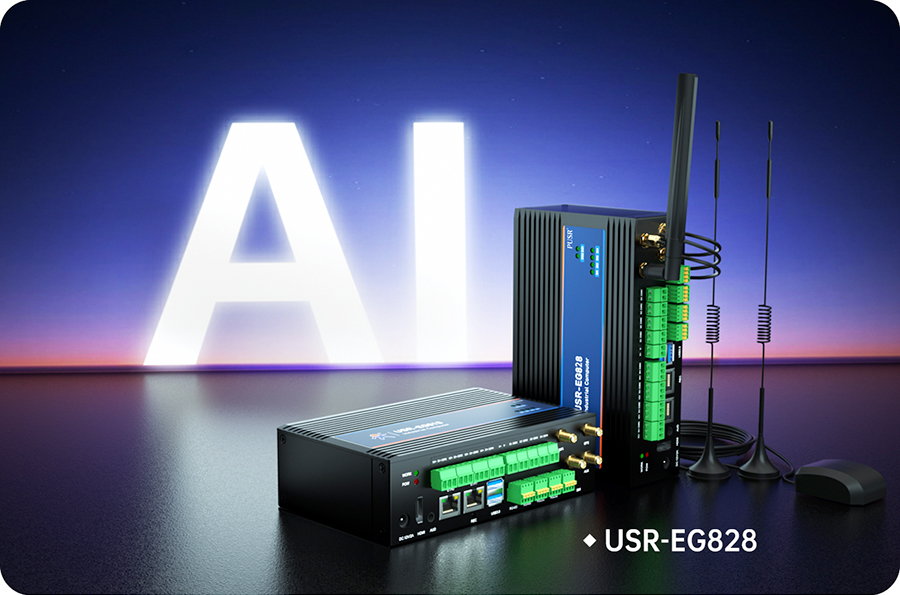
USR IoT's USR-EG828 is basically built to this security standard. RK3568 quad-core processor, built-in NPU with 1.0 TOPS computing power, supports Modbus, MQTT and other industrial protocols, comes pre-loaded with Ubuntu 20.04 capable of running Docker container isolation, HDMI output supports multi-screen extended display, wide-temperature -10°C to 70°C fanless design. In a smart grid project, it simultaneously connected to 200+ monitoring points with data upload latency controlled within 50ms. In retail scenarios, it's already driving unmanned cabinets, AGV controllers, and other devices — a chain brand that adopted it saw cargo damage rates drop by 80%.
I'm not saying it's the only choice. But if you're picking that "brain" for your AGV, shouldn't security capability rank ahead of performance?
Retail AGVs don't run in a vacuum. They run on WiFi. They run through USB ports. They run in the hands of every maintenance worker.
99% of industrial control networks have no security protection. 80% of incidents aren't caused by hackers. But 100% of the losses are borne by you.
The encryption cost you saved today might be a ransomware email tomorrow, a production-line shutdown, a headquarters accountability meeting.
Data security isn't a "should we do it" question. It's a "how long can you afford not to" question.
And that industrial mini PC that lets you "afford it" — that's the thing you should invest in first.