FMCG AGV "Flexible Handling": How Precise Are the Motion Control Algorithms in an Arm Industrial PC?
You've definitely seen this scene —
An FMCG warehouse, peak preparation for Double Eleven. An AGV carrying a full pallet of shampoo is cruising through a narrow aisle at 0.8 m/s. Suddenly, it jolts hard. The body shakes violently. The pallet tilts. Twenty-four bottles of shampoo crash to the ground and shatter everywhere.
Even worse: three more AGVs are trailing behind. The first one slams on the brakes. The second one rear-ends it. The third one swerves to avoid the pile-up and smashes into a shelf.
After three seconds of silence comes the warehouse supervisor's roar, the customer's complaint call, and another loss figure on the financial report.
You think this is an AGV problem? No. This is a motion control algorithm problem.
FMCG AGVs are nothing like the "fixed route, fixed cargo" AGVs on factory production lines. You have 20,000 SKUs. Your pallets come in all sizes. Your warehouse is a mix of humans and machines. Your promotional season and off-season can differ by tenfold — you don't need a "vehicle that can run." You need a "porter that can think."
And what teaches it to think isn't some flashy AI large language model. It's the motion control algorithm inside the arm industrial PC.
Today, I'm not throwing concepts at you or painting rosy pictures. I'm starting from that loud crash and peeling back the layers one by one: why your AGV shakes, crashes, and flips over — and how a precise motion control algorithm can take this to a completely different level.
Most people's understanding of AGVs still stops at "it can get from point A to point B." But in an FMCG warehouse, getting there isn't the skill — stopping accurately is.
Why? Because FMCG shelves are close together, pallet sizes vary wildly, and people are walking through the aisles. Your AGV isn't running on an open highway — it's threading through a rush-hour market.
How does traditional AGV motion control work? Open-loop control — send a command to the motor: "rotate this many turns, run this far," and then forget about it. The result: supposed to run 5 meters, actually runs 5.3 meters; supposed to stop in front of the shelf, actually pushes 10 centimeters past it.
That 10 centimeters is the source of that loud crash.
Today's arm industrial PC motion control algorithms have long since abandoned this logic. They use closed-loop control + servo compensation:
Real-world data from a leading unmanned forklift company: AGVs using laser SLAM navigation + closed-loop motion control achieved positioning accuracy of ±5mm and speed control accuracy of ±0.5%. In a 2.4-meter narrow aisle, the forks adapt to ±100mm offset and dock precisely with automated storage racks.
What does that mean? Your AGV can deliver a pallet into a shelf within the width of a water bottle, with an error no thicker than a bank card.
Not "close enough." "Millimeter-level precision."
What's the biggest characteristic of an FMCG warehouse? Chaos.
People suddenly cross aisles. Forklifts suddenly change lanes. There might be a dropped cardboard box on the floor, a swinging shelf label overhead. Your AGV isn't facing a static world — it's facing a battlefield that changes every second.
The fatal weakness of traditional motion control algorithms: slow reaction.
From the sensor detecting an obstacle, to the arm industrial PC processing the data, to issuing a deceleration command, to the motor actually slowing down — if this chain exceeds 200 milliseconds, at 0.8 m/s, the AGV has already surged forward 16 centimeters. Sixteen centimeters is enough to knock over an entire row of goods.
How do today's arm industrial PC motion control algorithms solve this? Three words: fast, accurate, predictive.
Fast— The arm industrial PC communicates directly with servo drives via native CAN bus, bypassing all external modules. Communication latency is compressed to microseconds. Not milliseconds — microseconds. The command goes out, the motor responds instantly. Zero packet loss, zero handoff delay. Real-world test from a Zhongshan client: after switching to a native CAN bus arm industrial PC, AGV motion control failure rate dropped 95% straight away. Ran for a full month with zero failures.
Accurate— Multi-sensor fusion. Laser scanners detect obstacles 8 meters away, ultrasonic sensors cover blind spots within 0.3 meters, and anti-collision bumpers provide a final 10-centimeter safety net. Three layers of protection stacked together, compliant with EN 1525 standard, with dead-zone-free detection for obstacles over 0.1 meters.
Predictive— This is the real killer app. AI models analyze the AGV's driving data in real time, predict sensor error trends, and proactively correct positioning deviations. An aerospace manufacturing company applied digital twin technology and cut AGV on-site commissioning time by 60%, with positioning accuracy stability improved by 35%. It doesn't wait until it hits something to stop. It's already decelerating before you even see the obstacle.
What's the most headache-inducing thing in FMCG? SKU explosion + seasonal pulses.
Today's hot seller is laundry detergent. Tomorrow it's tissues. The day after, an entire row of shelves might need rearranging. If your AGV can only carry one type of pallet and follow one route, what's the difference between it and a conveyor belt?
This is the core proposition of "flexible handling": can the AGV switch tasks via software without changing hardware?
The answer is yes — but only if the arm industrial PC's motion control algorithm is "soft" enough.
The traditional approach: change the pallet type, and you have to retune parameters, recalibrate, and rerun the path. Back and forth — half a day gone.
Today's motion control algorithms support multi-axis real-time motion planning + adaptive adjustment:
Put simply: your AGV is no longer just a "cargo mover." It's a "porter that can swap tools." One second it's carrying shampoo, the next second it's carrying tissues — nobody needs to touch anything in between.
That's flexibility. Not "the route can be changed" — that's not flexibility. True flexibility is: tasks can be switched, loads can be self-adapted, and precision never drops.
Run the numbers and you'll see.
Typical loss sources for FMCG warehouse AGVs:
| Loss Type | Traditional AGV (Open-Loop) | Precision Motion Control AGV | Gap |
|---|---|---|---|
| Mis-pick rate | 0.5%-3% | Below 0.01% | Reduced by 90%+ |
| Cargo damage rate (collision/tip-over) | Hundreds of items/month | Nearly zero | Save tens of thousands/month |
| Commissioning time (SKU/route change) | Half day–1 day | 15 min–1 hour | 80% efficiency gain |
| Manual intervention frequency | 3-5 times/day | Less than once/week | Save 1-2 manpower |
| Equipment downtime | 8-12 hours/month | <1 hour/month | 95% availability improvement |
The money you spend on "cleanup" is far more than the money you spend on "buying the right equipment."
A logistics center during the "618" promotion managed 200 AGVs simultaneously via a fleet scheduling system, with task response latency under 50ms and overall logistics efficiency up 35%. The prerequisite for all of this: every arm industrial PC behind every AGV was running closed-loop algorithms doing millisecond-level motion correction.
You're not buying an AGV. You're buying a "doesn't make mistakes" capability.
Not a faster motor. Not a more expensive LiDAR. You need an arm industrial PC whose algorithms can run, whose communication can keep up, and whose hardware can survive the environment.
It needs to meet four conditions:
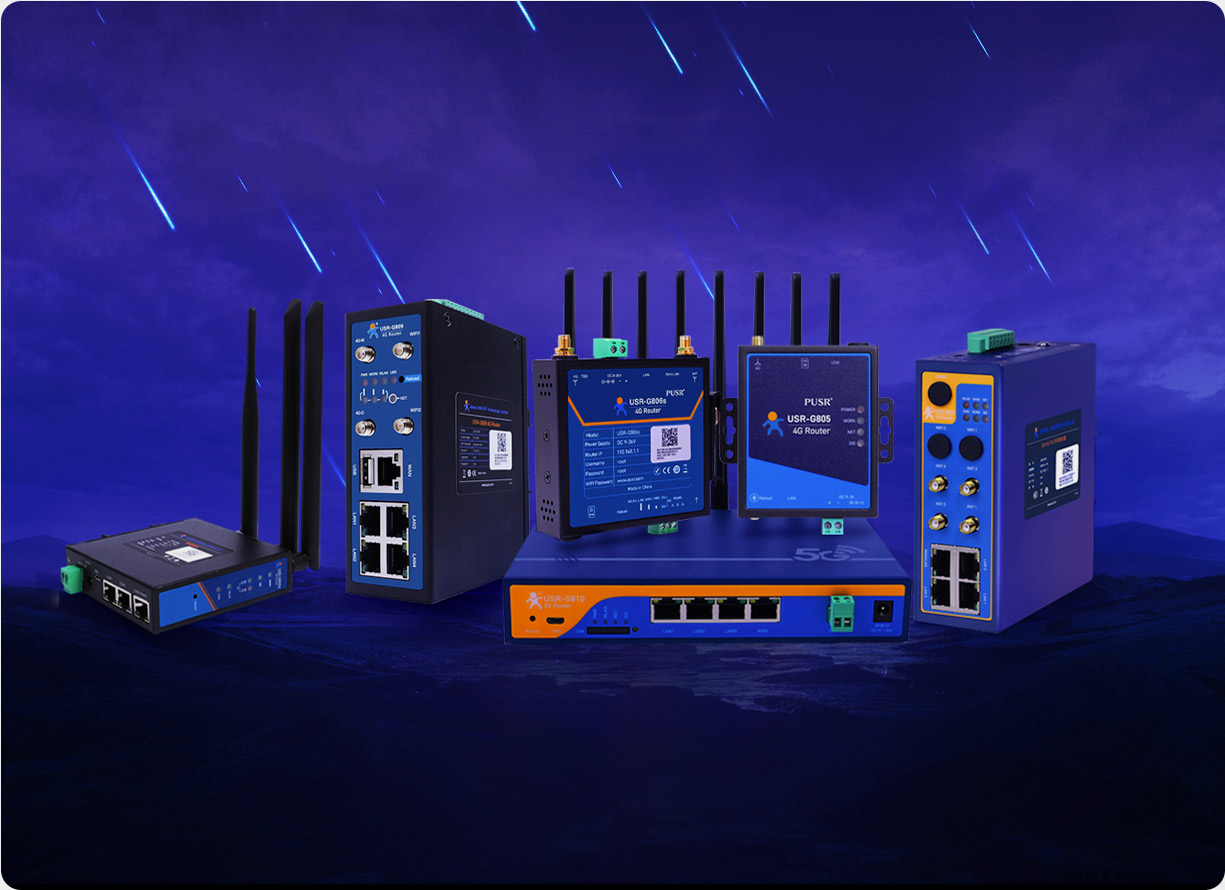
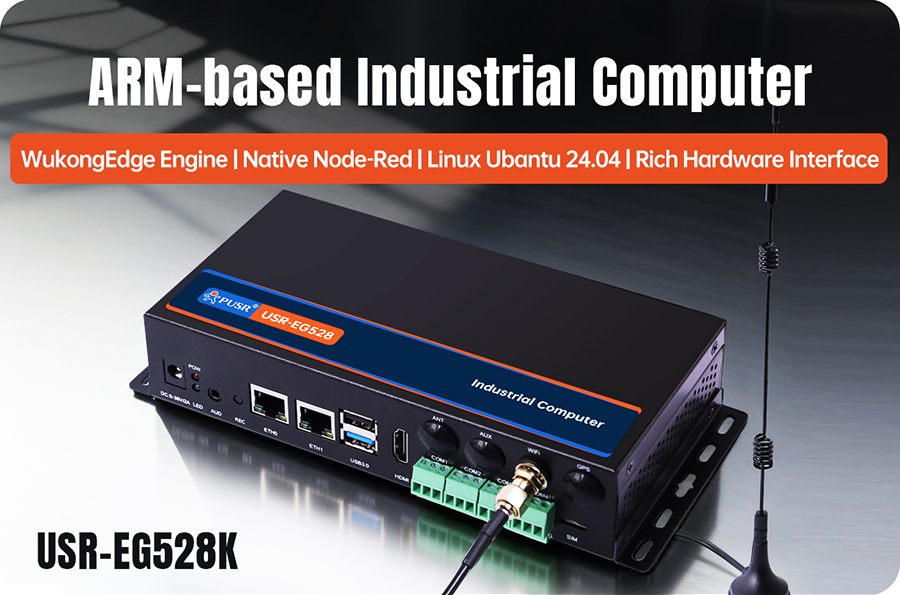
USR IoT's USR-EG528 is built exactly to these four standards. Palm-sized body, native multi-channel CAN interfaces, high-performance processor, 100+ industrial protocols supported, -40°C to 75°C wide-temperature operation, fanless fully sealed. An engineer at a Shenzhen new energy factory completed an entire production line upgrade in two weeks, saving 230,000 yuan in equipment procurement costs. It ran for 30 straight days in a 60°C workshop — zero failures.
I'm not saying it's the only choice. But if you're looking for a "brain that can make motion control algorithms truly run," it deserves the first line on your shortlist.
Your goods are low-value, high-volume, thousands of SKUs, brutal deadlines — you have zero room for error. One broken shampoo bottle doesn't cost you two yuan. It costs you customer trust, repeat purchase potential, and your reputation in this industry.
The precision of motion control algorithms isn't a technical spec. It's your profit moat.
±5mm positioning accuracy, microsecond-level response speed, 0.01% mis-pick rate — behind these numbers is the arm industrial PC's algorithm being pedantic every single millisecond.
Whether your AGV is worth anything isn't about how fast it runs. It's about how precisely it stops.
And that "brain" that makes it stop precisely — that's the thing you should invest in most.