Modular Design + Rapid Changeover: How Does an Industrial Panel PC Let Your Production Line Adapt to "100 SKUs Per Day" E-commerce Orders?
You do e-commerce OEM manufacturing. Or you run your own brand's production line. Or you're a third-party warehouse logistics provider.
No matter which one you are, you've definitely lived through this moment—
8 AM. You walk into the workshop, ready to start. The production plan you locked in yesterday was changed overnight by the client. Not a small tweak. A complete overhaul. Yesterday you were making 5,000 units of Style A. Today it's 3,000 units of Style A + 2,000 units of Style B. Style B has different packaging specs, different labels, and even the conveyor belt track width is different.
You stand in front of the production line, looking at the parameters you just tuned yesterday, the labels you just applied, the programs you just set. There's only one thought in your head: start all over again.
This isn't a one-day thing. This is your every day.
How insane are e-commerce orders in 2025? Data from a top e-commerce platform: during major promotions, the daily order fluctuation for a single SKU can reach 300%. A mid-sized e-commerce warehouse handles anywhere from dozens to over a hundred SKUs per day. Packaging ranges from cartons to bubble mailers to gift boxes. Delivery destinations range from local to nationwide. Delivery windows range from next-day to same-day.
Your production line isn't "producing." Your production line is "changing clothes"—a hundred times a day.
And the traditional industrial control solution? It's like making you peel off a layer of skin every time you change clothes.
You probably think "changeover" is just tweaking a few parameters. Adjust the PLC program, tune the touchscreen interface, swap the label template—done in half an hour.
You're wrong. Dead wrong.
Let me do the real math for you.
How many steps does a complete production line changeover actually involve?
Different SKUs may need different sensor configurations, different actuators, different communication interfaces. If your industrial PC has a fixed configuration, a changeover means replacing the machine. One industrial PC costs 5,000 RMB. 200 changeovers a year? That's 1 million RMB just in machines.
Every SKU has its own production parameters, its own HMI interface, its own communication protocol. Under a traditional approach, every SKU requires a separate program and a separate interface. A production line with 100 SKUs? Software maintenance alone is a bottomless pit.
The devices on your production line come from different vendors—Siemens PLCs, Mitsubishi inverters, Hikvision cameras, Keyence sensors. Every time you switch SKUs, the communication protocols between these devices may need to be reconfigured. Your engineers aren't tuning parameters—they're acting as translators, explaining the new rules to each device one by one.
During changeover, the production line is stopped. Every minute of downtime is real money lost. Measured data from an e-commerce warehouse: traditional solutions average 45 minutes of downtime per changeover. 3 changeovers a day means 2.25 hours wasted per day. That's 45 hours a month. 540 hours a year. At 5,000 RMB per hour of production capacity, that's 2.7 million RMB in changeover losses per year.
2.7 million. Your annual profit might not even be that high.
You say you don't want faster changeovers? You do. More than anyone. But the traditional industrial control solution is like a car with the seats welded shut—you want to adjust the seat position, you have to dismantle the whole car and re-weld it.
I've seen two factories. Same industry, same client, same batch of orders.
Factory A uses traditional fixed industrial PCs. Every SKU changeover takes engineers 2–3 hours to reconfigure. 4 changeovers a day, and actual effective production line runtime is under 60%.
Factory B uses a modular industrial panel PC. Changeover time is compressed to under 15 minutes. 8 changeovers a day, and effective production line runtime exceeds 90%.
Same order volume. Factory B's delivery speed is 1.8× Factory A's. Labor costs are 40% lower. Customer complaint rates are 60% lower.
Where's the gap? Not in algorithms. Not in equipment. In the industrial PC's architecture itself.
This is the core logic of modular design + rapid changeover: don't make the production line adapt to every SKU. Make the industrial PC "snap-switch" between SKUs on its own.
What is modular design?
A traditional industrial PC is an "iron box"—CPU, memory, hard drive, IO interfaces, communication interfaces, all soldered onto one board. Want to change a function? Replace the machine. Want to add an interface? Replace the machine. Want to upgrade the system? Replace the machine.
A modular industrial panel PC works completely differently. It breaks the entire system into independent, hot-swappable functional modules:
Every module is independent, standardized, and hot-swappable. Changeover is no longer "dismantle the machine and re-solder"—it's "unplug the module, plug in the module"—as simple as swapping a phone case.
This delivers three direct results:
Result one: Changeover time compressed from hours to minutes.Measured data from an e-commerce warehouse: after switching to a modular industrial panel PC, single changeover time dropped from 45 minutes to 12 minutes—a 73% reduction. 8 changeovers a day now wastes only 1.6 hours total, instead of 6 hours.
Result two: Hardware utilization increased by 300%.Before, every SKU needed its own industrial PC—100 SKUs meant 100 machines. Now, one modular industrial PC can cover 50+ SKUs by swapping IO and communication modules. Equipment procurement costs are cut in half.
Result three: Maintenance changes from "find a person" to "swap a part."With traditional solutions, when something breaks, you need an engineer to diagnose—is it software or hardware? Communication or driver? Half a day diagnosing, half a day fixing. With modular solutions, whichever module is broken gets swapped. Production line doesn't stop. Back up in 5 minutes. Data from a 3C electronics factory: average repair time dropped from 4 hours to 15 minutes.
Hardware modularity solves the "change fast" problem. But there's still one question: after the swap, what about the software?
You can't possibly rewrite an HMI interface for every SKU, can you?
This is where "software-defined production line" delivers its value.
A modular industrial panel PC paired with a configuration-based software platform can achieve "one hardware platform, infinite SKUs":
A real case from a home appliance company: their production line runs 60 SKUs per day. Before, they needed 3 engineers full-time just for changeover support. After switching to a modular industrial panel PC + configuration platform, 1 engineer handles it all—and changeover time dropped from an average of 30 minutes to 8 minutes.
Your engineers can finally go from "changeover machines" to "optimizing production lines."
| Metric | Traditional Fixed Industrial PC | Modular Industrial Panel PC | Gap |
|---|---|---|---|
| Single changeover time | 45 minutes | 12 minutes | 73% shorter |
| Daily effective runtime | 60% | 90%+ | +30 percentage points |
| Hardware cost (100 SKUs) | 100 units × 5,000 = 500K RMB | 20 units × 8,000 = 160K RMB | Save 68% |
| Annual changeover downtime loss | 2.7M RMB | 720K RMB | Save 1.98M RMB |
| Engineer staffing | 3 full-time | 1 part-time | Save 2 headcount |
You see, this isn't a "save a little money" issue. This is a "can you take the orders" issue.
E-commerce orders are getting more fragmented, more volatile every day. If you can't handle "100 SKUs per day," you only get what everyone else has already picked over. And the factories that can take those orders? They're not winning because they have more people. They're winning because they have smarter hardware architecture.
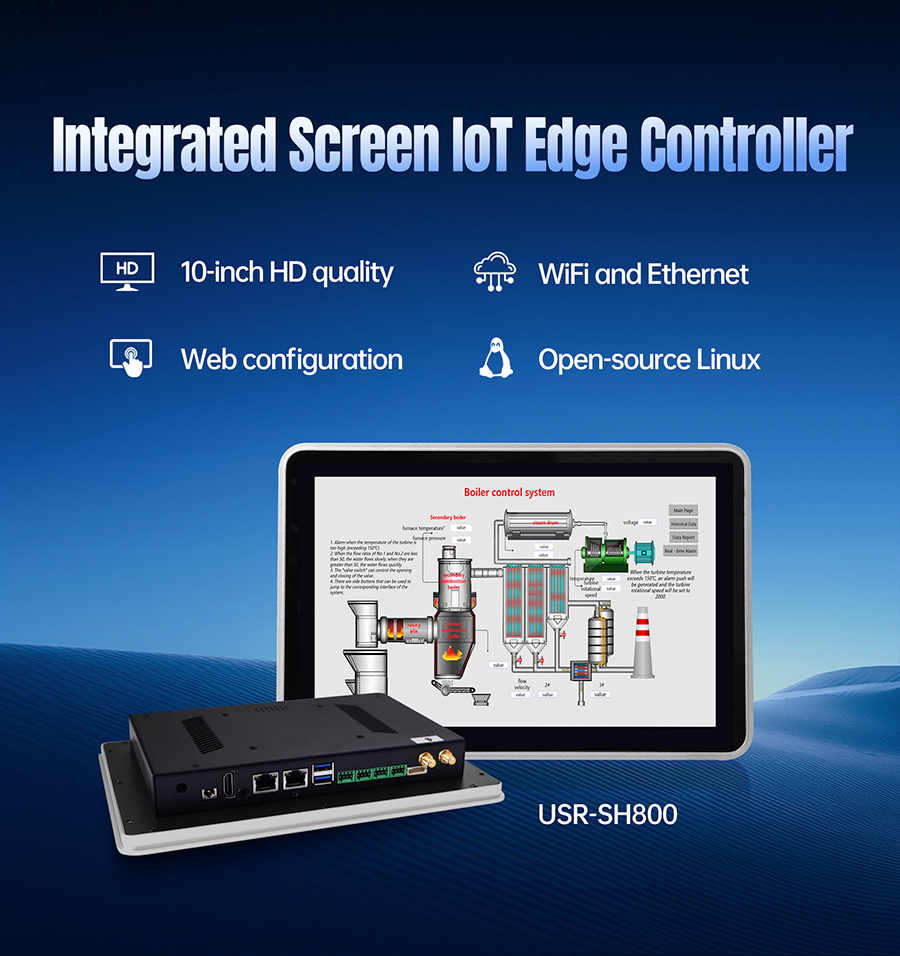
I won't make the decision for you. But I can share a reference I use myself—USR IoT's USR-SH800 industrial panel PC.
Why mention it? Because it actually delivers everything I just described in a single screen.
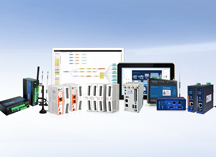
Modular IO design, hot-swappable—no need to dismantle the machine for changeovers. Pre-integrated 100+ industrial protocols—plug in a Siemens, Mitsubishi, or Omron device and it talks right away. 15.6-inch capacitive touchscreen, multi-touch and glove-operation support—changing interfaces is just drag and drop. Wide-temperature fanless design, stable from -10°C to 60°C—e-commerce warehouse environments with heavy dust and wide temperature swings are no problem.
An e-commerce warehouse used it as their production line terminal. Changeover time dropped from 40 minutes to under 10 minutes. The annual downtime savings exceeded 1.5 million RMB. The warehouse manager said something to me I'll never forget: "Before, changeover was a nightmare. Now, changeover is a coffee break."
I'm not saying it's the only choice. But if you're being cornered by "100 SKUs per day" orders—it deserves a spot on your comparison list.
Manufacturing in 2026 isn't about who runs fastest. It's about who changes fastest.
Your competitor might have newer equipment, better algorithms, more funding. But if their production line takes 2 hours per changeover and yours takes 10 minutes—you win.
Because in the "100 SKUs per day" e-commerce world, flexibility is productivity, and changeover speed is profit.
Modular design isn't a technical concept. It's your admission ticket to surviving in this fragmented era.
Stop making your production line "adapt" to orders. Make your industrial PC adapt to everything.
Is your production line ready?