Tool Wear Prediction Error Over 30%? How an IoT Gateway's "Multi-Parameter Fusion Model" Extends Tool Change Cycles by 40%
When was the last time you scrapped a batch of workpieces because of tool wear?
You probably can't remember. Because you've long since gotten used to it—every month there are always a few times: dimensions out of tolerance, surface roughness, entire batches scrapped. You chalk it up to "normal wear and tear," write a line item for "tool wear loss" on your cost sheet, and move on to the next batch.
But let me do the real math for you. You might not sleep tonight.
The 2026 industry data is right there: globally, equipment downtime caused by tool wear exceeds 20 million hours per year, with economic losses running into tens of billions of dollars. A survey by a domestic machine tool industry association hits even harder—among machining enterprises, equipment downtime caused by sudden tool failure accounts for 22% of total downtime, with an average repair time of 4.2 hours per incident, and annual capacity loss per machine reaching 12%.
Data from an auto parts manufacturer is even more direct: tool replacement costs account for 18% of manufacturing costs. Of that, premature replacement due to inaccurate wear prediction causes 23% cost redundancy, and delayed replacement causes 31% cost redundancy. Combined, more than half of all tool costs are burned for nothing.
Actual measurements from an aluminum profile company are even more shocking: before introducing a prediction system, the average tool change cycle was 8 hours. After introduction, it extended to 12 hours. Monthly cost savings: 180,000 RMB.
You see, the problem was never "will tools wear out"—that's physics, and nobody can change it. The question is: can you actually know in advance when it wears out to the point of being unusable?
If you can, each machine produces 12% more capacity per year. If you can't, you're paying for that 30% prediction error every single year.
You may have already deployed a prediction system. Vibration sensors are installed, temperature probes are connected, data is being collected. But the prediction results? Still inaccurate.
Why?
Because you're using "single-parameter linear regression"—a method from the last era.
From 2000 to 2015, the industry really did survive on this for over a decade. Install a vibration sensor, set a threshold, and when vibration exceeds a certain value, trigger an alarm. Simple, crude, functional.
But it's 2026 now. The fatal flaws of this method have been fully exposed:
Tool wear is the superposition of four mechanisms: mechanical wear, adhesive wear, oxidative wear, and fatigue wear. Looking at vibration alone is like judging whether someone is sick by only checking their temperature—a fever could be a cold, an infection, or an autoimmune issue. A single indicator never gives an accurate answer. Survey data shows only 35% of enterprises have achieved multi-sensor data interoperability. Prediction models are still dominated by single-parameter linear regression, with error rates exceeding 35% under complex conditions.
Traditional solutions send all data to the cloud, the cloud computes, then sends instructions back. What's the latency of this chain? 100 milliseconds at minimum, longer in complex scenarios. Your tool is cutting at 0.8 m/s—100 milliseconds means 8 centimeters of displacement. In precision machining, 8 centimeters is enough to scrap an entire batch of workpieces.
Traditional prediction models are "train once, use until death." But your conditions are changing—today you're cutting aluminum alloy, tomorrow titanium; morning finishing, afternoon roughing. The model doesn't adapt to new conditions, so the error only grows. Research shows that for every 0.5-hour delay in detecting wear, scrap costs increase by 1.2×.
You don't not want accurate predictions. You're locked in by the technical framework of the last era.
After "Industry 4.0" deepened in 2019, the industry found the real solution—multi-source data fusion.
What does that mean? It's not collecting vibration, temperature, cutting force, and chip images and calling that "multi-parameter." That's data hoarding, not fusion.
True multi-parameter fusion is letting these data points verify each other, complement each other, and correct each other.
Here's an example: the vibration sensor detects an anomaly, but the temperature is normal. The model doesn't immediately alarm—because the vibration anomaly could be a loose fixture, not necessarily tool wear. But if vibration anomaly + temperature rise + cutting force increase all appear simultaneously, the model's confidence jumps from 60% to 95%—that's a real wear warning.
How accurate is this kind of fusion model?
According to the latest research data:
| Fusion Method | System Identification Accuracy | Complex Condition Accuracy |
|---|---|---|
| Single Parameter (Vibration) | 78% | 65% |
| Dual Parameter (Vibration + Temperature) | 89% | 78% |
| Triple Parameter (Vibration + Temperature + Cutting Force) | 95% | 88% |
| Multi-Modal Fusion (+ Chip Image + Oil Analysis) | 98.3% | 95%+ |
A Kalman filter-based 3D state-space model achieves 98.3% system identification accuracy. Deep residual networks improve wear stage recognition accuracy by 11% through skip connections integrating multi-modal temporal features. Bayesian decision trees adaptively adjust weight coefficients based on operating conditions, achieving over 95% comprehensive diagnostic accuracy under variable conditions.
These aren't theoretical numbers from a lab. An AI monitoring system developed by a German machine tool manufacturer can advance wear warning time by 72 hours through vibration analysis. An aluminum profile company that introduced a multi-parameter fusion prediction system extended its tool change cycle from 8 hours to 12 hours—a 50% increase.
But here's the key problem: multi-parameter fusion requires real-time computation. Vibration signals need wavelet packet decomposition, temperature data needs trend analysis, cutting force needs spectral feature extraction… If these computations are done in the cloud, the latency is at least 100 milliseconds. On the edge, it can be compressed to under 10 milliseconds.
This is the meaning of an IoT gateway—not to "save money by skipping the cloud," but because some computations must be completed exactly where the data is generated.
You may have heard of edge computing, but you may not know what it actually solves in the context of tool wear prediction.
Let me break it down into three layers:
The data chain of a traditional cloud solution is: sensor → IoT gateway → cloud → compute → send instructions. The entire chain takes at least 100 milliseconds. An IoT gateway puts the compute node directly next to the machine tool. The chain becomes: sensor → IoT gateway → instruction. Latency drops from 100 milliseconds to under 10 milliseconds, with sub-millisecond response achievable in some scenarios.
What's 10 milliseconds? At a cutting speed of 0.8 m/s, your tool moves only 8 millimeters in 10 milliseconds. In precision machining, the difference between 8 millimeters and 8 centimeters is the difference between a batch of qualified parts and a batch of scrap.
A multi-parameter fusion model isn't a simple formula. It needs to simultaneously handle wavelet packet decomposition of vibration signals, trend analysis of temperature data, spectral feature extraction of cutting forces, YOLOv5s classification of chip images… The cloud can handle this compute load, but the latency is too high. An IoT gateway handles it with local compute power—real-time performance and accuracy, both.
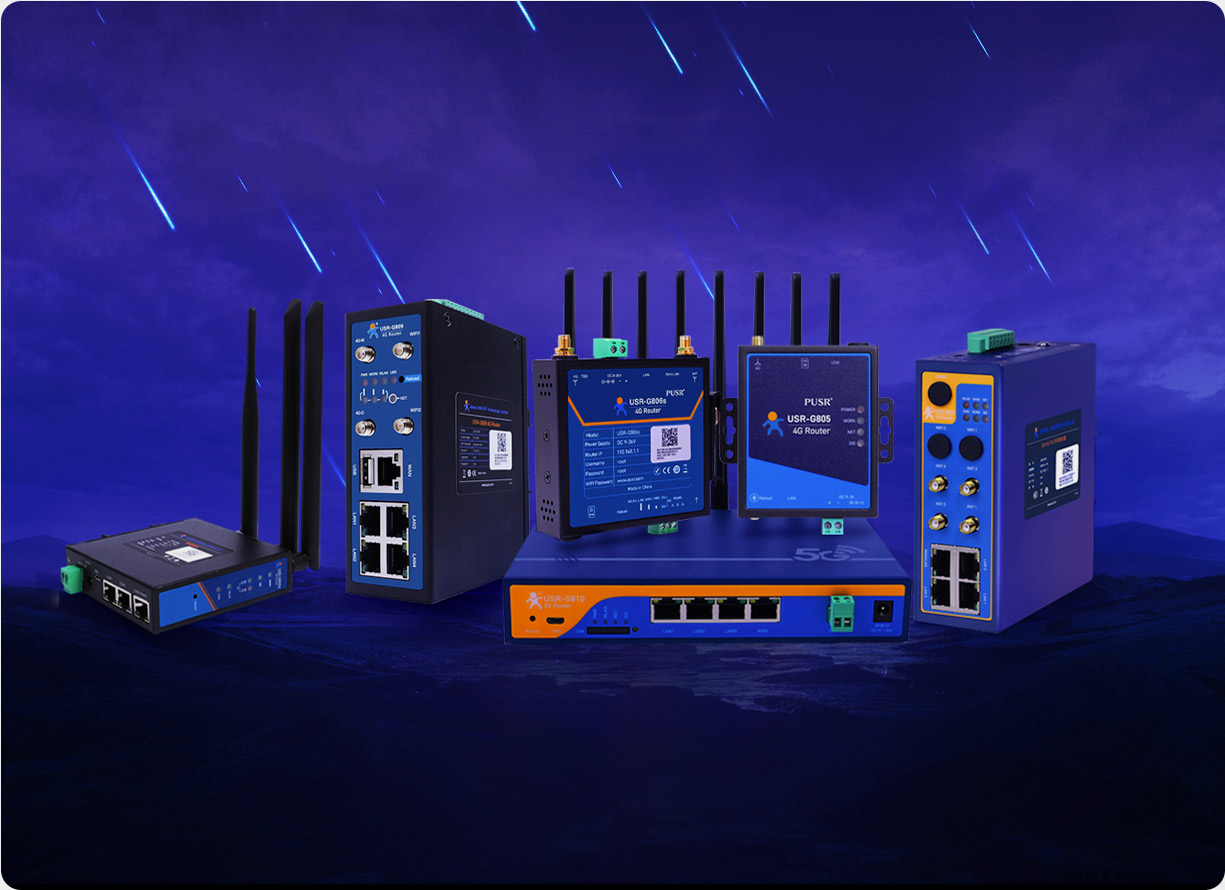
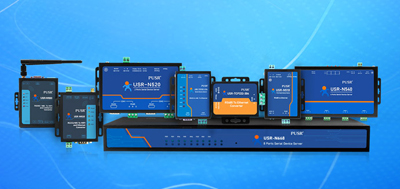
Take USR IoT's USR-M300 IoT gateway as an example. It runs a Linux kernel with a dual-core CPU clocked at up to 1.2 GHz, supporting parallel collection of up to 2,000 data points. It has built-in Node-RED graphical programming—no coding needed, just drag and drop modules to build your own multi-parameter fusion logic. It supports Modbus, OPC UA, Siemens, Mitsubishi, Omron, and over a hundred industrial protocols, collecting data from vibration sensors, temperature probes, and cutting force sensors, then completing fusion computation locally and proactively reporting results.
More critically: it supports offline buffering. When the network drops, data is stored in the local 2 GB storage space and automatically retransmitted when the network recovers. Your prediction model won't go "blind" because of a single network outage.
Traditional prediction models are static—train once, use until death. But an IoT gateway supports Python secondary development. You can continuously optimize model parameters based on new conditions. Today's model for cutting aluminum alloy, tomorrow's for titanium—you adjust a few lines of code on the IoT gateway to adapt. No retraining needed, no redeployment needed.
A research team achieved 92% prediction accuracy using an LSTM network fusing 12 categories of data including cutting parameters and material properties. If this model were in the cloud, every condition change would require re-uploading data, re-training, and re-deploying. But on an IoT gateway, you can do incremental learning locally—the model gets more accurate the more you use it.
| Metric | Traditional Single-Parameter | Edge Multi-Parameter Fusion | Gap |
|---|---|---|---|
| Prediction Accuracy | 65%–78% | 95%+ | +17–30 percentage points |
| Warning Lead Time | 0–2 hours | 48–72 hours | 2–3 days earlier |
| Tool Change Cycle | 8 hours | 11–12 hours | +40%–50% longer |
| Unplanned Downtime | 22% of total | Under 5% | −80% reduction |
| Tool Cost Redundancy | 54% (premature + delayed) | Under 15% | −nearly 40 percentage points |
| Annual Capacity Loss | 12% | 2%–3% | +9%–10% capacity recovered |
Actual data from an auto parts enterprise: after adopting multi-parameter fusion prediction, the tool change cycle extended from an average of 8 hours to 12 hours, and annual capacity loss per machine dropped from 12% to 2.5%. At 5 million RMB annual output per machine, one machine produces an extra 475,000 RMB per year. If you have 20 machines, that's 9.5 million RMB.
And the starting point for all of this isn't buying a more expensive tool. It's swapping in a smarter "brain."
An aerospace engine blade machining company once saw workpiece surface roughness deteriorate from Ra0.8μm to Ra3.2μm due to tool wear, with a rework rate as high as 15%. After introducing an IoT gateway + multi-parameter fusion model, average monthly tool wear dropped from 0.8mm to a controllable range, and the rework rate fell to under 3%.
Data from a bearing factory is even more intuitive: the relationship between dimensional change due to wear and wear volume is ΔD=0.08×W^1.7μm. This means when wear volume reaches 30%, machining error begins to grow exponentially. A multi-parameter fusion model can issue a warning when wear volume reaches just 10%—you get 20 percentage points of reaction time before the "exponential growth" kicks in.
An aluminum profile company extended its tool change cycle from 8 hours to 12 hours after introducing a prediction system, saving 180,000 RMB per month. Their engineer said something I think every machinist should remember: "Before, we changed tools based on experience—a gamble. Now, we change tools based on data—a calculation. The cost of gambling is scrap. The cost of calculating is electricity."
It's 2026. The tool wear prediction race has moved from "can it be done?" to "who does it accurately?"
Leading enterprises use multi-parameter fusion models with over 95% prediction accuracy, tool change cycles extended by 40%–50%, and unplanned downtime reduced to under 5%. SMEs are still using single-parameter threshold alarms with over 30% prediction error, still paying every month for that batch of "don't know why it was scrapped" workpieces.
The gap isn't in the tools. It isn't in the machine tools. It's in how the data is processed.
An IoT gateway isn't a new concept. But when it's combined with a multi-parameter fusion model, it's no longer a "networking device"—it's the most valuable "brain" on your production line.
You don't need to jump straight to the most expensive system. You just need to let your data start thinking the moment it's generated.
USR IoT's USR-M300 is built for exactly this. 1.2 GHz dual-core, 2,000+ collection points, Node-RED graphical programming, over a hundred industrial protocols, offline buffering, handles -25°C to 75°C. An engineer deployed the prediction system across an entire production line in two weeks, saving over 230,000 RMB in equipment procurement costs.
I'm not saying it's the only choice. But if you're being tortured by that 30% prediction error, it deserves a spot in your top three.
Your tools don't need to be harder. Your model needs to be more accurate. And a more accurate model needs a brain that's closer.