In the implementation practice of automated production lines, through the accumulation of a large number of front-line projects, we have found that the production line upgrading of most manufacturing enterprises is not stuck in the automated transformation of a single device, but has long been trapped in the systematic problems of multi-device collaboration and data flow.
As the core computing hub of the production line, the embedded industrial computer can connect the whole link of equipment, data and control from the bottom layer, and is the core support for realizing the collaborative operation of automated production lines with low cost and high reliability.
Most production lines that have completed basic automated transformation generally have several types of common problems that are difficult to solve for a long time.
PLCs, CNC machine tools and sensors of different brands on the production line belong to different communication protocols. Protocols such as EtherCAT, CANopen and Modbus are incompatible with each other, forming data silos between devices and making unified scheduling impossible.
The data of scattered on-site equipment such as switches, analog quantities and actuators cannot be collected centrally. Relying on manual recording is not only inefficient but also leads to severe data lag, making it impossible for managers to grasp the real operation status of the entire production line in real time.
A single-point failure of an ordinary industrial network will cause the entire line to shut down, making it impossible to guarantee the reliability of continuous operation of the production line. The production loss caused by unplanned shutdown remains high.
It is difficult to wire mobile equipment and scattered stations in the production line. Traditional wired networks cannot cover these areas, while wireless communication suffers from high latency and high packet loss rate, which makes it difficult to adapt to the dynamic adjustment requirements of flexible production lines.
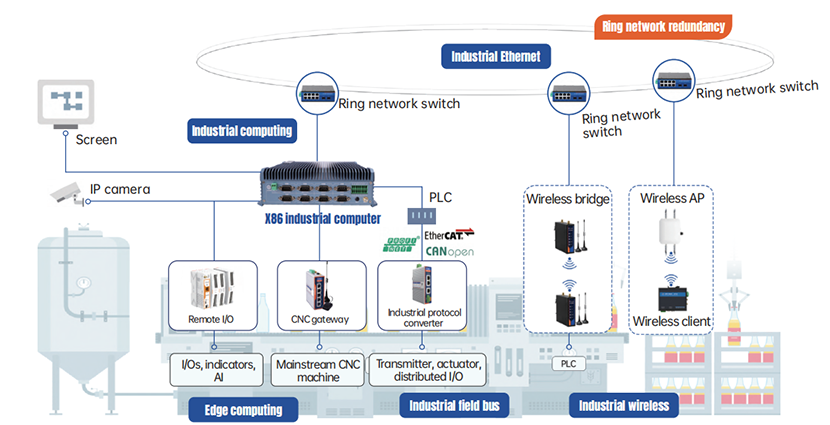
This solution forms a complete three-layer architecture from bottom-layer equipment to upper-layer monitoring, fully covering the full-link design.
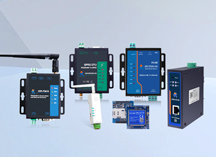
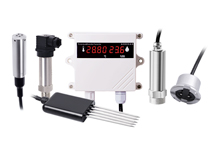
Through remote IO, CNC gateway and bus converter, it directly connects with the switch indicators, analog modules, mainstream CNC machine tools, transmitters, actuators and distributed IOs on the production line, completing the access and adaptation of all types of on-site equipment.
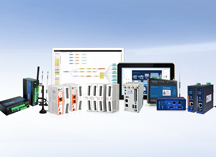
Taking the X86 embedded industrial computer as the core of industrial computing, it is downward compatible with mainstream industrial bus protocols such as EtherCAT and CANopen to connect PLC equipment of the entire production line, and simultaneously access cameras to complete on-site visual data acquisition. It is connected to the display screen upward to realize local visual centralized monitoring of production line data.
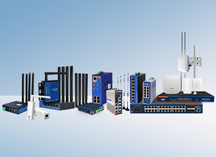
Multiple ring network switches are used to build an industrial Ethernet ring network redundancy architecture. The network can heal automatically when a single switch fails to ensure that the production line network is not interrupted. At the same time, through PLC communication wireless bridges, wireless APs and wireless clients, an industrial wireless coverage network is constructed to solve the network access problems of mobile equipment and scattered stations in the production line.
This solution based on embedded industrial computer fundamentally solves the upgrading problems of traditional production lines.
The X86 embedded industrial computer acts as a unified protocol conversion hub, and cooperates with the bus converter to complete the adaptation of different industrial protocols. Without replacing the existing old equipment, it can realize the interconnection of PLCs and CNC machine tools of different brands, greatly reducing the transformation cost of the production line.
The embedded industrial computer centrally summarizes the operation data of all edge data acquisition nodes, and can complete data cleaning and analysis locally. The display screen intuitively shows the equipment status and production progress of the entire production line, so that managers can grasp the overall picture of the production line in real time without manual patrol inspection, and the data accuracy and response speed are greatly improved.
The industrial Ethernet architecture with ring network redundancy completely avoids the shutdown of the entire line caused by single-point network failure. The embedded industrial computer itself adopts industrial-grade wide-temperature and anti-interference design, which can operate continuously for 7×24 hours, greatly reducing the probability of unplanned shutdown.
The industrial wireless network covers all mobile stations and AGV equipment. Combined with the centralized scheduling capability of the embedded industrial computer, there is no need to re-wire when changing production or adjusting stations on the production line, and the production line reconstruction can be completed quickly, effectively improving the flexible production capacity of the production line.
According to the actual feedback from a large number of implemented projects, this solution can quickly achieve the goal of an automated production line with multi-device collaboration and data transparency without making subversive transformations to the existing production line. It is a cost-effective and reliable path for manufacturing enterprises to promote the intelligent upgrading of production lines.